
As an Amazon Associate we earn from qualifying purchases made through links on this page.
The more expensive gun comes with less in the box. The Theragun Prime lists at about $330 with two attachments; the Hyperice Hypervolt 2 lists at about $229 with five, plus about an hour more battery by each brand’s own figures.
So what does the extra $100 buy? Mostly a handle. In Theragun vs Hypervolt, the Prime’s triangle grip is the one feature the cheaper gun cannot match, and it matters to exactly one kind of buyer.
Every number below is the manufacturer’s, taken from the Amazon listings and published specifications. Each brand prints the figure it wins on and stays quiet about the one it loses, which tells you a lot on its own.
Quick Answer
Get the Hypervolt 2. About $229 buys five heads, three published speeds and a stated three-hour battery, and it beats the Theragun on every spec line except force.
Pay the extra $100 for the Theragun Prime 6th Gen only if you live alone and your back and shoulders are the main target: its triangle handle reaches where a straight grip can’t.
The Extra $100 Buys a Handle, Not More in the Box
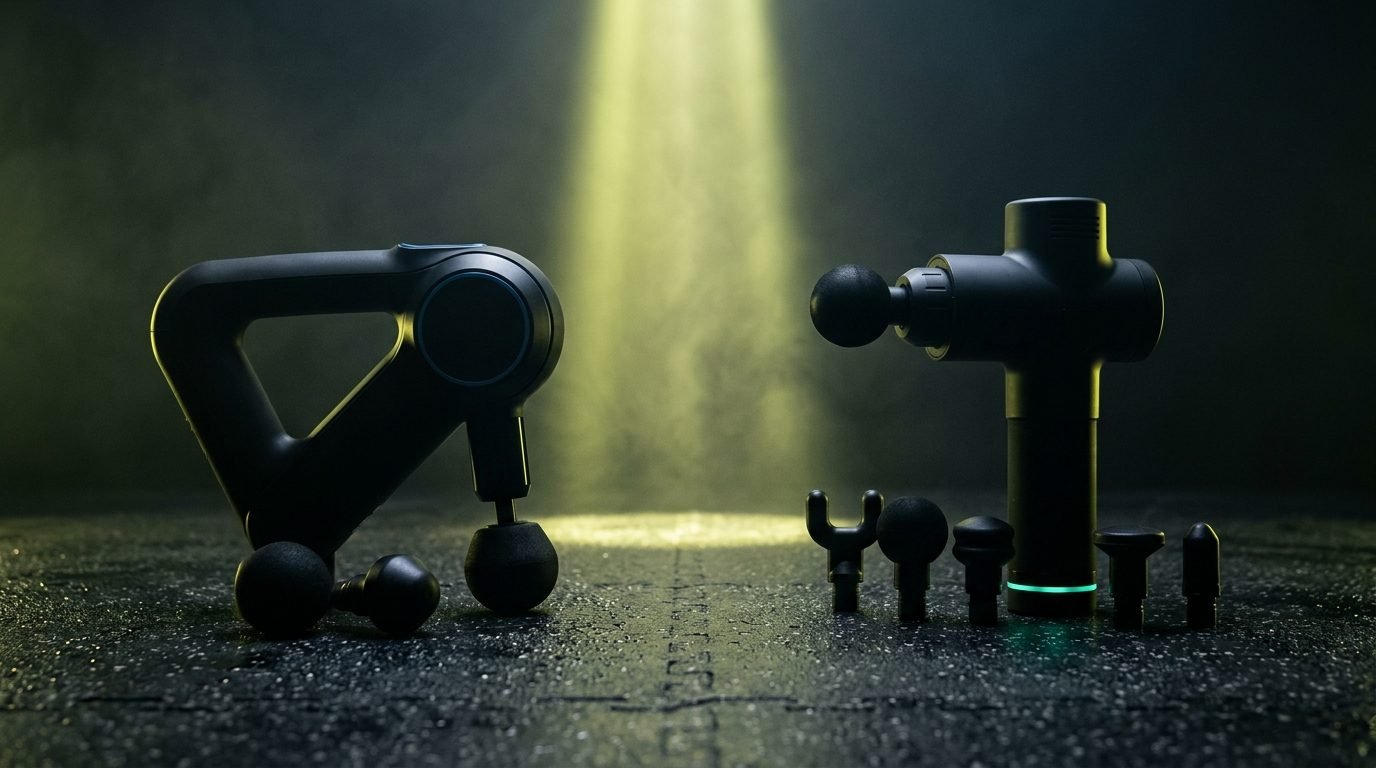
The more expensive gun ships with less in the box. The Theragun Prime lists at about $330 with two attachments. The Hypervolt 2 lists at about $229 with five: fork, ball, cushion, flat and bullet.
So the $100 is not paying for accessories. It pays for Therabody’s triangle grip, five speed settings instead of three, a drop-resistant rubber shell with reinforced corners, and LED feedback that shows how hard you are pressing.
Both connect over Bluetooth to their own app, so that is not a difference either.
If you want a gun that ships ready for every muscle group, the Hypervolt gives you more heads to choose from on day one. If you already know you only use one or two heads, the Theragun’s short list costs you nothing.
Each Brand Publishes the Number It Wins On
Therabody publishes force and Hyperice publishes speed, and neither publishes the other’s figure. Theragun states up to 35 lbs of force before the gun stops pushing back. Hyperice states three exact speeds for the Hypervolt 2: 2,000, 2,350 and 2,700 percussions per minute, from a brushless motor.
That makes a straight comparison impossible from the labels alone, which is exactly why each brand chose its number. A force rating tells you how hard you can lean before the motor stalls. A speed figure tells you how fast the head moves when you are not leaning at all.
If you press hard into large muscles, the 35 lb figure is the one that tells you what you are buying. If you use a light touch, the speed range is the more useful number, and the Hypervolt is the only one of the two that prints it.
Five Speeds on the Theragun Is Not More Power
More speed settings sound like a more capable gun, and here they only mean finer steps. The Theragun Prime lists five speeds; the Hypervolt 2 lists three.
Therabody does not publish the top speed, so there is no way to tell from the listing whether those five steps go higher than the Hypervolt’s 2,700 per minute or simply divide a similar range more finely.
In practice, most people settle on one or two settings and stay there. Five steps help if you share the gun with someone who wants a different intensity. For one user, three clearly published speeds are easier to choose between.
An Hour of Battery and 0.2 lb Go to the Cheaper Gun
The cheaper gun is also the one that lasts longer and weighs less. Hyperice states about three hours of battery for the Hypervolt 2 and a weight of 1.8 lb. Therabody states up to two hours for the Theragun Prime, at its lowest speed, and the gun weighs 2.0 lb.
At fifteen minutes a day, three hours of battery is about twelve days between charges, and two hours is about eight. The 0.2 lb is barely noticeable in the hand for a minute, and more noticeable when you are holding the gun at arm’s length behind your shoulder.
If the gun is going into a gym bag, the lighter and longer-lasting one is the obvious pick. If it lives next to the sofa and a charger, the gap matters much less.
The Triangle Handle Is the Real Reason to Pay More
The Theragun’s best feature is not in its specifications at all. Therabody’s patented triangle grip, with a wider opening on the 6th Gen, lets you hold the gun from three angles and reach your own shoulders and upper back without twisting your wrist.
The Hypervolt 2 uses a straight handle with an improved ergonomic design, according to Hyperice. It suits legs and arms well, and it is harder to angle onto your own upper back.
That is the whole case for the Prime. If your back and shoulders are the main target and nobody else is there to hold the gun, the handle is worth paying for. If you mostly work on legs after training, it is not.
Recovery gear rarely stops at one device; if sleep setup is next on your list, our cooling mattress pad guide compares six options by what each one physically does.
Spec vs Spec
More in the box, longer on a charge, and lighter in the hand.
Fewer heads, shorter battery, and the only published force figure here.
The Hypervolt takes most of these lines outright, and the two blanks cancel each other: neither brand publishes the figure the other does. The handle, which is the Theragun’s best argument, does not fit on a spec line at all.
Every figure is the brand’s own, from its Amazon listing or published specifications.
Head-to-Head
Hyperice Hypervolt 2 — Best Value for Most Men
About $229 buys five attachments, three published speeds of 2,000 to 2,700 percussions per minute, about three hours of stated battery and a weight of 1.8 lb. Every one of those figures beats or matches the more expensive gun, and it is sold on Amazon by Hyperice itself.
If you use a massage gun mostly on your legs after training, carry it in a gym bag, or simply want the most gun for the money, this is the one. Five heads mean you can try each shape before settling on a favorite, and the longer battery means fewer trips to the charger.
What you give up is reach. The straight handle suits legs, arms and the front of the body, and is awkward on your own upper back and shoulders, where the Theragun’s triangle grip was designed to go.
Hyperice also leans on its QuietGlide technology as a selling point, but the listing does not put a decibel figure next to the name.
One thing the box leaves out: how much force the Hypervolt 2 delivers before it stalls. Hyperice publishes speed in detail and force not at all, so a buyer who presses hard has no number to compare against Therabody’s 35 lbs.
Theragun Prime 6th Gen — Best for Reaching Your Own Back
This is the wrong gun for a buyer who mostly works on their legs, because it costs about $100 more than the Hypervolt 2 for fewer attachments and a shorter stated battery.
For a buyer who lives alone and wants to reach their own shoulders and upper back, the triangle grip changes the comparison. The 6th Gen widens the opening of that grip, and the gun lists up to 35 lbs of force, five speeds, LED pressure feedback and a drop-resistant TPU rubber exterior with reinforced corners. It is sold on Amazon by Theragun.
The reason it costs more is the design rather than the box: the grip, the rubber shell and the pressure LEDs, with two attachments where the Hypervolt has five.
Weight and battery both go the other way. At 2.0 lb and up to two hours at the lowest speed, it is a little heavier and runs about an hour less than the Hypervolt, by each brand’s own figures.
Nowhere on the page will you find the top speed. Therabody lists five settings and no percussions-per-minute figure, so you cannot tell from the listing how fast the fastest one is.
What the Label Doesn’t Say
Is Theragun better than Hypervolt?
Not for most men. The Hypervolt 2 costs about $100 less, includes five attachments against two, and lists about an hour more battery; the Theragun Prime’s advantage is its triangle handle for reaching your own back.
Which massage gun has the longer battery?
The Hypervolt 2, by each brand’s own figures: about three hours against up to two hours for the Theragun Prime at its lowest speed.
Can you use Hypervolt attachments on a Theragun?
Neither listing claims it. Plan on buying each brand’s own attachments, since no compatibility is stated on either page.
If you are pricing recovery gear against a daily supplement habit, AG1 vs Ritual shows what a year of the most expensive one costs.
What the Label Decides
The Hypervolt 2 wins on price, attachments, battery and weight, which makes it the default for most men. The Theragun Prime earns its extra $100 only if reaching your own upper back without help is the main job.