
As an Amazon Associate we earn from qualifying purchases made through links on this page.
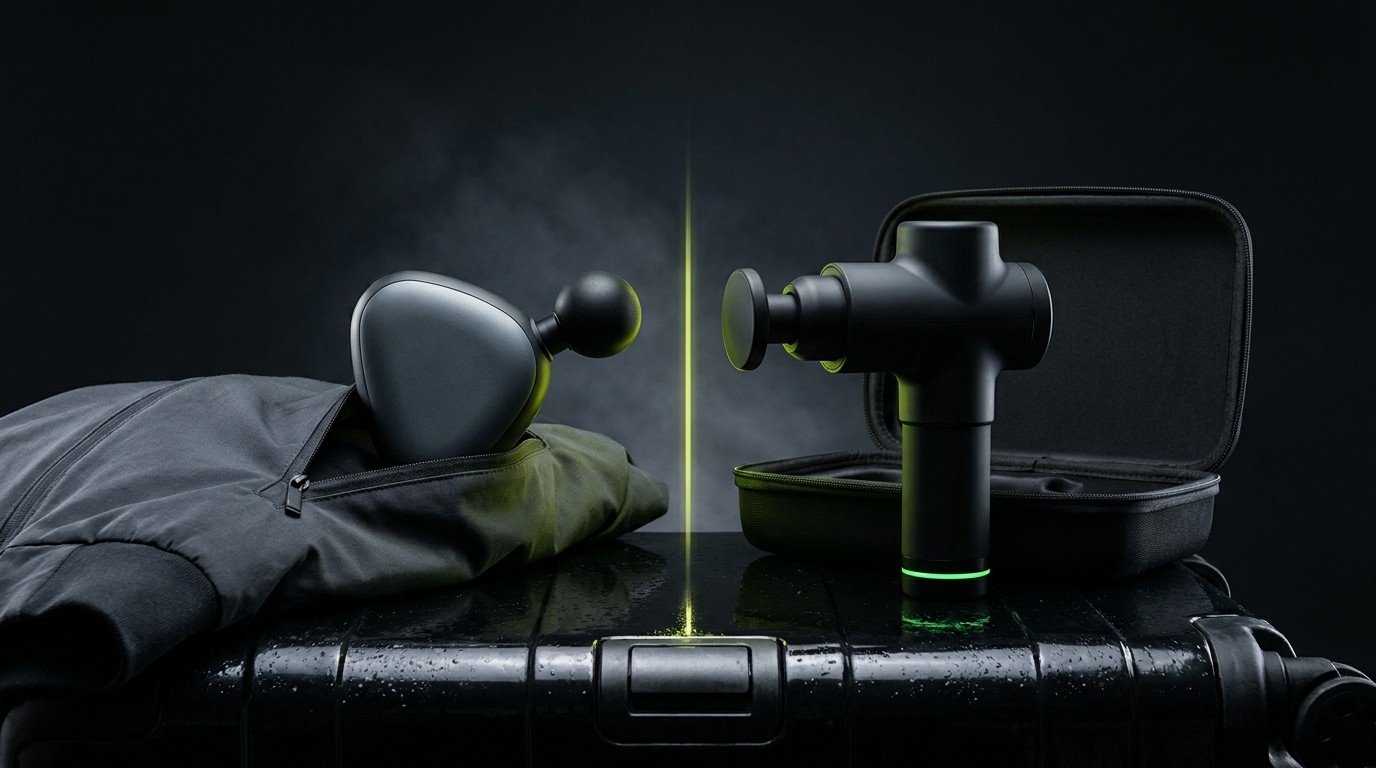
Pack both for a weekend away and the difference shows before the bag is zipped. The Theragun Mini is a rounded triangle that weighs 15.8 ounces and stands under two inches thick. The Hypervolt Go 3 is a small gun with a handle, weighs 1.6 pounds, and costs about $71 less.
That trade, a smaller shape against a lower price, is the whole of Theragun Mini vs Hypervolt Go. The search results for it circle the same three questions: whether the Mini is worth what it costs, which one packs better, and which one is quieter. The Amazon reviews add a fourth, about batteries that stop taking a charge.
After reading both Amazon listings, both brands’ spec pages and the critical reviews on each, one gap stands out: neither brand publishes how hard its gun hits. So this comparison sticks to what is printed.
Quick Answer
About $149 gets you the Hypervolt Go 3: five speeds, a stated four hours of battery, a published 55 dB and a carry case, for about $71 less than the Mini.
Pick the Theragun Mini only if pocket size is the point. It is about 10 ounces lighter and under two inches thick, and that is most of what the extra money buys.
The Mini’s $71 Premium Buys a Smaller Shape, Not More Settings
The cheaper gun has more speeds and the longer stated battery. The Go 3 is about $149 on Amazon, sold by Hyperice. The Mini 3rd Gen is about $220, sold by Therabody’s own store. For the extra $71 you get three speeds instead of five, and a stated 150 to 180 minutes of battery instead of four hours.
Google’s questions under this search include whether the Mini is worth it and why it costs so much. The listing answers with what it adds, not with anything it does harder: Bluetooth and the Therabody app, a travel lock that stops it switching on in a bag, and three heads to the Go 3’s two.
If you would never open an app to run a massage routine, most of that $71 pays for a shape. That is a fair thing to buy, but only if the shape is why you are buying. The same brand gap runs through the full-size guns in our Theragun vs Hypervolt comparison, one of several brand matchups on this site.
Ten Ounces and Two Inches Settle the Travel Question for the Mini
This is the line the Mini wins outright. Amazon lists it at 15.8 ounces and 1.9 inches thick. The Go 3 weighs 1.6 pounds, about 10 ounces more, and its handle stands 7.5 inches tall. In a carry-on, that is the difference between something that slips into a side pocket and something that needs its own corner.
Owners notice it. “Easy to travel with” is the most common theme in the Mini’s Amazon review summary, raised by 267 reviewers, 249 of them positive. Both listings say the gun can go through airport security, and Hyperice adds that the Go 3 belongs in carry-on luggage because of its lithium-ion battery.
The heavier gun is the one that arrives ready to pack. The Go 3 listing includes a carry case. The Mini listing names three attachments and a USB-C cable, and no case at all, so the pocket-sized gun is the one that ends up loose in your bag next to the charger.
Only One of These Puts a Decibel Figure on the Page
Hyperice publishes 55 dB for the Go 3. That is quieter than two people talking across a table, which matters when the gun comes out in a hotel room where someone else is asleep. Therabody prints no decibel figure for the Mini. It says only that the 3rd Gen is 30% quieter than the original Mini, and without the original’s number that percentage tells you nothing.
Noise is the oldest argument between these brands. In Reddit threads comparing them, the line that keeps coming back is that Theragun runs louder and Hypervolt hums. That reputation was earned by the full-size guns, and the Mini’s own review summary says it does the job quietly.
A quieter claim without a number is not a quieter gun. On what the two brands print, the Go 3 takes this line by default: it is the only one that gives you a figure to hold the brand to.
The Battery Complaints Pile Up on the Mini, and Its Warranty Runs One Year
Of the ten most recent critical reviews on the Mini’s Amazon listing, five describe a battery that stopped taking a charge, several of them somewhere after the first year. Therabody prints a one-year limited warranty on its product page. An owner who keeps a Mini for two years carries that risk alone.
Even the Mini’s battery figure is unsettled: Therabody’s page says 150 minutes, the Amazon listing up to 180. The Go 3 states up to four hours, at least an hour more on either reading.
The Go 3 is too new to show a long-term pattern: it went on sale on Amazon in March 2026 and has 92 ratings. Two of its three critical reviews say the four-hour claim runs short, and Hyperice prints no warranty length on the Go 3 page, only a link to a warranty article. The longer battery is on the cheaper gun, and so is the warranty you have to go looking for.
Spec vs Spec
Both brands’ own numbers, with the gaps left where a brand prints nothing.
More speeds, a longer stated charge and the only published noise figure, for about $71 less.
About ten ounces lighter and under two inches thick, with an extra head and a warranty it actually prints.
The lines split four to three for the Mini, but they do not weigh the same. The Mini wins on how it carries; the Go 3 wins on what you pay and how long it runs, and the Mini’s own battery figure changes with the page you read. Force and amplitude, the two figures that would say how hard either gun hits, are published by neither brand.
Every figure is the brand’s own, from its Amazon listing or published specifications.
Head-to-Head
Hyperice Hypervolt Go 3 — Best Value Compact Gun
Five speeds running from 1,500 to 2,500 a minute is what Hyperice prints for the Go 3, and at about $149 that is two more settings than the Mini offers for about $71 less. It also states up to four hours of battery, publishes 55 dB, and ships with two heads, a Flat and a Wedge, plus a carry case.
If the gun lives in a gym bag and comes out after training, the case and the longer stated battery matter more than ten ounces. A 1.6-pound gun disappears next to the shaker and the protein tub you already carry. If you train at home beside a set of adjustable dumbbells, the weight argument for the Mini barely exists.
What you give up is pocket size. At 7.5 inches tall with a handle, this is a small gun rather than a pocket device, and it will not slide into a jacket. The review base is also thin at 92 ratings. Two of the three critical reviews say the battery falls short of four hours, and one says the head is hard to pull off, which matters on a gun with only two heads to swap.
Missing from the listing and the brand page: a warranty length, a stall force and an amplitude figure, so there is no printed way to say how hard it hits next to the Mini.
Theragun Mini 3rd Gen — Best for Pocket-Size Travel
Anyone who wants the most gun for the money should stop here. The Mini costs about $220 and gives you three speeds, 1,750 to 2,400 a minute by Therabody’s figures, and a shorter stated battery than the $149 Go 3.
Its case is size, and it is a strong one. At 15.8 ounces and 1.9 inches thick, it is the one of the two you can carry without planning for it. If you fly every week and the gun has to share a backpack with a laptop, the rounded triangle body and the travel lock that keeps it off in transit are worth paying for. It ships with three heads, Dampener, Standard Ball and Thumb, and pairs with the Therabody app.
The reason to hesitate is the battery. Owner reviews keep circling back to the same failure: a Mini that worked well for a year or so and then stopped taking a charge, half of the ten most recent critical reviews. With a one-year limited warranty, that failure tends to land just after the cover ends, on a device that costs about $220.
Left unprinted: a decibel figure, a stall force, and a battery life that the brand’s own page and its Amazon listing agree on.
What the Label Doesn’t Say
Is the Theragun Mini worth it?
Only if size is what you are paying for. At about $220 it costs about $71 more than the Hypervolt Go 3, which publishes more speeds, a longer battery and a noise figure. The Mini’s advantage is that it is about 10 ounces lighter and under two inches thick.
Is the Hypervolt Go 3 worth $10 more than the Go 2?
Yes, if you charge from a laptop or a phone brick. On Amazon the Go 2 is about $139 and the Go 3 about $149, and the Go 3 adds two speeds, a carry case and USB-C charging. The Go 2’s own listing says it will not run while plugged in and does not work with USB-C to USB-C cables.
Theragun Relief or Hypervolt Go 3?
They sit about $11 apart but they are different shapes. The Theragun Relief is about $160, uses Therabody’s full triangle handle, ships with three heads and is described by Therabody as its gentlest percussion. The Go 3 is smaller and has five speeds to the Relief’s three.
Is Hypervolt quieter than Theragun?
On these two compact models, only Hyperice prints a number: 55 dB for the Go 3. Therabody says the Mini 3rd Gen is 30% quieter than the original Mini but gives no decibel figure, so the labels alone cannot settle it.
What the Label Decides
The Hypervolt Go 3 is the buy at about $149: cheaper, longer on a stated charge, and the only one of the two with a published noise figure. The Theragun Mini earns its $71 premium only for someone who measures a travel gun in ounces and inches.