

This article contains affiliate links. We may earn a commission if you buy through our links, at no extra cost to you.
How to Increase Testosterone Naturally in 2026
Testosterone levels in men have been declining for decades — not by a little, but by roughly 1% per year since the 1980s. A 40-year-old man today has significantly lower testosterone on average than a 40-year-old man in 1990, controlling for age and body weight. That’s not a scare statistic — it’s a measurable shift with real consequences for energy, body composition, mood, and sexual health. The good news is that learning how to increase testosterone naturally — through sleep, training, nutrition, and targeted supplementation — is well-supported by research and accessible to any man willing to be consistent about it.
After researching hundreds of studies and comparing dozens of approaches, here is what actually works for men who want to optimize testosterone without prescription intervention in 2026.
This guide is for men 25 and older who want practical, evidence-informed strategies to support healthy testosterone levels.
Quick Answer
The three most impactful natural ways to increase testosterone are optimizing sleep (7-9 hours in a cool, dark room), resistance training with compound lifts 3-4 times per week, and correcting nutritional deficiencies — particularly zinc, magnesium, and vitamin D. These three changes alone can produce meaningful improvements in testosterone within 8-12 weeks for most men who are currently deficient in any of them.
Why Testosterone Declines and What You Can Actually Control
Before covering solutions, understanding why testosterone drops matters. Some causes are beyond your control — age-related decline begins around 30 and accelerates after 40 at approximately 1-2% per year. But the majority of testosterone decline in younger men is driven by controllable lifestyle factors that most men haven’t addressed.
Chronic sleep deprivation is the biggest and most underappreciated driver. A study published in the Journal of the American Medical Association found that restricting sleep to 5 hours per night for one week reduced testosterone levels in healthy young men by 10-15%. That’s the equivalent of 10-15 years of age-related decline, produced by one bad week of sleep.
Excess visceral fat — particularly around the abdomen — converts testosterone to estrogen via an enzyme called aromatase. The more visceral fat you carry, the more testosterone gets converted before it can function. This creates a frustrating cycle: low testosterone makes fat loss harder, and excess fat suppresses testosterone further.
Chronic stress elevates cortisol, which directly suppresses testosterone production. These two hormones operate in opposition — when cortisol is chronically elevated, testosterone tends to be chronically suppressed. Men under sustained high-stress conditions often see meaningful testosterone recovery simply from reducing cortisol load, without changing anything else.
The counterintuitive point: most men focus on finding the right supplement when they haven’t addressed sleep, body fat, or chronic stress. No supplement stack compensates for 5-6 hours of nightly sleep. Fix the foundations first — supplements work as amplifiers on top of an already solid base, not as substitutes for one.
For a complete overview of how natural testosterone strategies interact with diet, see our guide on best foods to boost testosterone — nutrition is one of the most consistently underestimated levers.
Sleep: The Single Biggest Lever for Natural Testosterone
If you could only change one thing to increase testosterone naturally, sleep is the answer. Not supplements. Not training frequency. Sleep.
The majority of daily testosterone production happens during sleep — specifically during deep slow-wave sleep stages. Men who consistently sleep 7-9 hours have testosterone levels approximately 15-20% higher than men sleeping 5-6 hours, according to multiple independent studies. That gap is substantial enough to be clinically meaningful and large enough to explain many of the symptoms men attribute to “low T” that are actually low-sleep consequences.
Practical scenario: a 32-year-old who works late, scrolls his phone until midnight, and wakes at 6am is operating on a chronically suppressed testosterone baseline before he considers diet or exercise. Moving bedtime to 10:30pm, eliminating screens 60 minutes before bed, and keeping the room at 65-67°F can produce noticeable changes in morning energy and testosterone markers within 2-3 weeks — without changing anything else.
Key sleep optimization strategies for testosterone:
- Target 7-9 hours in a dark, cool room (65-67°F is optimal for testosterone-supporting sleep architecture)
- Eliminate alcohol within 3 hours of bedtime — alcohol suppresses REM sleep and blunts overnight testosterone recovery
- Consistent wake time matters as much as bedtime — your circadian rhythm is the hormonal production framework your body follows
- Magnesium glycinate taken 30-60 minutes before bed supports deeper sleep for men who are deficient — which is the majority of men eating a modern Western diet
For men who struggle with sleep onset and sleep maintenance, see our guide on the best magnesium supplement for men — magnesium glycinate is the most consistently effective sleep supplement with the strongest evidence base at standard doses.
Resistance Training: The Exercise Protocol That Actually Works
Exercise is good for testosterone. But not all exercise is equally good — and some exercise is actively counterproductive at extreme volumes.
Resistance training with compound movements — squats, deadlifts, bench press, rows, overhead press — produces acute testosterone spikes immediately post-workout and, with consistent training over months, supports higher baseline testosterone levels. The key variables are intensity and volume. Heavy sets in the 4-8 rep range with multiple compound exercises produce stronger hormonal responses than lighter, higher-rep isolation work. The hormonal signal from loading large muscle groups simultaneously (squat, deadlift) is meaningfully greater than from training small muscle groups (curls, leg extensions).
High-intensity interval training (HIIT) also supports testosterone production and has the added benefit of reducing visceral fat, which reduces aromatase activity — a double benefit on the testosterone side.
What most reviews won’t tell you is that chronic high-volume endurance training can actively suppress testosterone in some men. Marathon training, ultra-distance running, and excessive cardio volume elevate cortisol significantly over time. The combination of caloric deficit, high hormonal stress load, and repetitive impact can push testosterone downward — the opposite of the intended effect. Moderate cardio 2-3 times per week is fine and beneficial. Extreme endurance volume at 60+ miles per week is a different calculation.
Practical protocol for testosterone support:
- 3-4 resistance training sessions per week targeting large compound movements
- Moderate to high intensity — 70-85% of maximum effort
- Keep sessions under 60-75 minutes — beyond that, cortisol rises sharply and partially offsets the testosterone benefit
- Rest 2-3 minutes between heavy compound sets — shorter rest intervals reduce the hormonal response
Nutrition: The Deficiencies That Suppress Testosterone
Diet affects testosterone through two main pathways — micronutrient deficiencies that directly impair hormone production, and body composition effects that influence aromatase activity. Most men have at least one correctable deficiency that’s suppressing their baseline.
Zinc is the most well-established micronutrient connection to testosterone. Zinc is required for the production of luteinizing hormone, which signals the testes to produce testosterone. Studies in zinc-deficient men show testosterone increases of 50-100% when zinc is restored to adequate levels — among the largest effects of any single intervention. Oysters, red meat, and pumpkin seeds are the best dietary sources. Men whose diet is low in these foods benefit from 15-30mg of supplemental zinc daily.
Vitamin D functions more like a hormone than a vitamin — vitamin D receptors are present in testicular Leydig cells that produce testosterone. A 12-month randomized controlled trial found men supplementing with 3,332 IU of vitamin D3 daily had significantly higher testosterone than the placebo group. Most men above 35° latitude are vitamin D deficient from October through April regardless of diet.
Dietary fat is more relevant than most men realize. Testosterone is synthesized from cholesterol. Very low-fat diets — below 20% of calories from fat — are consistently associated with lower testosterone in research. Healthy fat sources like olive oil, avocado, eggs, and fatty fish support the hormonal substrate your body needs for production.
In our experience, zinc and vitamin D are the two most commonly correctable deficiencies driving suboptimal testosterone in men who otherwise live reasonably healthy lives. Getting blood levels tested before supplementing is the most efficient approach — it eliminates guesswork and confirms whether deficiency is actually present.
Supplementation: What the Evidence Actually Supports
Most “testosterone booster” products on shelves are proprietary blends with underdosed ingredients and no clinical evidence. That said, several individual compounds have genuine research support and are worth considering once the lifestyle foundations are in place.
Ashwagandha — Jarrow Formulas KSM-66
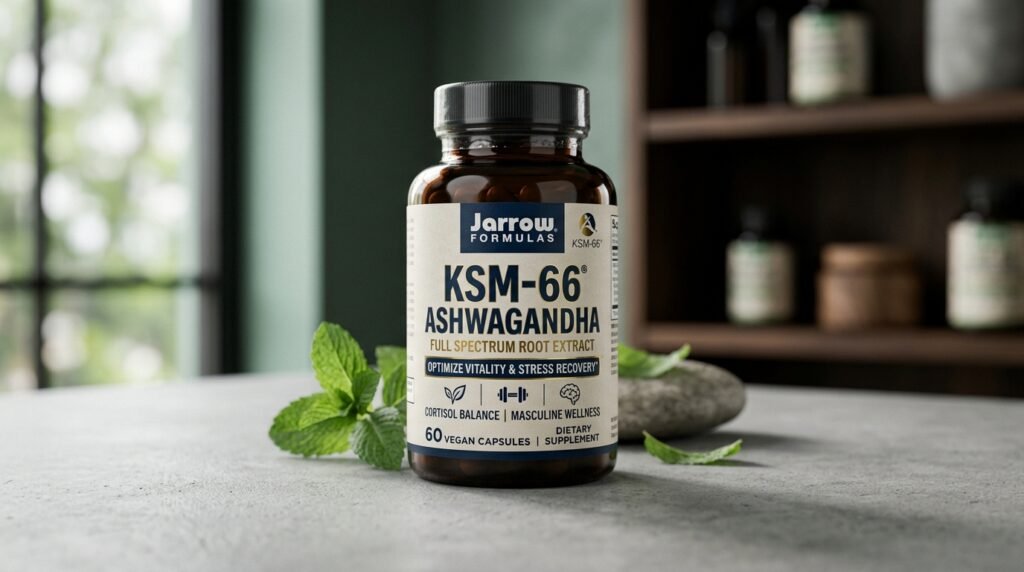
Ashwagandha is the most evidence-backed adaptogen for testosterone support in men. Multiple randomized controlled trials using KSM-66 extract at 300-600mg daily show cortisol reductions of 22-27% and significant associations with increased testosterone and improved sperm quality. The cortisol-testosterone seesaw is the primary mechanism — lower chronic cortisol, higher testosterone production.
Best for: Men under chronic stress whose cortisol is chronically elevated. Less likely to produce dramatic effects in men with already-normal cortisol.
Recommended dose: 300mg twice daily with meals. Give it 8-12 weeks before evaluating.
Pros: Multiple RCTs, reduces cortisol, improves sleep quality, well-tolerated at standard doses. Cons: Effects take 8-12 weeks to fully manifest, some users experience mild digestive discomfort, not recommended during pregnancy.
Zinc + Magnesium — Thorne Zinc Picolinate
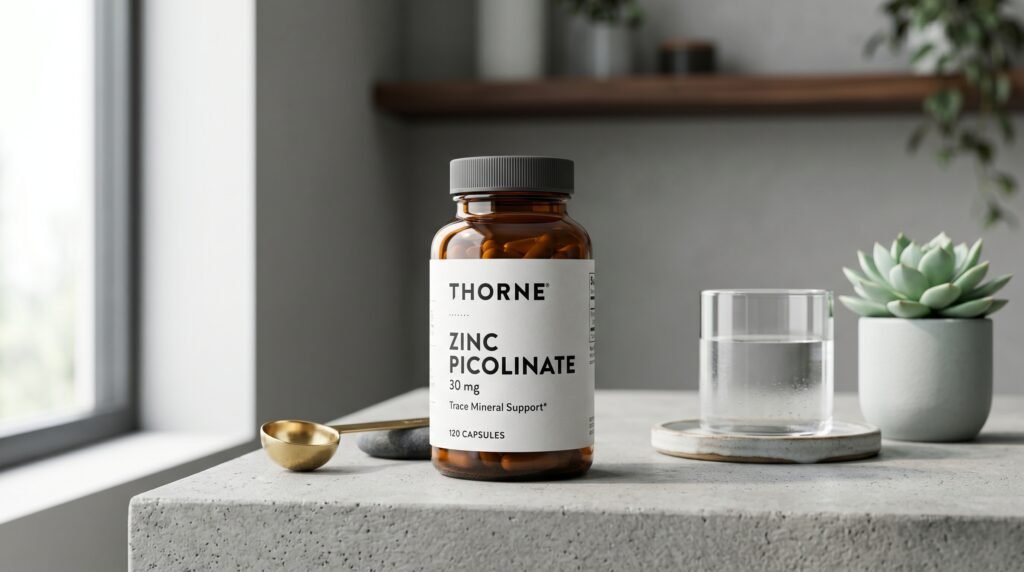
Zinc at 25-30mg daily addresses the most common mineral deficiency associated with suppressed testosterone. Thorne Zinc Picolinate uses the picolinate form — better absorbed than zinc oxide or sulfate — at the clinical dose used in testosterone research. Combined with magnesium glycinate at 200-400mg before bed, these two minerals address the most correctable nutritional gaps in most men’s diets.
Best for: Men whose diet is low in red meat, oysters, nuts, and leafy greens — the primary dietary zinc and magnesium sources.
Important caveat: Zinc supplementation above 40mg daily long-term can deplete copper. Take with a copper supplement at a 15:1 zinc-to-copper ratio or cycle off periodically.
Pros: Addresses real, common deficiencies, improves sleep, well-tolerated, inexpensive, produces the largest effects in genuinely deficient men. Cons: Zinc over 40mg daily depletes copper, effects minimal in men with adequate baseline zinc.
Vitamin D3 + K2 — Thorne D3+K2 Liquid
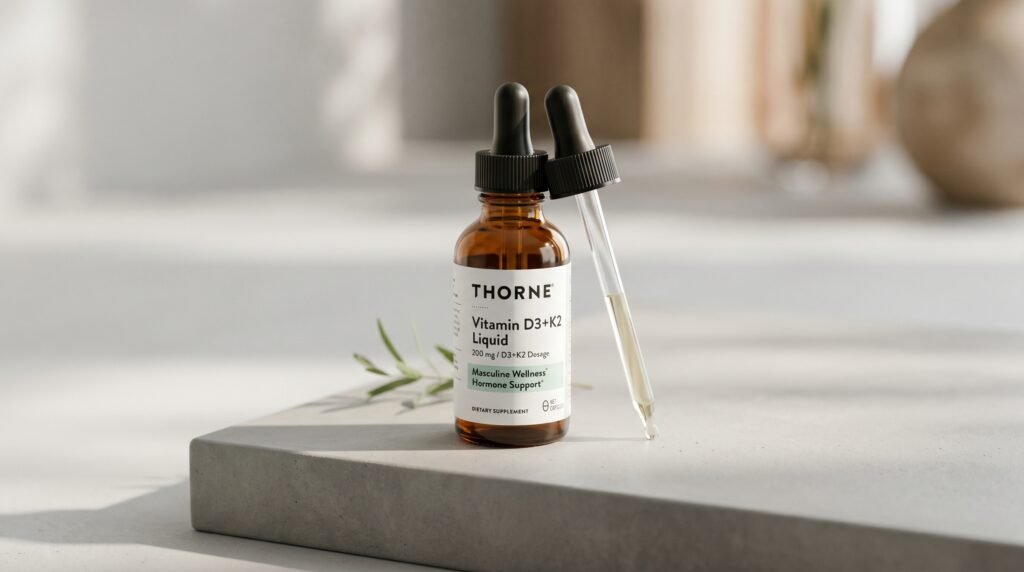
Vitamin D3 at 2,000-4,000 IU daily with vitamin K2 (MK-7 form, 100-200mcg) is the most practical intervention for men deficient in vitamin D — which is the majority of men in northern latitudes from October through April. Thorne’s D3+K2 liquid uses a metered dispenser for precise dosing, with K2 directing calcium appropriately and working synergistically with D3 for bone and cardiovascular health alongside the hormonal benefits.
Best for: Men who don’t get significant sun exposure year-round, confirmed by a blood test showing 25-OH vitamin D below 40 ng/mL.
Recommended: 2,000-4,000 IU D3 with 100mcg K2 daily, taken with a fat-containing meal for proper fat-soluble vitamin absorption.
Pros: Addresses widespread deficiency, multiple health benefits beyond testosterone, inexpensive per dose, easy liquid format allows flexible dosing. Cons: Fat-soluble — builds up over time at excessive doses, get blood levels tested before and after to avoid oversupplementation above 80 ng/mL.
Tongkat Ali — Double Wood LJ100
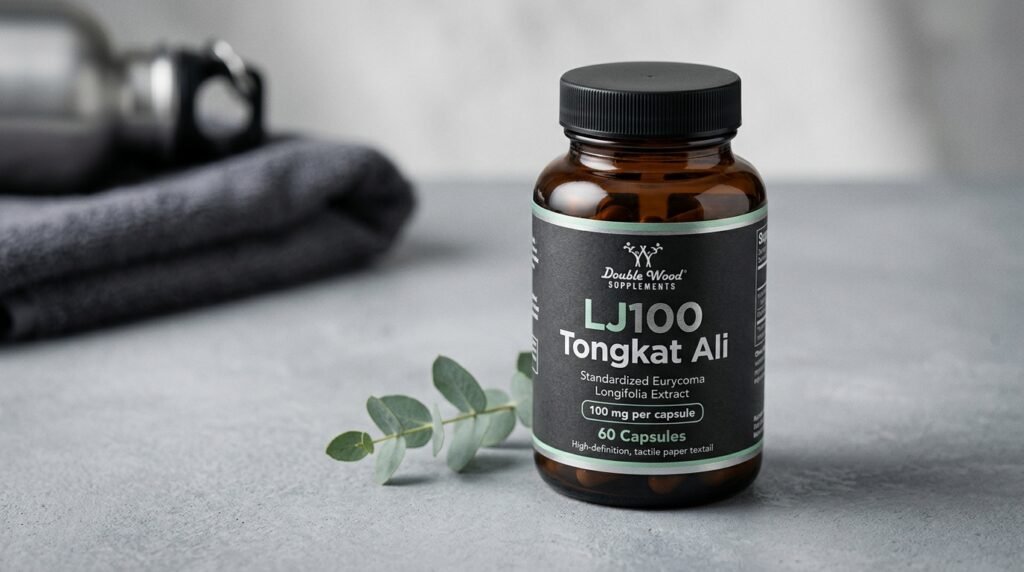
Tongkat Ali is an increasingly studied herb from Southeast Asia that supports testosterone through multiple mechanisms including reducing sex hormone-binding globulin (SHBG) — the protein that binds testosterone and makes it biologically unavailable. Lower SHBG means more free testosterone, which is the active form that drives energy, muscle, and libido effects. Double Wood’s LJ100 uses the patented LJ100 extract standardized to 40% glycosaponins and 22% eurypeptides — backed by over 15 published human clinical trials, more than any other Tongkat Ali extract.
Best for: Men with normal total testosterone but low free testosterone, or men over 40 experiencing age-related hormonal decline where SHBG tends to rise.
Recommended dose: 100-200mg daily in the morning with food.
Pros: Patented LJ100 extract with 15+ human clinical trials, targets free testosterone specifically via SHBG reduction, 4-month supply per bottle, well-tolerated. Cons: Research less extensive than ashwagandha overall, effects vary between individuals, less relevant for men with already-low SHBG.
Supplement Comparison Table
| Supplement | Product | Price/month | Best For | Evidence | Rating |
|---|---|---|---|---|---|
| Ashwagandha KSM-66 | Jarrow KSM-66 | ~$20 | Cortisol and stress reduction | Strong (multiple RCTs) | 9/10 |
| Zinc Picolinate | Thorne Zinc | ~$15 | Zinc deficiency correction | Strong | 9/10 |
| Vitamin D3 + K2 | Thorne D3+K2 | ~$10 | Vitamin D deficiency | Strong | 9/10 |
| Tongkat Ali LJ100 | Double Wood LJ100 | ~$15 | Free testosterone via SHBG | Moderate-Strong | 8/10 |
What to Look for When Building a Natural Testosterone Protocol
1. Address deficiencies before adding enhancers Get a basic blood panel first if possible — total testosterone, free testosterone, vitamin D, and a general metabolic panel. Correcting a genuine deficiency produces dramatically larger effects than adding an adaptogen on top of adequate levels. A man with vitamin D at 15 ng/mL who supplements to 50 ng/mL will see larger testosterone changes than a man with adequate D who adds ashwagandha.
2. Supplement form and quality matters For ashwagandha, only KSM-66 or Sensoril extracts have clinical research behind them — generic root powder at undisclosed concentrations does not. For zinc, picolinate or bisglycinate absorbs significantly better than oxide or sulfate. For magnesium, glycinate outperforms oxide dramatically. For Tongkat Ali, only LJ100 and Physta are patented extracts with published human trials. Form matters as much as the ingredient name on the label.
3. Realistic timeline expectations Natural testosterone optimization is a 3-6 month project, not a 2-week fix. Sleep improvements show up fastest — 2-4 weeks. Training adaptations take 8-12 weeks to produce measurable hormonal effects. Ashwagandha peaks at 8-12 weeks of consistent use. Vitamin D correction takes 6-8 weeks to meaningfully raise blood levels. Set a 12-week timeline before evaluating results from any protocol change.
4. Lifestyle foundation before supplements Research consistently shows that lifestyle interventions — sleep, training, body composition — produce larger testosterone effects than supplements in men who haven’t optimized the basics. A man sleeping 8 hours, training 4 times per week, and maintaining a healthy body weight doesn’t need an expensive supplement stack. A man sleeping 5 hours, sitting all day, and carrying excess visceral fat won’t see meaningful results from supplements alone.
5. Avoid proprietary blends Most commercial testosterone boosters use proprietary blends that hide individual ingredient doses. An ingredient list showing “testosterone support complex — 500mg” with 8 ingredients means each ingredient is likely severely underdosed. Buy individual, well-dosed ingredients from reputable brands — Thorne, Jarrow Formulas, Double Wood, Pure Encapsulations.
FAQ
How quickly can I increase testosterone naturally?
Sleep improvements can produce measurable changes in testosterone within 2-4 weeks of consistently hitting 7-9 hours. Resistance training effects on resting testosterone take 8-12 weeks of consistent training to become significant. Correcting vitamin D or zinc deficiencies shows hormonal effects within 4-8 weeks depending on initial deficiency severity. The honest answer is that meaningful, sustained increases take 3-6 months of consistent lifestyle change — there are no legitimate shortcuts that work faster.
What are the signs of low testosterone in men under 35?
The most common signs include persistent fatigue that isn’t explained by sleep debt, reduced motivation and drive, difficulty building or maintaining muscle mass despite consistent training, lower libido, and mood changes including increased irritability or low-grade depression. These symptoms overlap with many conditions, so a blood test is the only way to confirm whether testosterone is actually low. Normal ranges are typically 300-1000 ng/dL, with many practitioners considering optimal to be 600-900 ng/dL for men under 40.
Does masturbation lower testosterone?
The research on this is consistently weak and contradictory. Short-term abstinence studies show minor testosterone fluctuations that normalize within hours to days — nothing clinically meaningful. The widely circulated claim that abstinence dramatically boosts testosterone is not supported by peer-reviewed evidence at any meaningful magnitude. Chronic pornography use may have indirect effects through dopamine dysregulation affecting motivation and stress, but this is mechanistically different from testosterone production itself. Sleep, training, and nutrition produce real, measurable effects. This doesn’t.
Should I get my testosterone tested before starting a protocol?
Yes, if accessible. A baseline blood test gives you actual data rather than guesses, identifies specific deficiencies to correct, and gives you a comparison point at 12 weeks. Many men discover their fatigue or mood issues come from thyroid problems, vitamin D deficiency, or iron deficiency rather than testosterone — conditions requiring different interventions entirely. Ask your doctor for total testosterone, free testosterone, SHBG, LH, vitamin D, and a basic metabolic panel. Several online services offer at-home hormone testing for men who prefer not to go through a physician.
Our Final Verdict
Learning how to increase testosterone naturally comes down to three non-negotiable foundations — sleep, resistance training, and correcting deficiencies — plus targeted supplementation that amplifies what you’ve already built. Start with 8 hours of sleep and compound lifting 3-4 times per week. Correct vitamin D and zinc deficiencies confirmed by blood work. Add Jarrow KSM-66 Ashwagandha after 4-6 weeks if stress is chronically elevated. Consider Thorne Zinc and Thorne D3+K2 to address the two most common correctable deficiencies. Add Double Wood LJ100 if free testosterone specifically is the concern. Give the full protocol 12 weeks before evaluating. Check current pricing on Amazon for all recommended supplements in this guide