
As an Amazon Associate we earn from qualifying purchases made through links on this page.
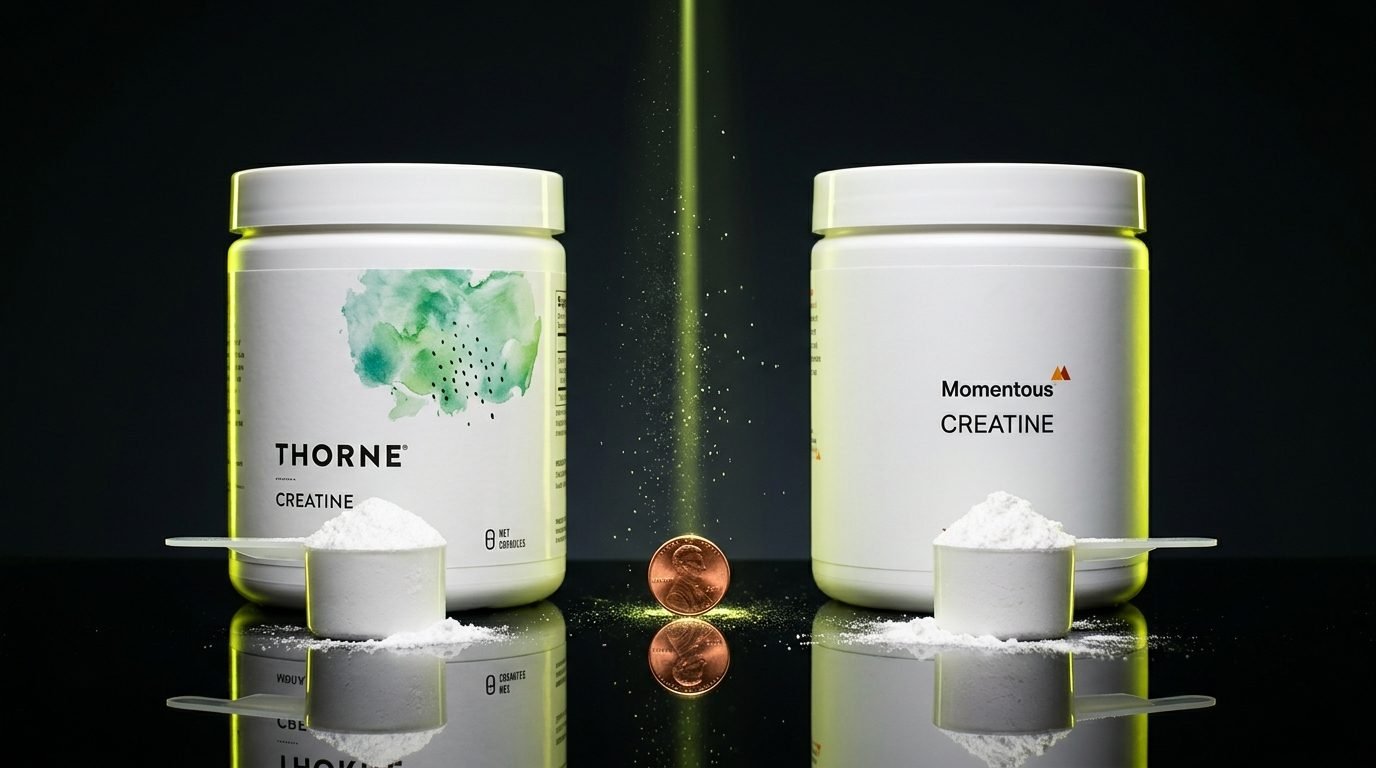
Peel the labels off and you could not tell these two tubs apart. Thorne Creatine and Momentous Creatine both hold 90 scoops of 5 g creatine monohydrate, both carry NSF Certified for Sport, and they sit about a cent apart per scoop, at about $44 and about $43.
When two products are this close, the tie gets broken by something most buyers never scroll down to read. In the Thorne vs Momentous creatine match-up, that something is how much each brand tells you beyond the seal they share.
We went through both Amazon listings and supplement facts panels, plus the creatine HCl tub that keeps turning up as the “cheaper” option. Per gram, it is anything but.
Quick Answer
Momentous Creatine Monohydrate edges it at about 48 cents a scoop: the same seal, and it is the only one of the two that publishes its own purity limits.
Already on Thorne for everything else? Thorne Creatine costs a cent more, carries the same seal and adds a micronized powder, so staying loyal costs you nothing.
Same Seal, Same 90 Scoops, One Cent Apart
The cheaper tub and the better tub are the same tub here, and it is not by much. Thorne lists about $44 for about 90 servings, which is about 49 cents a scoop. Momentous lists about $43 for 90 servings, about 48 cents.
Over a year of one scoop a day, that gap is about $4. It should not decide anything, and it is the reason this comparison has to be settled on something other than price.
Both tubs hold 5 grams of creatine monohydrate per scoop, and both list NSF Certified for Sport. For someone in a tested sport, either one clears the bar, which is not true of every creatine on Amazon at a lower price.
If you are building a full shelf of certified products, Thorne carries the same seal across its multivitamin, whey and magnesium, which we laid out in Thorne vs Garden of Life.
Momentous Prints Its Own Purity Spec; Thorne Lets the Seal Speak
The seal is the floor, not the whole story. Momentous goes further on its listing and publishes its own claims against what it calls industry premium creatine: 10 times fewer impurities, heavy metal limits 2 to 5 times tighter, testing for microplastics and a comparison of particle size.
Those are manufacturer claims, and we cannot verify them independently. But they are specific, they are printed, and they are the kind of promise a brand can be held to.
Thorne prints the NSF seal and that its powder is micronized, ground finer so it disperses more easily in water, and stops there. That is not a weakness in the product. It is a choice to let the certification do the talking.
If you mix creatine into water on its own, the micronized powder is the one practical difference you will notice in the glass. If you stir it into a protein shake, the shake hides any difference. For the protein side of that glass, Optimum Nutrition vs Dymatize runs the same per-scoop math.
The Small Tub Is the Worst Deal on the Page
Momentous also sells a 15-serving tub at about $23. That is about $1.53 a scoop, more than three times the price of the same powder in the 90-serving size.
Most buyers reach for the small tub to try a product before committing. With creatine monohydrate that logic barely applies: there is no flavor to dislike in an unflavored powder, and the scoop is the same 5 grams in the small tub as in the large one. Thorne’s 30-serving tub runs about $36, about $1.20 a scoop, so the pattern holds for both brands.
If you are sure you will take it daily, the large tub is the better buy from the first month: 15 scoops cost about $23, and 90 cost about $43. If you are not sure, the small tub costs about $23 to find out, which is still about half the price of the large one.
Creatine HCl Costs Less per Scoop and About Four Times More per Gram
The cheapest-looking tub in the category is the most expensive per gram. Kaged Creatine HCl lists about $25 for about 75 servings, roughly 33 cents a scoop, but each scoop holds 750 mg of creatine hydrochloride, not 5 grams.
Per gram of creatine on the label, that is about 44 cents for Kaged against about 10 cents for either monohydrate tub. Kaged markets HCl as a more concentrated form, and that is its claim to make. What the labels show is that you are buying much less creatine per dollar.
Kaged carries the Informed Sport mark, so it does clear a testing bar. It is a different product with a different serving size, not a cheaper version of the two tubs above, and anyone comparing tubs by price per scoop alone will read the shelf backwards.
Label vs Label
Thorne first, Momentous second. These are the 90-serving tubs, as listed on Amazon.
Price. About $44 against about $43.
Cost per scoop. About 49 cents against about 48 cents.
Creatine per scoop. 5 g monohydrate against 5 g monohydrate.
Powder. Micronized against not stated.
Certification. NSF Certified for Sport against NSF Certified for Sport.
Published purity limits. Not disclosed against impurity, heavy metal and microplastics claims.
Sold on Amazon by. Pattern against Momentous US.
Five of seven lines are a draw or near enough. The two that differ point in opposite directions: Thorne tells you the powder is micronized, Momentous tells you how it tests. Our tie-breaker is the second, because it is a promise about the product rather than a description of it.
Head-to-Head
Momentous Creatine Monohydrate — Best for Most Men
What Momentous publishes beyond the seal is the reason it edges this comparison: the listing claims 10 times fewer impurities and 2 to 5 times tighter heavy metal limits than what it calls industry premium creatine, plus microplastics testing. Those are brand claims, but they are specific numbers, and Thorne’s listing prints none of its own.
The 90-serving tub costs about $43, about 48 cents for 5 grams, sold on Amazon by Momentous itself, and carries NSF Certified for Sport. If you take one scoop a day and want the most documented tub at this price, this is the one.
If you are a buyer who mixes creatine into plain water, you may prefer Thorne’s micronized powder, because Momentous does not state particle size as a figure on the parts of the listing we could read, only that it compares it.
Its smaller 15-serving tub is the trap in the range. At about $1.53 a scoop it costs more than three times as much per serving, so buy it only if you genuinely want to try before committing.
Missing from the label: the lab behind the purity figures. NSF certifies the product; the impurity and heavy metal comparisons are Momentous’s own, and the listing does not name who measured them.
Thorne Creatine — Best for a Single-Brand Shelf
NSF Certified for Sport covers this tub the same way it covers Thorne’s multivitamin, whey and magnesium: an outside lab tests for substances banned in sport and checks that the contents match the label. It does not rate the powder against other creatines, and Thorne does not add its own comparison on top.
At about $44 for about 90 servings of 5 grams, the price per scoop is within a cent of Momentous. The powder is micronized, which matters if you stir it into water rather than a shake.
If you already take other Thorne products and like having one brand and one seal across the cupboard, buy this one. You give up nothing measurable by doing so.
What you give up is documentation. Thorne relies on the certification alone, and the listing does not add impurity limits or heavy metal figures of its own. It is sold on Amazon by Pattern, a third-party seller, rather than by Thorne or Amazon.
The listing never tells you what micronized means in numbers. Thorne uses the word without a particle size, so you know it is finer than standard powder but not by how much.
What the Label Doesn’t Say
Is Thorne or Momentous creatine better?
They are almost identical on the label: 5 grams of monohydrate, about 90 servings, NSF Certified for Sport, and about a cent apart per scoop. Momentous publishes more of its own testing claims, which is why it edges ahead.
Is creatine HCl better value than monohydrate?
No, not per gram. Kaged Creatine HCl works out to about 44 cents per gram of creatine against about 10 cents for monohydrate, because each scoop holds 750 mg rather than 5 grams.
Which creatine has NSF Certified for Sport?
Both Thorne Creatine and Momentous Creatine Monohydrate list NSF Certified for Sport. Kaged Creatine HCl lists Informed Sport instead.
If you are weighing a daily scoop against a daily multivitamin, AG1 vs Ritual prices those per day.
What the Label Decides
Momentous and Thorne sell the same 5 grams under the same seal for the same money, and Momentous wins only because it prints more about how it tests. If one brand across the whole cupboard matters more to you than that extra line, Thorne is the equal buy.