
This article contains affiliate links. We may earn a commission if you buy through our links, at no extra cost to you.
Thorne vs Garden of Life Supplements 2026
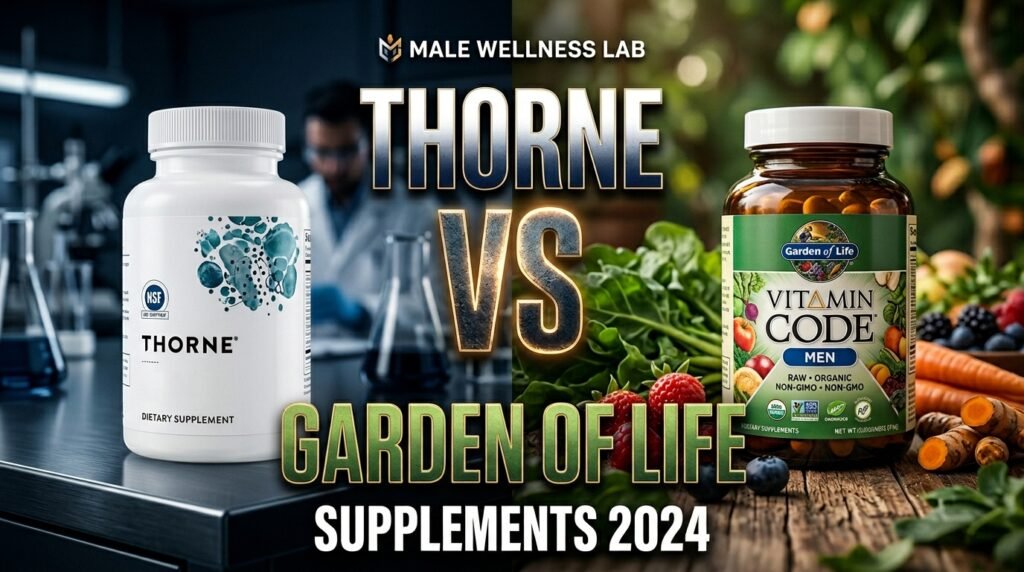
Choosing between Thorne and Garden of Life is one of the more consequential supplement brand decisions a man can make — because once you commit to a brand’s ecosystem for your multivitamin, protein, magnesium, and B vitamins, switching means replacing your entire stack. Both brands position themselves as premium, both have genuine quality credentials, and both cost significantly more than the supplement aisle alternatives at a drugstore. The difference between them is fundamental: Thorne is built around pharmaceutical-grade manufacturing and precise synthetic nutrient forms, while Garden of Life is built around whole-food sourcing and certified organic ingredients.
After researching both brands in depth across their testing standards, ingredient sourcing, and specific product formulas for men — here is what actually determines which brand wins for your specific situation in 2026.
This guide is for men who’ve decided to invest in supplement quality and need to choose between these two specifically.
Quick Answer
Thorne is the better choice for most men who prioritize verified potency, pharmaceutical-grade manufacturing, and the most bioavailable synthetic nutrient forms available. Garden of Life is the better choice for men who prioritize certified organic whole-food sourcing, NSF Certified for Sport verification across their sport line, and a cleaner label philosophy — and who are willing to accept slightly lower individual nutrient doses in exchange for food-matrix delivery.
The Core Philosophy Difference That Changes Everything
Most supplement comparisons focus on price and ingredient lists. With Thorne versus Garden of Life, the more important comparison is manufacturing philosophy — because it determines not just what’s in the product but how confidently you can trust the label.
Thorne operates its own FDA-registered, NSF-certified manufacturing facility in South Carolina. Every raw material is tested when it arrives, during production, and on the finished product before it ships. Thorne holds multiple NSF certifications including NSF Certified for Sport — the highest standard in the industry for banned substance testing. The company has supplied supplements to the Mayo Clinic, US Olympic teams, and professional sports organizations. That institutional credibility is built on manufacturing consistency that third-party retailers and contract manufacturers can’t match.
Garden of Life takes a fundamentally different approach — sourcing whole-food and fermented ingredients certified organic and non-GMO, then concentrating them into capsule form. Rather than isolated synthetic vitamins, Garden of Life products contain nutrients derived from real food sources — their vitamin C comes from amla and acerola cherry, their B vitamins from fermented yeast, their minerals from algae. The NSF Certified for Sport certification applies specifically to their Sport line, not their entire catalog.
The counterintuitive point: whole-food sourced vitamins aren’t automatically better absorbed than pharmaceutical-grade synthetic vitamins. The research on comparative bioavailability between food-matrix nutrients and high-quality synthetic forms is genuinely mixed. Methylcobalamin from fermented yeast and pharmaceutical-grade methylcobalamin from Thorne absorb similarly — the food-matrix advantage is more meaningful for minerals than for B vitamins and fat-soluble vitamins.
For men building a complete supplement foundation and deciding where these brands fit, see our guide on the best supplements for energy and focus for men — Thorne products appear frequently in evidence-based supplement stacks for good reason.
Testing Standards and Quality Verification
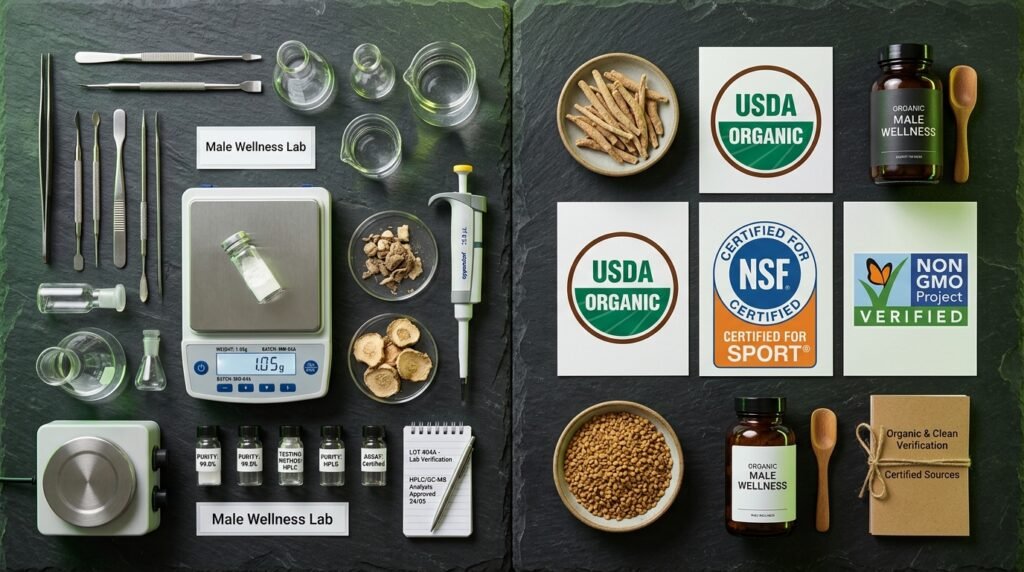
This is the category where the comparison matters most and where marketing claims are most likely to diverge from reality.
Thorne’s testing infrastructure is the most comprehensive available in the consumer supplement market. Every batch undergoes 11 stages of quality testing. Raw materials are tested on arrival before entering production. In-process testing occurs during manufacturing. Finished products are tested before release. Thorne’s NSF International certification covers manufacturing practices, label accuracy, and banned substance testing — and unlike some brands that certify select products, Thorne’s NSF certification applies to their manufacturing facility as a whole.
The practical implication: when a Thorne product says it contains 5g of creatine monohydrate, you can trust that number with a level of confidence that approaches pharmaceutical medication. Label accuracy at this standard is not universal in the supplement industry — independent testing by organizations like Labdoor and ConsumerLab regularly finds that supplements from other brands contain 10-30% less active ingredient than labeled.
Garden of Life’s testing is robust but applied differently. Their SPORT line — protein powders, pre-workout, creatine — carries NSF Certified for Sport verification. Their vitamin and supplement lines carry different certifications: USDA Organic, Non-GMO Project Verified, Certified B Corporation, and Informed Sport for select products. These certifications verify ingredient sourcing and purity but apply different testing standards than NSF Certified for Sport.
The distinction matters for men in competitive sports where banned substance testing applies — NSF Certified for Sport from Thorne provides stronger protection than Garden of Life’s non-Sport line certifications. For recreational fitness and general wellness, both brands are credible.
Product-by-Product Comparison for Men
Multivitamins
Thorne Basic Nutrients 2/Day (~$35/month) contains 25 nutrients in pharmaceutical-grade forms — methylcobalamin for B12, 5-MTHF for folate, zinc bisglycinate, and vitamin D3 at 1000 IU. No proprietary blends, every ingredient listed with exact dose and molecular form. Two capsules per day, straightforward design with no unnecessary fillers or colorants.
Garden of Life Vitamin Code Men (~$30/month) contains whole-food sourced vitamins from a raw food blend — 23 organic fruits and vegetables provide the food matrix, with additional nutrients from fermented and raw sources. 4 capsules per day provides higher doses of some nutrients than Thorne’s 2/day formula, but the food-matrix delivery means individual nutrient potency is inherently harder to verify with precision.
For men who want verifiable potency in a 2-capsule daily format, Thorne wins. For men who want organic whole-food sourcing and don’t mind 4 capsules per day, Garden of Life is a legitimate choice.
Protein Powder
Thorne Whey Protein Isolate (~$55/30 servings) delivers 21g protein per serving from NSF Certified for Sport verified whey isolate. Clean label, no artificial sweeteners, pharmaceutical manufacturing standards.
Garden of Life Sport Organic Plant-Based Protein (~$45/19 servings) delivers 30g protein per serving from an organic pea, sprouted grain, and legume blend. NSF Certified for Sport, USDA Organic, non-GMO. For men avoiding whey for dietary or ethical reasons, it’s the most credibly certified plant protein available.
Magnesium
Thorne Magnesium Bisglycinate (~$22/60 servings) uses the chelated bisglycinate form for superior absorption without digestive side effects. 200mg elemental magnesium per serving — the go-to magnesium recommendation for men prioritizing sleep and muscle recovery.
Garden of Life Dr. Formulated Magnesium (~$20/40 servings) sources magnesium from whole food ingredients with probiotics included for digestion support. Lower elemental magnesium per serving than Thorne — typically 80-100mg per serving — which means a higher daily serving to reach the same therapeutic dose.
For magnesium specifically, Thorne’s bisglycinate at 200mg per serving is the more practical choice for men targeting 300-400mg daily for sleep and recovery support. See our guide on the best magnesium supplement for men for a full breakdown.
B Vitamins and Individual Nutrients
Thorne B-Complex #12 delivers both active B12 forms plus methylated folate at pharmaceutical precision. Thorne Zinc Picolinate at 30mg delivers the most bioavailable zinc form at the clinical dose used in testosterone research. Thorne D3+K2 provides vitamin D3 with K2 in the MK-7 form — the most researched K2 variant for cardiovascular and bone health.
For individual therapeutic nutrients where dose precision matters — zinc, B12, vitamin D — Thorne’s pharmaceutical manufacturing standard is the stronger choice.
Cost Comparison Across Core Products
| Product | Thorne | Garden of Life |
|---|---|---|
| Multivitamin | ~$35/month | ~$30/month |
| Plant/Whey Protein | ~$55/30 servings | ~$45/19 servings |
| Magnesium | ~$22/60 servings | ~$20/40 servings |
| Creatine | ~$35/100 servings | ~$30/60 servings |
| B-Complex | ~$22/60 servings | ~$20/30 servings |
Thorne is consistently 10-20% more expensive per serving across comparable products. The premium reflects the manufacturing facility overhead, more extensive testing infrastructure, and the NSF certification costs that apply facility-wide rather than product-by-product.
Head-to-Head: Thorne
Thorne Basic Nutrients 2/Day (~$35/month — Best Overall Brand for Most Men)
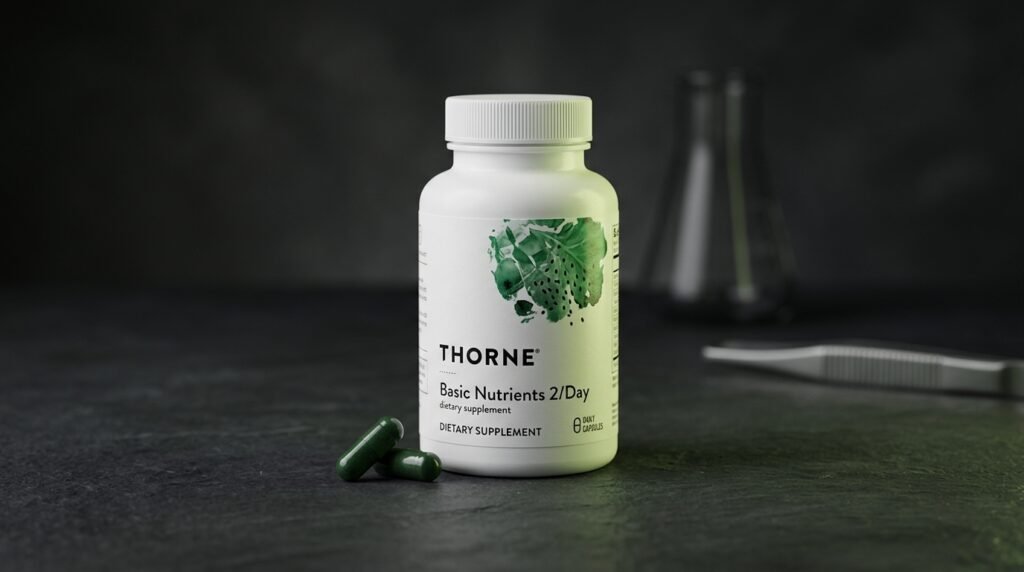
Thorne is the recommendation for most men who are serious about supplement quality and want the highest available confidence in label accuracy and manufacturing consistency. The FDA-registered facility, 11-stage testing protocol, and NSF certification at the facility level rather than product level represent a quality standard that Garden of Life’s third-party certifications don’t fully replicate.
The practical scenario where Thorne’s standard matters most: a man taking a daily supplement stack for 12+ months and wanting to know that what’s on the label matches what’s in the capsule every month, not just in the tested batch. Consistency is Thorne’s core proposition, backed by institutional partnerships — Mayo Clinic, US Olympic committees — that require demonstrated quality rather than just claimed quality.
Pros: FDA-registered manufacturing facility, NSF certification facility-wide, 11-stage batch testing, institutional quality credibility, optimal synthetic nutrient forms, clean labels without unnecessary additives. Cons: 10-20% more expensive than Garden of Life, synthetic nutrient forms rather than food-matrix delivery, smaller organic/non-GMO product selection, less accessible in retail stores.
Head-to-Head: Garden of Life
Garden of Life Vitamin Code Men (~$30/month — Best for Organic Whole-Food Priority)
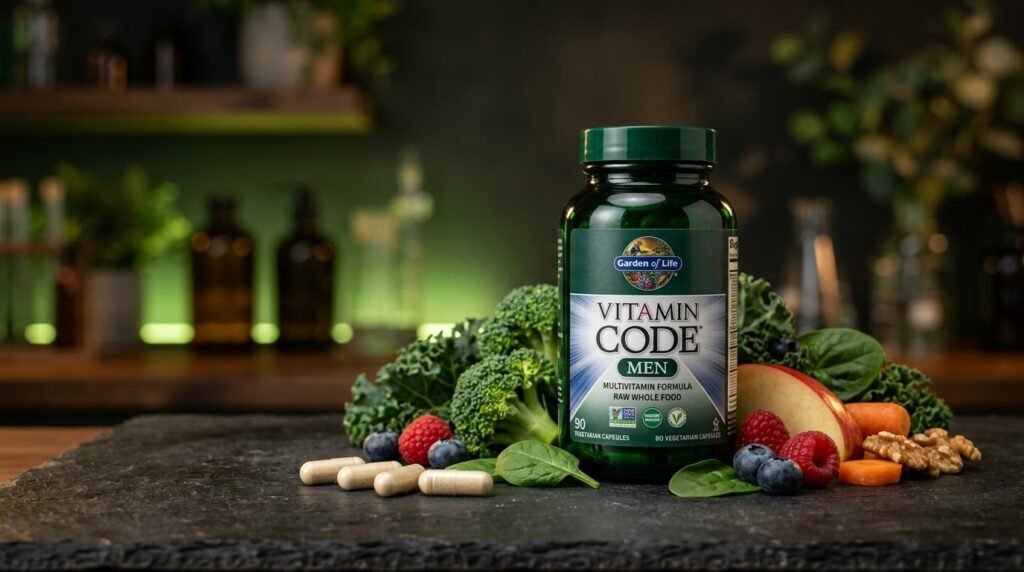
Garden of Life is the recommendation for men who prioritize whole-food sourcing, certified organic ingredients, and a clean label philosophy that avoids synthetic nutrient forms entirely. The NSF Certified for Sport verification on the SPORT line — including the Garden of Life Sport Organic Protein — provides the banned substance testing assurance that competitive athletes need.
What most reviews won’t tell you is that Garden of Life’s whole-food sourcing philosophy creates a genuine tradeoff: whole-food nutrient concentrations vary batch to batch depending on ingredient quality and harvest conditions in ways that synthetic pharmaceutical-grade nutrients don’t. Garden of Life’s testing addresses this, but the inherent variability of natural sourcing creates a different confidence profile than Thorne’s controlled manufacturing.
Pros: USDA Organic across most of the line, NSF Certified for Sport on SPORT products, non-GMO Project Verified, whole-food nutrient sourcing, Certified B Corporation, generally 10-20% less expensive. Cons: Whole-food sourcing creates batch-to-batch variability, higher daily capsule counts on vitamins, NSF Sport certification doesn’t apply to full supplement catalog, lower elemental mineral doses per serving.
What to Look for When Choosing Between Thorne and Garden of Life
1. Prioritize testing standard over organic certification for therapeutic supplements For supplements where dose precision matters — magnesium for sleep, creatine for performance, B12 for energy — Thorne’s pharmaceutical manufacturing certainty is more important than Garden of Life’s organic sourcing. For general multivitamins where dose precision is less critical, Garden of Life’s whole-food approach is a legitimate alternative.
2. NSF Certified for Sport if competitive athletics apply If you’re subject to drug testing in any sport, NSF Certified for Sport from Thorne’s facility-wide certification provides stronger protection than Garden of Life’s product-specific certifications on their non-SPORT line. Garden of Life SPORT products carry equivalent NSF protection on that specific line.
3. Capsule count tolerance Thorne consistently delivers higher nutrient concentrations per capsule — 2 capsules per day for their multivitamin versus 4 for Garden of Life’s equivalent. Lower capsule counts improve compliance for men who struggle with daily supplement habits.
4. Synthetic versus whole-food form preference This is genuinely a values decision as much as a science decision. The bioavailability research doesn’t strongly favor one approach across all nutrients. Men who prefer avoiding synthetic forms will be better served by Garden of Life. Men who want the most precisely characterized forms available will prefer Thorne.
5. Budget across a full stack The 10-20% premium across an entire Thorne stack — multivitamin, magnesium, fish oil, B complex, creatine — adds up to $15-25 per month more than the equivalent Garden of Life stack. Over a year that’s $180-300 in additional spending. Whether the manufacturing certainty is worth that annual premium depends on your risk tolerance.
FAQ
Is Thorne better than Garden of Life for quality?
Thorne’s manufacturing quality — FDA-registered facility, 11-stage testing, facility-wide NSF certification — represents a higher standard of manufacturing certainty than Garden of Life’s third-party certifications on individual products. For men who prioritize label accuracy and batch consistency above all else, Thorne is the better choice. Garden of Life’s quality is genuinely good — it’s built on a different model with different tradeoffs.
Does Garden of Life’s whole-food sourcing actually improve absorption?
For some nutrients, yes — the food matrix can improve mineral absorption by providing co-factors that aid uptake. For others, particularly B vitamins in their methylated forms, high-quality synthetic versions from Thorne absorb comparably to food-derived versions. The whole-food advantage is most meaningful for men with digestive issues who absorb isolated synthetic nutrients poorly.
Which brand is better for men over 40?
Both brands offer products formulated for men over 40 and 50 with adjusted nutrient doses. For men over 40 where B12 absorption specifically declines with age, Thorne’s methylcobalamin at pharmaceutical-grade potency provides stronger assurance of effective delivery than whole-food sourced B12 at inherently variable concentrations. Thorne’s B-Complex #12 is specifically formulated with both active B12 forms for this reason.
Can I mix products from both brands?
Yes, and it’s often the most practical approach. Using Thorne for the nutrients where dose precision matters most — magnesium, creatine, B12 — and Garden of Life for categories where organic sourcing is your priority — multivitamin, protein — lets you capture the best of both brands without committing exclusively to either.
Our Final Verdict
For most men, Thorne Basic Nutrients 2/Day and the broader Thorne lineup wins on the factors that matter most — manufacturing certainty, label accuracy, and optimal bioavailable nutrient forms backed by the most rigorous testing infrastructure in the consumer supplement market. The 10-20% price premium is justified for men who take their supplement stack seriously. Garden of Life Vitamin Code Men earns its place for men who prioritize organic whole-food sourcing, and Garden of Life Sport Organic Protein is the best certified plant protein available for men avoiding whey.
The practical approach: use Thorne for therapeutic supplements where dose precision matters, and consider Garden of Life for general nutrition products where organic sourcing aligns with your values. Check current pricing on Amazon for both brands across their full product lines.