

This article contains affiliate links. We may earn a commission if you buy through our links, at no extra cost to you.
Best Multivitamin for Men Over 30 in 2026
Most men in their 30s take a multivitamin out of habit rather than strategy — grabbing whatever’s cheapest at the pharmacy without checking whether it addresses what actually changes in male physiology after 30. The best multivitamin for men over 30 isn’t about covering every possible nutrient at trace amounts; it’s about delivering meaningful doses of the specific vitamins and minerals that decline or become more critical during this decade — vitamin D, magnesium, B12, and zinc chief among them. After researching the formulations that actually matter for men in this age range and comparing what’s on the market in 2026, here is what’s worth your money.
This guide is for men in their 30s and 40s who want a multivitamin that functions as a genuine nutritional foundation — not a placebo in pill form.
Quick Answer: Thorne Basic Nutrients 2/Day is the best multivitamin for men over 30 — NSF Certified for Sport, methylated B vitamins, and meaningful doses of vitamin D and magnesium without the mega-dosing gimmicks common in the category. Garden of Life Vitamin Code Men is the best whole-food option for men who prioritize raw ingredient sourcing. Pure Encapsulations Men’s Nutrients is the best choice for men specifically wanting added prostate support as they approach 40.
Why Multivitamin Needs Change After 30

The standard multivitamin formula hasn’t changed much since the 1990s — but male physiology in your 30s has specific nutritional pressure points that a generic one-size-fits-all formula doesn’t address.
Vitamin D deficiency affects approximately 42% of American adults, and the risk increases with age, indoor work, and higher body weight — all factors that become more common through the 30s. Vitamin D supports testosterone production, immune function, and bone density. Most basic multivitamins include 400-600 IU — well below the 1000-2000 IU that addresses deficiency in most men.
Magnesium is involved in over 300 enzymatic reactions, and approximately 50% of men consume below the 420mg RDA. Most multivitamins include 50-100mg — a fraction of what’s needed for the sleep, muscle, and hormonal benefits magnesium provides. This isn’t a formulation oversight; magnesium at full dose takes up too much capsule volume for a typical one-a-day multivitamin to include alongside everything else.
B12 and methylation become more relevant as digestive efficiency gradually decreases with age, and a significant percentage of the population has genetic variants (MTHFR) that impair conversion of standard folic acid and cyanocobalamin to their active forms. Methylated B vitamins — methylcobalamin, L-5-MTHF — bypass this conversion step entirely.
Zinc supports testosterone production and immune function, with requirements that don’t decrease with age but that dietary intake often fails to meet, particularly for men eating less red meat and shellfish than in their 20s.
The counterintuitive point: a multivitamin with fewer ingredients at meaningful doses outperforms one with 40+ ingredients at trace amounts. “Kitchen sink” formulas with mega-dose vitamin lists often include nutrients at doses too low to matter while padding the label for marketing purposes. For men over 30, the question isn’t “does it have everything” — it’s “does it have enough of what actually matters.”
For men wanting the complete priority framework for supplementation in this decade, see our guide on best supplements for men in their 30s — a multivitamin is the foundation layer, not the complete picture.
What a Quality Multivitamin Should Actually Contain
Understanding what to look for on the supplement facts panel separates a multivitamin that does something from one that exists primarily for peace of mind.
Vitamin D3 at 1000-2000 IU is the range that meaningfully moves blood levels for most men without requiring a separate D3 supplement. D3 (cholecalciferol) is the form your body produces naturally from sunlight and is 87% more potent than D2 (ergocalciferol), which some budget multivitamins still use.
Methylated B-complex — methylcobalamin (B12), L-5-MTHF (folate), and pyridoxal-5-phosphate (B6) — ensures absorption regardless of individual genetic variation in folate metabolism. Standard cyanocobalamin and folic acid require enzymatic conversion that a meaningful percentage of men perform inefficiently.
Zinc at 11-15mg matches the RDA without excessive dosing that can interfere with copper absorption — a genuine concern with high-dose zinc-only supplements but less relevant at multivitamin-level doses, provided copper is also included.
Magnesium at whatever dose fits — even 50-100mg from a multivitamin contributes meaningfully toward the 420mg daily target when combined with diet and a dedicated magnesium supplement for sleep, which most men over 30 benefit from regardless.
What to actively avoid: iron in a men’s multivitamin, unless a doctor has diagnosed iron deficiency. Men rarely need supplemental iron, and excess iron accumulation is associated with oxidative stress and cardiovascular risk in men specifically. A men’s-formulated multivitamin should be iron-free or contain minimal iron — this is one of the clearest differentiators between a generic multivitamin and one actually formulated for men.
The 3 Best Multivitamins for Men Over 30 in 2026
1. Thorne Basic Nutrients 2/Day — Best Overall (~$30–35 / 60 servings)
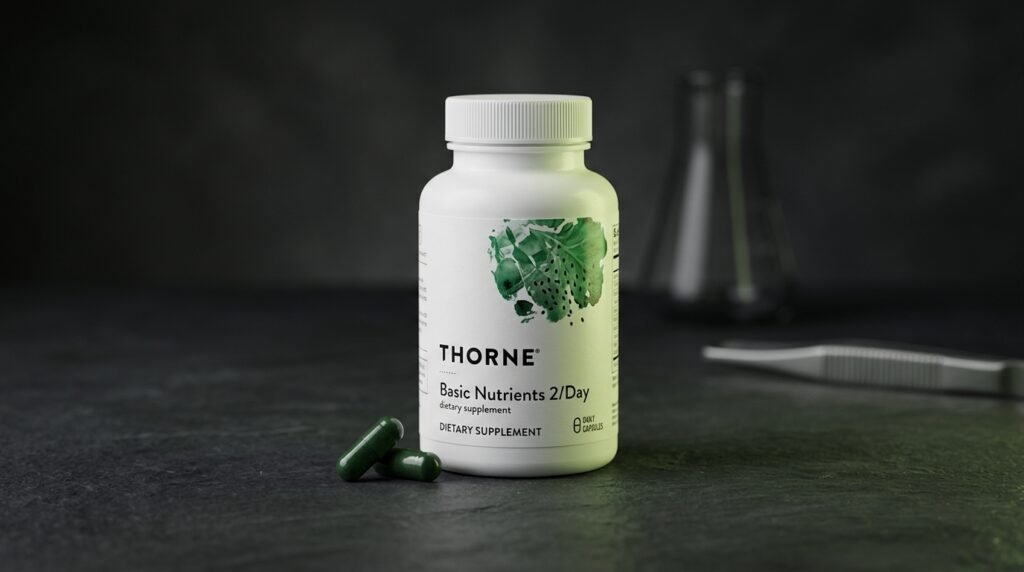
Thorne Basic Nutrients 2/Day is the multivitamin built on the principle this guide has been making — meaningful doses of what matters rather than trace amounts of everything. NSF Certified for Sport, iron-free, methylated B vitamins throughout (methylcobalamin, L-5-MTHF, P5P), 1000 IU vitamin D3, and zinc at 15mg with appropriate copper ratio.
Two capsules daily — split morning and evening or both at once — delivers a foundation that doesn’t require a separate B-complex or basic vitamin D supplement for most men. The pharmaceutical manufacturing standard means batch-to-batch consistency that budget brands don’t guarantee. A man in his late 30s with a demanding job who wants one supplement that covers foundational bases without building a 6-pill daily stack finds Basic Nutrients 2/Day does the job at $0.50-0.58 per day.
What most reviews won’t tell you is that Thorne deliberately left some nutrients at lower doses specifically because they’re better addressed by dedicated supplements — magnesium and omega-3 aren’t crammed in at trace amounts that wouldn’t matter anyway. This is a design choice, not an oversight.
Pros: NSF certified, iron-free, fully methylated B-complex, meaningful vitamin D and zinc doses, pharmaceutical manufacturing, two-capsule flexibility. Cons: Two capsules required daily (not true one-a-day), capsule size noticeable for some users, doesn’t include magnesium at meaningful dose — requires separate supplement.
2. Garden of Life Vitamin Code Men — Best Whole-Food Option (~$35–40 / 120 capsules)
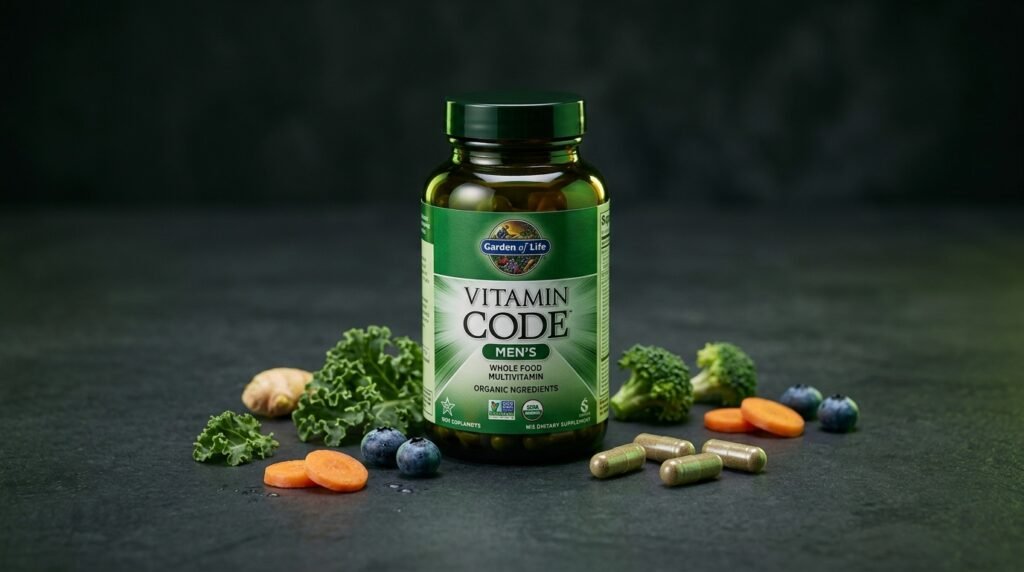
Garden of Life Vitamin Code Men takes a different formulation approach — nutrients delivered through a raw whole-food matrix rather than isolated synthetic compounds. Certified organic, non-GMO, vegetarian capsules, and includes a men’s-specific blend with saw palmetto and lycopene for prostate support alongside the core multivitamin nutrients. Probiotics and enzymes are included in the formula — a feature unique to this product among the three reviewed here.
The whole-food delivery means nutrients arrive bound to the cofactors and enzymes naturally present in food sources — some research suggests this improves absorption versus isolated synthetic vitamins, though the evidence is less robust than the case for methylated B vitamins specifically.
A man who prioritizes “food-first” nutrition philosophy and wants his supplement to align with that approach — even if it costs slightly more per serving — chooses Vitamin Code Men specifically for the whole-food sourcing and added digestive support that the other two options don’t include.
Pros: Whole-food nutrient matrix, certified organic and non-GMO, includes probiotics and enzymes, men’s-specific blend with saw palmetto, vegetarian capsules. Cons: Larger capsule size due to whole-food matrix, requires 4 capsules daily for full dose, not NSF certified, higher cost per serving than Thorne.
3. Pure Encapsulations Men’s Nutrients — Best for Prostate Support (~$40–45 / 180 capsules)
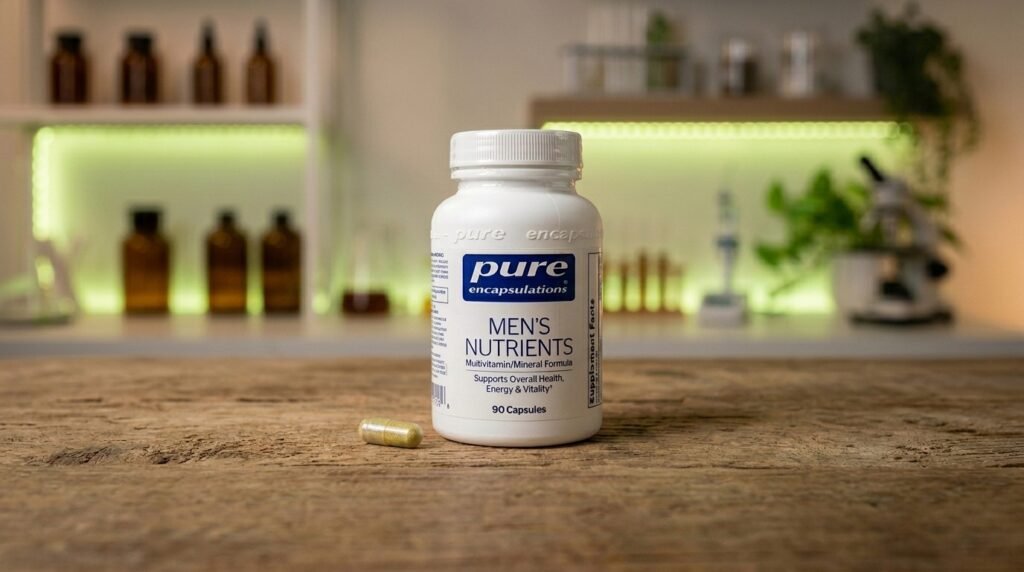
Pure Encapsulations Men’s Nutrients is formulated specifically with men over 40 in mind — but for men in their late 30s who want to proactively address prostate health before it becomes a clinical concern, starting earlier makes sense. The formula includes saw palmetto and pygeum for prostate support, lycopene and green tea extract for cellular health, alongside core multivitamin nutrients in highly bioavailable forms. Gluten-free, non-GMO, and manufactured to Pure Encapsulations’ hypoallergenic standard — free from common allergens and unnecessary fillers.
At 180 capsules per bottle with a 1-2 capsule daily dose, it’s a 90-180 day supply depending on dosing — among the most economical per-day options when the prostate support ingredients are factored into the value comparison against buying saw palmetto separately.
A man in his late 30s whose father had prostate issues and wants to start incorporating prostate-supportive ingredients into his daily routine before age 40 — rather than waiting for a doctor’s recommendation — is the specific profile this product serves best.
Pros: Includes saw palmetto and pygeum for prostate support, hypoallergenic formulation, gluten-free and non-GMO, 180-capsule supply offers excellent value, highly bioavailable nutrient forms. Cons: Formulated primarily for men over 40 — some men in early 30s may not need prostate-specific ingredients yet, not NSF certified, less widely available than Thorne or Garden of Life.
Comparison Table
| Product | Price/Month | Key Differentiator | Best For | Rating |
|---|---|---|---|---|
| Thorne Basic Nutrients 2/Day | ~$15–17 | Methylated B’s + NSF certified | Best overall foundation | 9.5/10 |
| Garden of Life Vitamin Code Men | ~$18–20 | Whole-food matrix + probiotics | Food-first philosophy | 8.5/10 |
| Pure Encapsulations Men’s Nutrients | ~$13–15 | Saw palmetto + prostate support | Proactive prostate health | 8.5/10 |
What to Look for When Choosing a Multivitamin for Men Over 30
1. Iron-free formulation Unless a doctor has diagnosed iron deficiency through bloodwork, a men’s multivitamin should contain little to no iron. Excess iron accumulates in men over time and is associated with oxidative stress markers. This is one of the simplest checks — look at the supplement facts panel and confirm iron is absent or minimal. All three products in this guide are formulated with this in mind.
2. Methylated B vitamins Check for “methylcobalamin” (not cyanocobalamin) and “L-5-MTHF” or “Metafolin” (not folic acid). These active forms bypass the conversion step that a meaningful percentage of men perform inefficiently due to genetic variation, ensuring the B vitamins are actually usable rather than just present on the label.
3. Vitamin D3 at 1000 IU or higher D3 (cholecalciferol), not D2 (ergocalciferol). At 1000-2000 IU, a multivitamin meaningfully contributes toward correcting the deficiency that affects approximately 42% of American adults. Below 600 IU, the contribution is nutritionally minor — closer to a label requirement than a functional dose.
4. Third-party certification for daily long-term use A multivitamin taken daily for years benefits from NSF Certified for Sport or equivalent independent verification of label accuracy and absence of contaminants. Thorne’s NSF certification provides this; the other options rely on manufacturer quality processes without the same independent verification layer.
5. Realistic expectations about what a multivitamin does and doesn’t do A quality multivitamin fills nutritional gaps — it doesn’t replace a magnesium supplement for sleep, creatine for performance, or omega-3 for inflammation. Men who expect a multivitamin alone to address energy, sleep, or hormonal concerns will be disappointed regardless of which product they choose. Use the multivitamin as the foundation and add targeted supplements for specific goals.
FAQ
Do men over 30 actually need a multivitamin?
For men eating a varied, whole-food diet with adequate sun exposure, a multivitamin’s marginal benefit is smaller than for men with restricted diets, limited sun exposure, or known deficiencies. That said, the majority of men don’t consistently meet vitamin D, magnesium, and B12 targets through diet alone — and a quality multivitamin closes those gaps at low daily cost. It’s insurance, not a performance enhancer, but the insurance is worth having for most men in this age range.
What’s the difference between a regular multivitamin and a men’s multivitamin?
The primary differences are iron content (men’s formulas are typically iron-free or low-iron, since men rarely need supplemental iron) and the inclusion of ingredients relevant to male-specific health — saw palmetto and lycopene for prostate support, for example. A generic multivitamin formulated for general adult use often includes iron at doses appropriate for women with menstrual losses, which represents unnecessary and potentially counterproductive iron intake for most men.
Can a multivitamin replace individual supplements like vitamin D or magnesium?
Partially, depending on dose. A multivitamin with 1000-2000 IU vitamin D3 can replace a separate D3 supplement for many men, particularly those without diagnosed severe deficiency. Magnesium is different — multivitamins rarely include more than 50-100mg, far below the 300-400mg that produces sleep and muscle benefits, so a dedicated magnesium supplement remains necessary for men targeting those specific outcomes.
When should I take my multivitamin?
With a meal containing some fat, since vitamins A, D, E, and K are fat-soluble and absorb better with dietary fat present. Morning with breakfast works well for most men and helps build consistency. For multivitamins requiring multiple capsules (Garden of Life’s 4-capsule dose, Thorne’s 2-capsule dose), splitting between breakfast and dinner can improve absorption and reduce the chance of GI discomfort from taking everything at once.
Our Final Verdict
The best multivitamin for men over 30 in 2026 comes down to what you’re prioritizing beyond basic coverage. Thorne Basic Nutrients 2/Day is the right default for most men — NSF certified, iron-free, methylated B vitamins, and meaningful vitamin D and zinc doses without unnecessary padding. Garden of Life Vitamin Code Men is the right choice for men who prioritize whole-food sourcing and want probiotics included.
Pure Encapsulations Men’s Nutrients is worth considering for men approaching 40 who want to proactively add prostate-supportive ingredients now rather than later. Whatever you choose, verify it’s iron-free, contains methylated B vitamins, and delivers at least 1000 IU vitamin D3 — those three checks separate a multivitamin that does something from one that’s mostly marketing. Check current pricing on Amazon for all three options in this guide.