
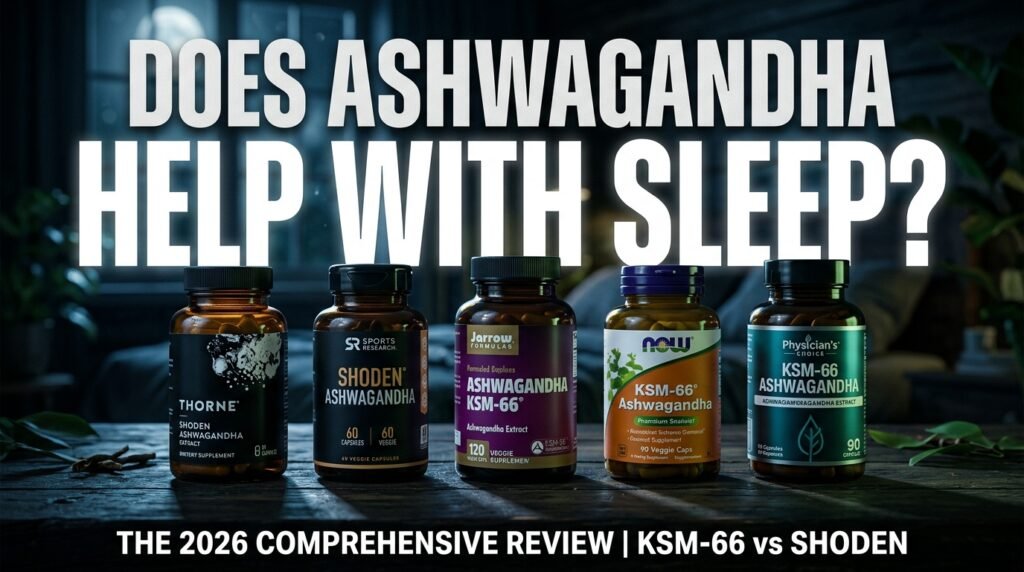
This article contains affiliate links. We may earn a commission if you buy through our links, at no extra cost to you.
Does Ashwagandha Help With Sleep in 2026?
Ashwagandha has been used in Ayurvedic medicine for thousands of years — and its Latin name, Withania somnifera, literally translates to “sleep-inducing.” That’s not coincidence. Modern clinical research has started catching up to what traditional medicine suggested centuries ago, and the evidence for ashwagandha’s sleep benefits is now strong enough to take seriously. But does ashwagandha help with sleep in the way most supplement marketing claims, or is the mechanism more nuanced than the label suggests?
After researching the clinical literature on ashwagandha and sleep, comparing extract types, and evaluating what the evidence actually supports for men specifically, here is what actually works in 2026.
This guide is for men who are curious whether ashwagandha could improve their sleep, want to understand which extract type is most effective for this purpose, and want product recommendations that match the research.
Quick Answer
Yes — ashwagandha helps with sleep, primarily by reducing cortisol and activating GABA pathways that support nervous system calm. The effect is strongest in men whose sleep problems are driven by stress and elevated cortisol rather than circadian disruption. Thorne Ashwagandha (Shoden) is the best option for sleep specifically — the Shoden extract’s higher glycowithanolide content targets the calming mechanism more directly than KSM-66. Most men notice improved sleep onset within 2-3 weeks of consistent evening use.
How Ashwagandha Actually Improves Sleep — The Mechanism
Understanding why ashwagandha helps with sleep changes how you evaluate whether it’s the right tool for your specific situation.
Ashwagandha’s sleep benefits operate primarily through two pathways. The first is cortisol reduction. Cortisol — the primary stress hormone — operates in opposition to sleep. It’s meant to keep you alert and responsive, and when it’s chronically elevated from work stress, high training loads, or poor recovery, it directly suppresses melatonin production and prevents the nervous system from downshifting into the parasympathetic state needed for sleep. Ashwagandha’s withanolides regulate the hypothalamic-pituitary-adrenal (HPA) axis — the cortisol production system — reducing the chronic overactivation that keeps many men awake despite physical exhaustion.
The second pathway is triethylene glycol and GABA modulation. Research published in PLOS ONE in 2017 identified triethylene glycol — a compound in ashwagandha leaves — as the primary sleep-inducing active compound, distinct from the withanolides responsible for stress and testosterone effects. This compound promotes GABA receptor activity, the same inhibitory neurotransmitter pathway that sleep medications target.
The counterintuitive implication: ashwagandha is not a sedative. It doesn’t make you feel immediately drowsy the way melatonin or antihistamines do. It works by systematically lowering the cortisol and neural activation that prevents sleep — producing a calmer baseline that makes falling asleep and staying asleep easier over time, not an acute knock-out effect on night one.
Real-world scenario: a 34-year-old professional who lies awake running through work scenarios at 11pm isn’t struggling with circadian timing — he’s struggling with elevated cortisol that his brain can’t shut off. Melatonin doesn’t fix that. Ashwagandha, consistently taken over 3-4 weeks, reduces the cortisol load that’s driving the mental activation.
For a complete comparison of all evidence-based sleep supplements and how ashwagandha fits into the broader stack, see our guide on the best supplements for sleep for men — ashwagandha works best as part of a targeted approach rather than in isolation.
What the Research Actually Shows
The clinical evidence for ashwagandha and sleep has grown meaningfully in the last five years. Here’s what the strongest studies actually demonstrate.
A 2020 randomized, double-blind, placebo-controlled study published in PLOS ONE found that adults taking 120mg of ashwagandha (Shoden extract) daily for 6 weeks showed significant improvements in sleep quality scores, sleep onset latency, sleep efficiency, and morning alertness compared to placebo. This is the study most often cited in ashwagandha sleep marketing — and it’s legitimate.
A 2019 study in Medicine found that 300mg of KSM-66 ashwagandha twice daily for 10 weeks produced significant improvements in sleep quality and mental alertness on waking, alongside the cortisol reduction effect. The sleep improvement was measured using validated questionnaires (PSQI — Pittsburgh Sleep Quality Index) rather than self-report alone.
What the research shows consistently: ashwagandha improves sleep quality rather than sleep quantity — meaning men sleep more deeply and wake feeling more rested without necessarily sleeping more hours. This is the profile consistent with cortisol reduction and GABA pathway support.
What the research doesn’t show: ashwagandha doesn’t meaningfully reduce sleep onset latency in men with circadian rhythm disruption (jet lag, shift work) — that’s melatonin’s territory. The mechanism is wrong for that application.
KSM-66 vs Shoden for Sleep — Which Extract Is Better
This is the most practically important question for men choosing an ashwagandha supplement specifically for sleep — and most articles get it wrong by treating all ashwagandha extracts as equivalent.
KSM-66 is a root-only extract standardized to 5% withanolides. It’s the most researched ashwagandha extract overall — over 24 published human clinical trials — and its effects on cortisol reduction, testosterone, and cognitive function are well-documented. For men whose sleep problems are stress-driven and who also want the testosterone and cognitive benefits of ashwagandha, KSM-66 is the most evidence-backed option.
Shoden is a root-and-leaf extract standardized to 35% withanolides — seven times the withanolide concentration of KSM-66 at equivalent capsule weight. The leaf fraction contributes higher glycowithanolide content, which is specifically associated with the calming and sleep-promoting effects. The PLOS ONE sleep study used Shoden. For men prioritizing sleep quality specifically over testosterone or cognitive effects, Shoden is more targeted.
Sensoril is a root-and-leaf extract standardized to 10% withanolides, positioned between KSM-66 and Shoden. Its withanolide profile is more heavily weighted toward calming glycowithanolides than KSM-66, making it more sleep-oriented than KSM-66 but less targeted than Shoden.
In our experience, the extract distinction matters practically. Men who’ve tried KSM-66 and noticed more energy and stress resilience than sleep improvement are experiencing the correct KSM-66 effect profile — they’d benefit from switching to a Shoden-based product for sleep specifically.
When Ashwagandha Helps Sleep — And When It Doesn’t
Ashwagandha’s sleep benefit is mechanism-specific. Getting this match right determines whether it produces noticeable results for you.
Ashwagandha is most effective for sleep when:
Your sleep difficulty is stress-driven — lying awake with a racing mind, cortisol-driven 3am waking, inability to wind down after demanding workdays. The cortisol-reducing mechanism directly addresses the underlying cause.
You’re in a high-demand period — work pressure, training overload, significant life stress. These situations chronically elevate cortisol, and ashwagandha’s adaptogenic cortisol regulation produces the most measurable sleep benefit in these populations.
You’ve already addressed sleep hygiene basics — consistent bedtime, dark room, limited evening screens. Ashwagandha amplifies a good sleep foundation; it doesn’t substitute for one.
Ashwagandha is less effective for sleep when:
Your sleep problem is circadian — you can’t fall asleep before 1-2am regardless of stress levels. This is delayed sleep phase and requires melatonin or light therapy for correction.
Your insomnia is medication-related or tied to a specific medical condition. Ashwagandha’s adaptogenic mechanism doesn’t override pharmacological or pathological causes of insomnia.
You have low baseline cortisol — men with already-normal or low cortisol see less sleep benefit from ashwagandha’s cortisol-reducing effect because there’s less excess cortisol to reduce.
The 5 Best Ashwagandha Supplements for Sleep in 2026
1. Thorne Ashwagandha (Shoden) — Best Overall for Sleep (~$30-35/30 caps)
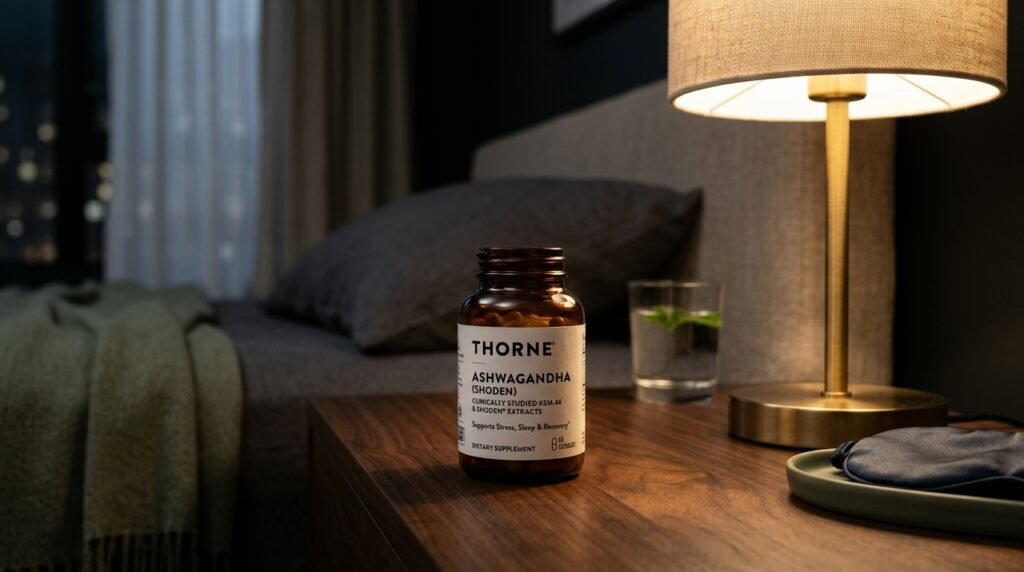
Thorne Ashwagandha uses the Shoden extract — the same extract used in the most-cited human clinical trial on ashwagandha and sleep — at 120mg per capsule, standardized to 35% withanolides. NSF Certified, manufactured to Thorne’s four-round testing protocol, and the brand most recommended by healthcare practitioners in the US.
The Shoden extract’s higher glycowithanolide content means the calming, sleep-promoting mechanism is more directly targeted than KSM-66 at equivalent withanolide activity. One capsule daily, taken in the evening with food. Most men notice improved sleep depth and easier winding-down within 2-3 weeks.
Real-world detail: at 120mg Shoden per capsule, you’re getting approximately the same withanolide activity as 840mg of KSM-66 at 5% standardization — a substantially higher concentration than most ashwagandha products.
Pros: Shoden extract used in sleep RCT, NSF Certified for Sport, Thorne’s four-round testing, 35% withanolides, highest withanolide activity per capsule, practitioner-recommended. Cons: 30 caps = 30-day supply, highest price per bottle on this list, less total research volume than KSM-66 extract.
2. Sports Research Shoden Ashwagandha — Best Value Shoden Option (~$25-30/120 softgels)
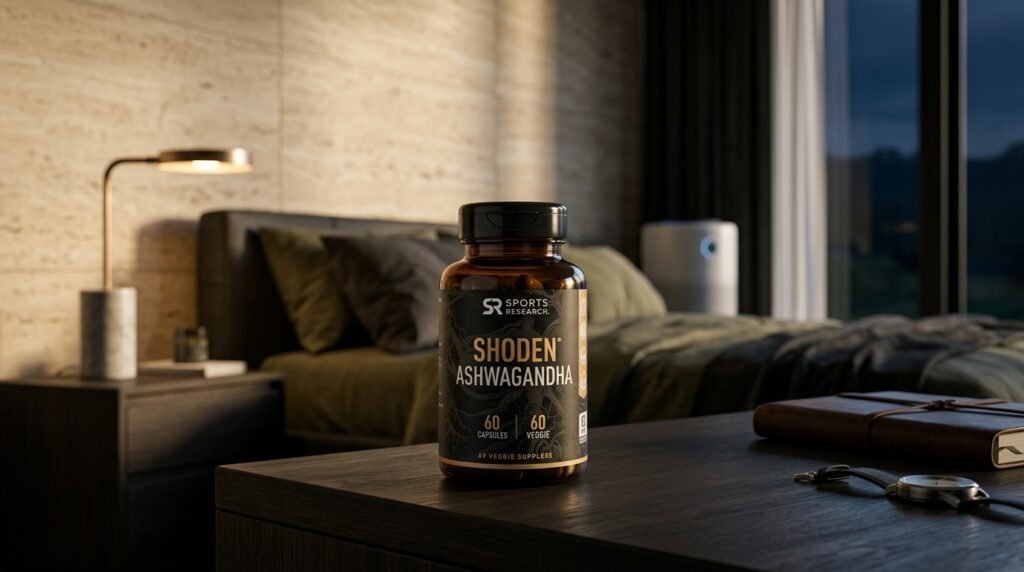
Sports Research Shoden Ashwagandha uses the same Shoden extract as Thorne at 120mg per serving, enhanced with coconut MCT oil and sunflower lecithin for improved absorption — a meaningful formulation detail given that ashwagandha’s active compounds are fat-soluble. The softgel format with MCT oil improves bioavailability over standard capsules at equivalent doses.
At 120 softgels per bottle with 2 softgels per serving, it provides 60 servings — double the supply of Thorne at a lower price per serving. Non-GMO Project Verified, third-party tested, manufactured in cGMP-certified US facilities.
Real-world detail: the coconut MCT oil enhancement is not marketing — fat-soluble compounds including withanolides absorb significantly better with a fat carrier, making the Sports Research formulation more bioavailable than the same Shoden dose in a dry capsule.
Pros: Shoden 35% withanolides, MCT oil and lecithin for enhanced absorption, 60 servings per bottle, Non-GMO Verified, third-party tested, cGMP manufactured, best value Shoden on this list. Cons: 2 softgels per serving requires remembering a two-capsule dose, slightly larger softgels than standard capsules, not NSF Certified for Sport.
3. Jarrow Formulas KSM-66 — Best for Stress-Driven Sleep Problems (~$18-22/60 caps)
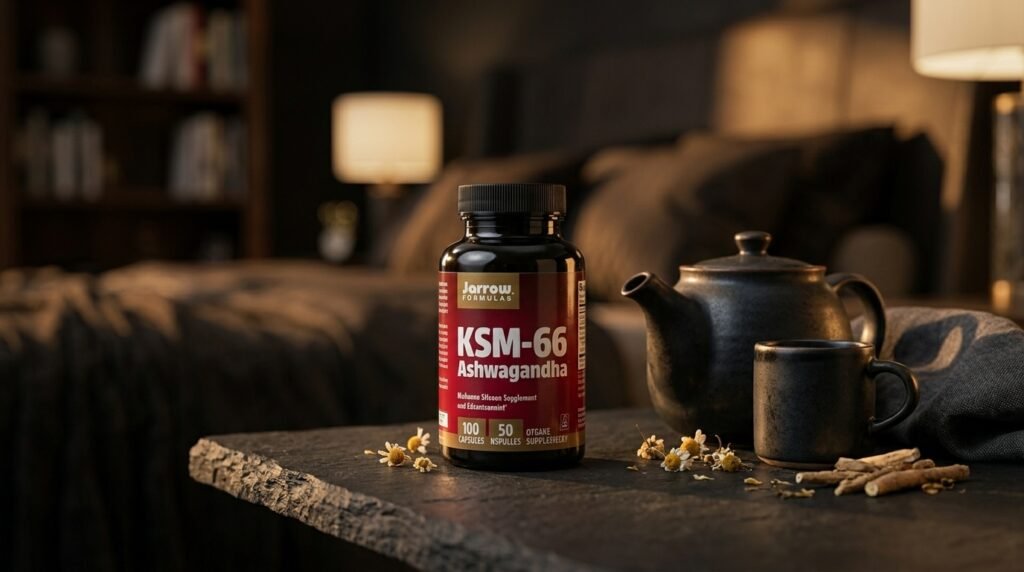
Jarrow Formulas KSM-66 is the most affordable entry into evidence-backed ashwagandha supplementation — 300mg KSM-66 per capsule, taken twice daily for 600mg total, matching the dose used in the KSM-66 sleep quality study. Non-GMO, vegan, and manufactured in a GMP-compliant facility.
For men whose sleep problems are clearly cortisol-driven — high-demand work periods, overtraining, significant life stress — KSM-66 at 600mg daily addresses the root cause effectively. The cortisol reduction mechanism is the same as Shoden; the glycowithanolide sleep-specific pathway is less targeted. For men who want both testosterone support and sleep improvement from one supplement, KSM-66 covers both more completely than Shoden.
Pros: 600mg clinical dose at twice daily, non-GMO, vegan, 60-day supply per bottle, best price on this list, multiple RCTs at this dose, testosterone and sleep benefits combined. Cons: KSM-66 less targeted for sleep than Shoden, requires two-capsule daily protocol for clinical dose, not NSF certified.
4. NOW Supplements KSM-66 Stress and Sleep — Best Single-Capsule Convenience (~$20-25/90 caps)
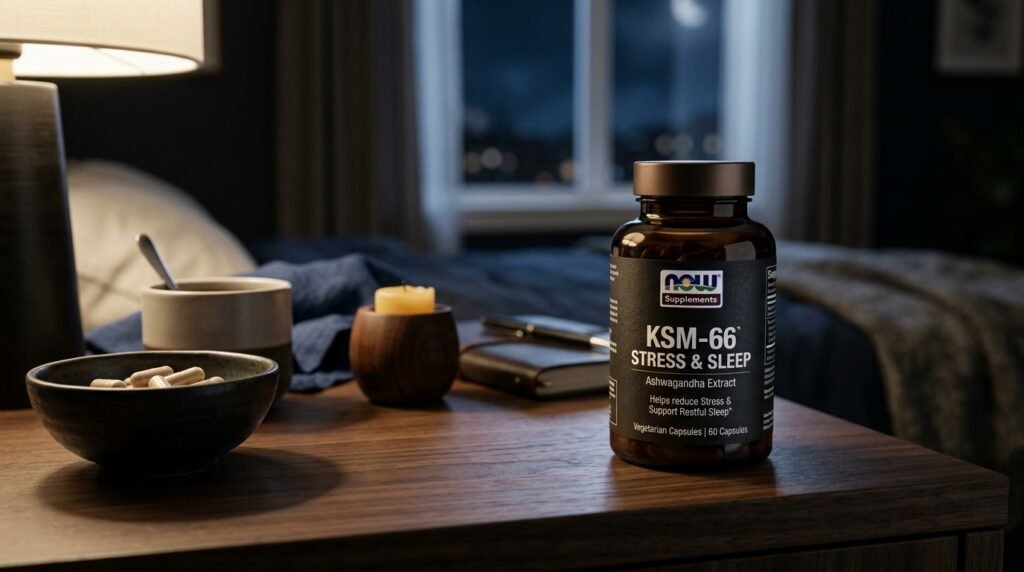
NOW Supplements KSM-66 Stress and Sleep delivers 600mg of KSM-66 in a single capsule — the full clinical dose in one daily capsule, specifically positioned for both stress and sleep support. NOW is one of the most established supplement brands in the US, with consistent GMP manufacturing and third-party testing standards across their product line.
The single-capsule clinical dose is the practical differentiator — Jarrow requires two capsules for 600mg, while NOW delivers the full amount in one. For men who struggle with supplement compliance, fewer capsules per day produces better consistency, and consistency is what produces results with ashwagandha’s cumulative mechanism.
Real-world detail: 90 capsules at one daily = 90-day supply at $20-25 — the best supply-to-cost ratio for a clinical-dose KSM-66 on this list.
Pros: 600mg KSM-66 in single capsule, 90-day supply per bottle, best supply-to-cost ratio, NOW brand consistency, specifically formulated for sleep and stress, GMP certified. Cons: Not NSF Certified for Sport, KSM-66 less sleep-targeted than Shoden, established brand but less premium positioning than Thorne.
5. Physician’s Choice KSM-66 — Best High-Dose with Absorption (~$25-30/60 caps)
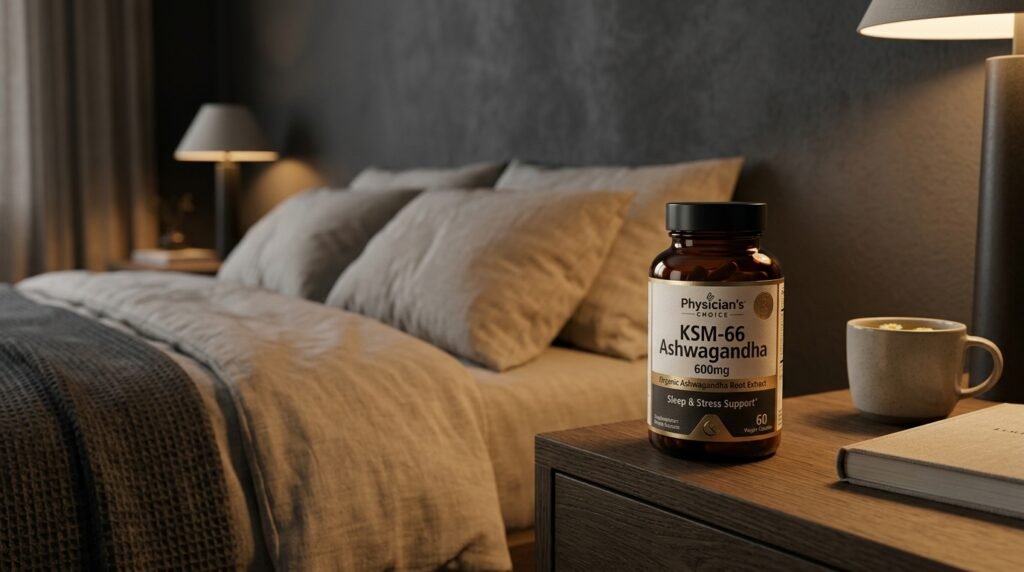
Physician’s Choice KSM-66 delivers 1,000mg of organic KSM-66 per serving with black pepper extract (BioPerine) for enhanced absorption — the highest dose on this list and the only one to include an absorption enhancer alongside the ashwagandha. For men whose previous KSM-66 experience at 300-600mg produced minimal sleep improvement, the higher dose with improved bioavailability is the logical next step before switching to a Shoden product.
At 1,000mg per serving, it exceeds the doses used in most published sleep studies, but some men with higher cortisol burdens or faster ashwagandha metabolism may respond better at higher doses. The BioPerine inclusion (standardized black pepper extract at 95% piperine) improves absorption of fat-soluble compounds including withanolides.
Pros: Highest dose on this list at 1,000mg, BioPerine for improved absorption, organic certified, vegan, 5% withanolides standardized, widely available. Cons: Two capsules per serving, 60 caps = 30-day supply at full dose, no NSF certification, overkill for men who haven’t first tried standard 600mg dosing.
Comparison Table
| Product | Extract | Dose | Price/Month | Best For | Rating |
|---|---|---|---|---|---|
| Thorne Ashwagandha | Shoden 35% | 120mg | ~$32 | Best sleep-specific extract | 9.5/10 |
| Sports Research Shoden | Shoden 35% | 120mg | ~$15 | Best value Shoden with MCT | 9/10 |
| Jarrow KSM-66 | KSM-66 5% | 600mg | ~$18 | Best for stress + sleep + T | 8.5/10 |
| NOW KSM-66 Sleep | KSM-66 5% | 600mg | ~$8 | Best convenience + value | 8.5/10 |
| Physician’s Choice KSM-66 | KSM-66 5% | 1,000mg | ~$28 | Best high-dose option | 8/10 |
What to Look for When Choosing Ashwagandha for Sleep
1. Extract type matched to your sleep goal Shoden for sleep quality specifically — higher glycowithanolide content targets the calming GABA pathway more directly. KSM-66 for combined stress, cortisol, testosterone, and sleep benefits with the most published research. Sensoril as a middle-ground option. Never buy unbranded “ashwagandha root powder” without standardization data — the withanolide content is unknown and clinical results are unpredictable.
2. Evening dosing for sleep optimization Timing matters for ashwagandha’s sleep benefit. Taking ashwagandha in the evening — 60-90 minutes before bed, with a fat-containing meal — maximizes the calming effect during the transition to sleep. Morning dosing optimizes for daytime stress resilience but produces less direct sleep onset benefit. Men using ashwagandha specifically for sleep should default to evening timing.
3. Consistent use for at least 3-4 weeks before evaluating Ashwagandha’s sleep mechanism works through cumulative cortisol reduction, not acute sedation. Most men notice the first changes at 10-14 days — reduced end-of-day tension, easier mental shutdown. Full sleep quality improvement typically requires 3-4 weeks of consistent daily use. Evaluating at day 5 and concluding it doesn’t work is the most common reason men miss the benefit.
4. Fat-soluble absorption consideration Ashwagandha’s active compounds are fat-soluble — taking it with a fat-containing meal or a fat-enhanced formula (Sports Research MCT oil softgels) meaningfully improves absorption compared to taking it with water alone on an empty stomach. This is the practical detail most supplement instructions omit.
5. Safety considerations for specific populations Men with thyroid conditions should consult a physician before use — ashwagandha may influence thyroid hormone levels. Men on sedative medications should avoid combining with ashwagandha without medical guidance. Pregnant women should avoid use entirely. For healthy adult men without these contraindications, ashwagandha at clinical doses is well-tolerated in most published trials.
FAQ
How long does ashwagandha take to improve sleep?
Most men notice the first changes within 10-14 days of consistent daily use — typically reduced end-of-day mental tension and easier mental shutdown at bedtime. Meaningful improvement in sleep quality scores typically requires 3-6 weeks, matching the timelines in published clinical trials. Men who evaluate at 5-7 days and conclude it isn’t working are cutting the protocol short before the cumulative cortisol-reducing effect has had time to build.
Should I take ashwagandha in the morning or at night for sleep?
Evening, taken 60-90 minutes before bed with a fat-containing meal or snack. This timing aligns the cortisol-reducing and GABA-modulating effects with the transition to sleep. Morning dosing is more appropriate for men using ashwagandha primarily for daytime stress resilience and cognitive clarity rather than sleep. Men who want both effects can split the dose — half in the morning, half in the evening.
Can I take ashwagandha with magnesium glycinate for sleep?
Yes — these two supplements have complementary and non-overlapping mechanisms. Magnesium glycinate activates GABA receptors and lowers core body temperature for sleep onset. Ashwagandha reduces cortisol and supports the HPA axis for deeper sleep and fewer cortisol-driven night wakings. Together they address the two most common physiological drivers of poor sleep in men. This is one of the most consistently recommended sleep supplement combinations by functional medicine practitioners for stress-driven insomnia.
Does ashwagandha cause drowsiness the next morning?
No — this is one of the clearest differences between ashwagandha and sedative sleep aids. Ashwagandha improves sleep quality by reducing cortisol and activating calming neurotransmitter pathways, not by forcing sedation. The studies that document improved sleep quality consistently show improved morning alertness as an additional outcome — men wake feeling more rested, not groggy. This is the mechanism-based difference between a cortisol-reducing adaptogen and a sedative supplement.
Our Final Verdict
Ashwagandha helps with sleep — specifically for men whose sleep problems are driven by elevated cortisol, chronic stress, and an overactive nervous system that won’t shut off at night. Thorne Ashwagandha Shoden is the best option for sleep quality specifically — the Shoden extract is the most targeted for the calming sleep mechanism. Sports Research Shoden is the best value alternative with MCT oil for improved absorption. Jarrow KSM-66 covers both sleep and testosterone benefits at an accessible price.
NOW KSM-66 Sleep delivers the clinical dose in one capsule with the best supply-to-cost ratio. And Physician’s Choice is the high-dose option for men whose previous KSM-66 experience produced minimal results. Take it in the evening, give it 4 weeks, and pair it with magnesium glycinate for the most complete stress-driven insomnia approach available. Check current pricing on Amazon for all five options.