
This article contains affiliate links. We may earn a commission if you buy through our links, at no extra cost to you.
Rhodiola Rosea vs Ashwagandha: Which Is Better in 2026?
Both rhodiola rosea and ashwagandha are adaptogens — plants that help the body regulate its stress response. Both reduce cortisol. Both improve energy. Both have published human clinical trial support. And yet they work through completely different mechanisms, produce different effects on different timelines, and suit different men in different situations. The rhodiola rosea vs ashwagandha question doesn’t have a universal answer. It has a specific answer that depends on what you’re trying to fix.
After researching the clinical evidence behind both adaptogens in depth, comparing their mechanisms, timelines, and the situations where each produces the most measurable results for men, here is what actually distinguishes them in 2026.
This guide is for men who’ve heard about both and want a clear, honest framework for choosing rather than taking both hoping something works.
Quick Answer
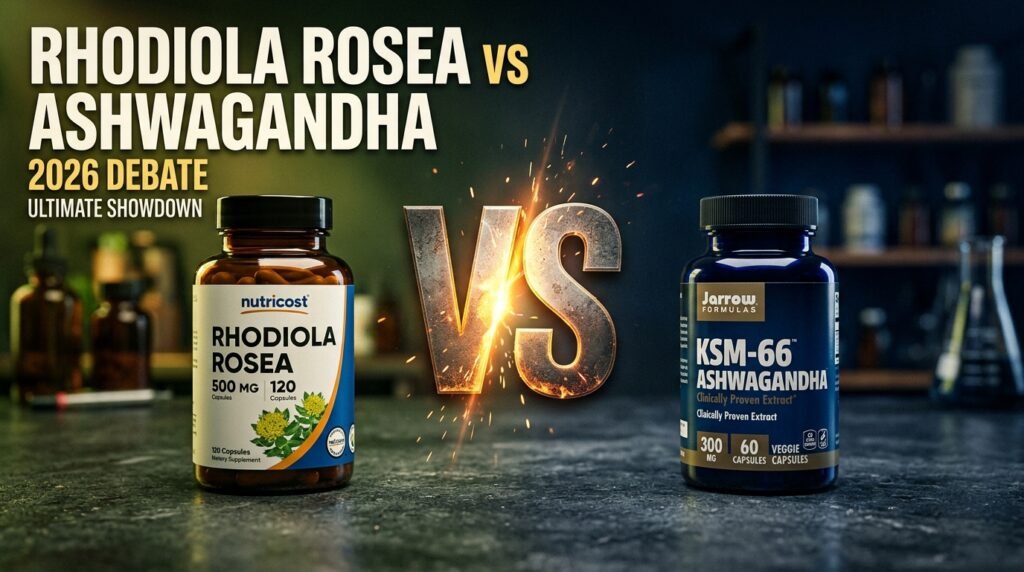
Rhodiola rosea is better for acute mental fatigue, physical endurance, and fast-acting stress resilience — effects appear within 1-2 weeks and it works best taken in the morning. Ashwagandha is better for chronic stress, sleep quality, testosterone support, and long-term cortisol normalization — effects build over 4-8 weeks. If you can only choose one: rhodiola for men whose primary issue is daytime energy and cognitive fatigue under stress; ashwagandha for men whose primary issue is sleep quality, recovery, and sustained hormonal health. Nutricost Rhodiola Rosea and Jarrow KSM-66 are the best value options for each respectively.
The Fundamental Difference — Two Adaptogens, Two Mechanisms
Most articles treating rhodiola and ashwagandha as interchangeable alternatives are missing the most important distinction between them. They both reduce stress — but they reduce it through different biological pathways that produce different practical outcomes.
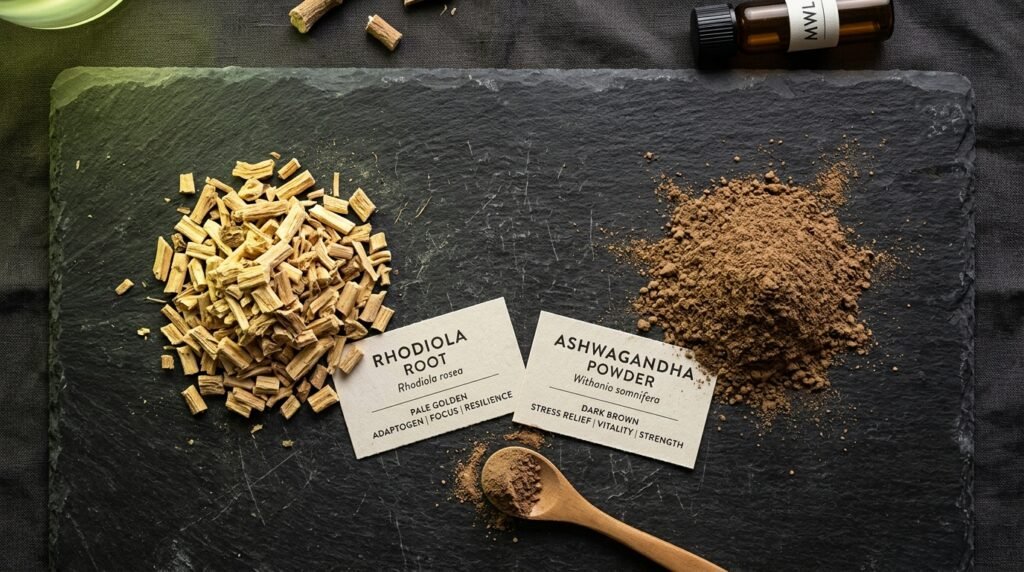
Rhodiola rosea works primarily through the central nervous system. Its active compounds — rosavins and salidrosides — influence serotonin, dopamine, and norepinephrine transport in the brain, and regulate the stress protein Hsp70 that mediates the cellular stress response. The result is fast-acting mental stress resistance, improved cognitive function under pressure, and reduced perception of physical fatigue. Rhodiola is a stimulatory adaptogen — it activates the stress response system more efficiently rather than broadly suppressing it.
Ashwagandha works primarily through the HPA (hypothalamic-pituitary-adrenal) axis — the hormonal system that regulates cortisol production. Its withanolides normalize cortisol output over time by regulating the signaling pathway that triggers cortisol release. The result is slower but deeper cortisol normalization, improved sleep quality through GABA pathway support, and downstream testosterone benefits from reduced cortisol competition. Ashwagandha is a normalizing adaptogen — it reduces excess stress hormone output rather than optimizing the stress response acutely.
The counterintuitive implication: rhodiola makes you better at handling stress in the moment; ashwagandha reduces the amount of stress your system is generating in the first place. For men under intense acute pressure — a deadline, a competition, a demanding presentation — rhodiola is more immediately useful. For men under chronic sustained stress — high-demand careers, training overload, poor sleep cycles — ashwagandha addresses the underlying hormonal burden that rhodiola can’t reach.
For context on how ashwagandha specifically fits into a broader sleep and recovery protocol, see our guide on does ashwagandha help with sleep — the sleep mechanism is distinct from the stress mechanism and worth understanding before choosing.
Timeline — When Each Adaptogen Starts Working
This is the practical difference that most supplement comparisons understate. Timeline determines whether you’ll stick with a protocol long enough to see results — and rhodiola and ashwagandha operate on very different timelines.
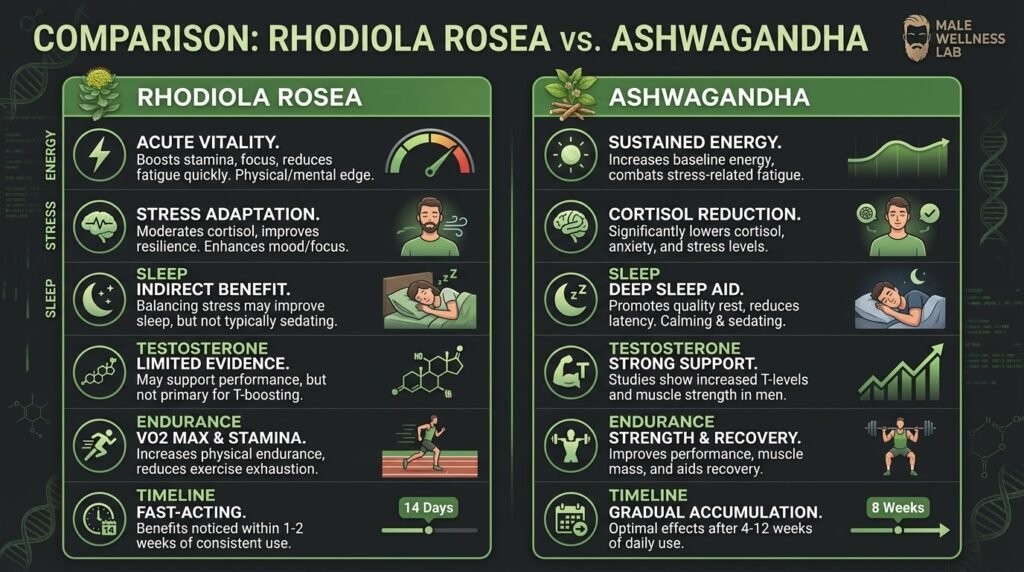
Rhodiola rosea produces noticeable effects within 3-7 days of consistent use for most men. A 2009 study published in Planta Medica found that subjects taking rhodiola extract showed significant improvements in stress-related fatigue, cognitive function, and concentration within the first week. This fast onset is explained by rhodiola’s central nervous system mechanism — it doesn’t require weeks of HPA axis recalibration to produce an effect. Most men who respond to rhodiola notice it clearly within the first 5 days and strongly by day 14.
Ashwagandha requires 4-8 weeks of consistent daily use to produce its most significant effects. The cortisol normalization mechanism operates through gradual HPA axis recalibration — not acute drug-like intervention. Most published ashwagandha trials run 8-12 weeks precisely because the sleep quality, testosterone, and sustained stress reduction benefits accumulate progressively rather than appearing at a specific threshold. Men who evaluate ashwagandha at day 10 and conclude it doesn’t work are consistently making the same protocol error.
Real-world scenario: a 31-year-old with a high-demand project deadline next week needs acute cognitive performance support. Rhodiola is the right tool — it will produce measurable stress resilience and mental stamina improvement within 5 days. The same man whose career is chronically stressful and who has been sleeping poorly for months needs ashwagandha’s 8-week cortisol normalization protocol — not rhodiola’s acute support.
In our experience, the timeline mismatch between expectation and mechanism is the primary reason men abandon ashwagandha and conclude adaptogens don’t work. Rhodiola’s faster timeline produces more consistent user compliance — which matters for long-term outcomes.
Head-to-Head — Six Key Categories
Energy and cognitive performance under acute stress: Rhodiola wins. Its direct central nervous system mechanism produces faster, more pronounced acute improvements in mental stamina, working memory under pressure, and perceived exertion during physically demanding tasks. A 2004 study found 576mg of rhodiola daily for 20 days reduced mental fatigue and improved work performance in physicians during night duty — exactly the profile of acute cognitive stress support.
Chronic stress and HPA axis normalization: Ashwagandha wins. Multiple RCTs show KSM-66 at 600mg daily reduces cortisol by 22-27% over 8-12 weeks — a sustained, meaningful reduction that rhodiola doesn’t match in comparable studies.
Sleep quality: Ashwagandha wins clearly. Rhodiola’s mild stimulatory properties can actually interfere with sleep when taken after 2pm. Ashwagandha’s GABA pathway support and cortisol reduction produce direct improvements in sleep quality that rhodiola doesn’t provide.
Testosterone support: Ashwagandha wins. Multiple studies document testosterone increases of 10-17% in men taking KSM-66 for 8+ weeks. Rhodiola has no comparable evidence for testosterone.
Physical endurance: Rhodiola wins. Studies in athletes show rhodiola reduces perceived exertion and improves endurance performance acutely — it’s one of the few supplements used in Soviet-era athletic programs with legitimate performance evidence.
Side effects and safety: Both are well-tolerated at standard doses. Rhodiola’s mild stimulatory effect can cause restlessness or sleep disruption when taken late in the day — always take it before noon. Ashwagandha may influence thyroid hormones and should be used with caution by men on thyroid medication.
The 5 Best Rhodiola and Ashwagandha Supplements in 2026
1. Nutricost Rhodiola Rosea 500mg — Best Rhodiola Overall (~$15-20/month)
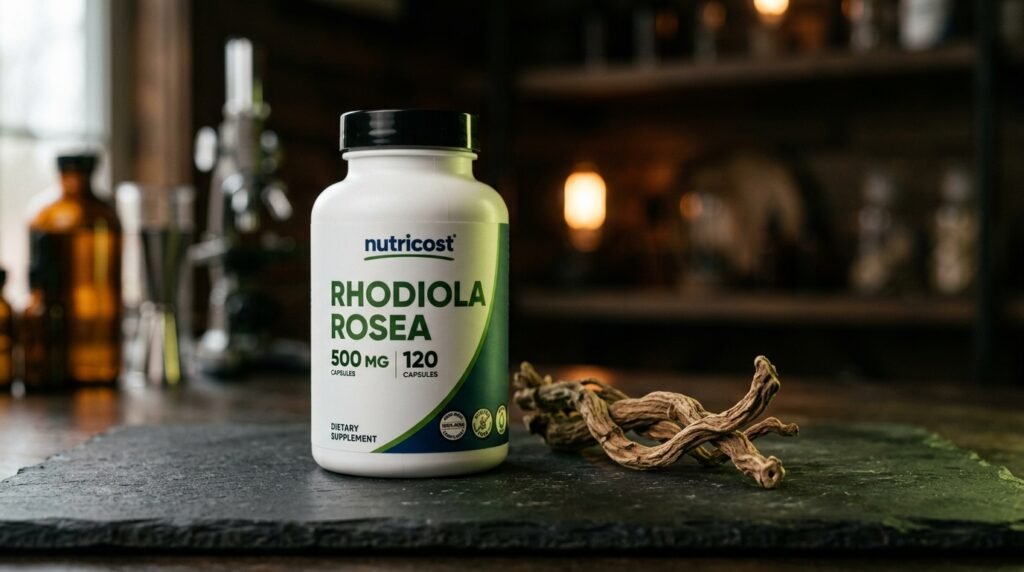
Nutricost Rhodiola Rosea delivers 500mg per capsule standardized to 3% rosavins and 1% salidrosides — the standardization that matches published clinical research protocols. NSF-certified GMP manufacturing, ISO-accredited third-party lab testing, non-GMO, gluten-free. 60 capsules per bottle provides a 60-day supply at one capsule daily or 30 days at the 1,000mg doses used in athletic performance studies.
The 3% rosavin standardization is the key specification — unstandardized rhodiola root powder delivers unpredictable active compound concentrations that make clinical dosing impossible. At $15-20 for a standardized, third-party tested product, Nutricost delivers clinical-quality rhodiola at the most accessible price on this list.
Take one capsule with breakfast or lunch — never after 2pm due to the mild stimulatory effect that disrupts sleep in sensitive individuals.
Pros: 3% rosavin + 1% salidroside standardization, NSF-certified GMP facility, ISO lab tested, 60 caps per bottle, best value standardized rhodiola available, non-GMO, gluten-free. Cons: No NSF Certified for Sport label, mild stimulatory effect requires morning timing, less brand recognition than premium alternatives.
2. Jarrow Formulas KSM-66 Ashwagandha — Best Ashwagandha for Stress + Testosterone (~$18-22/month)
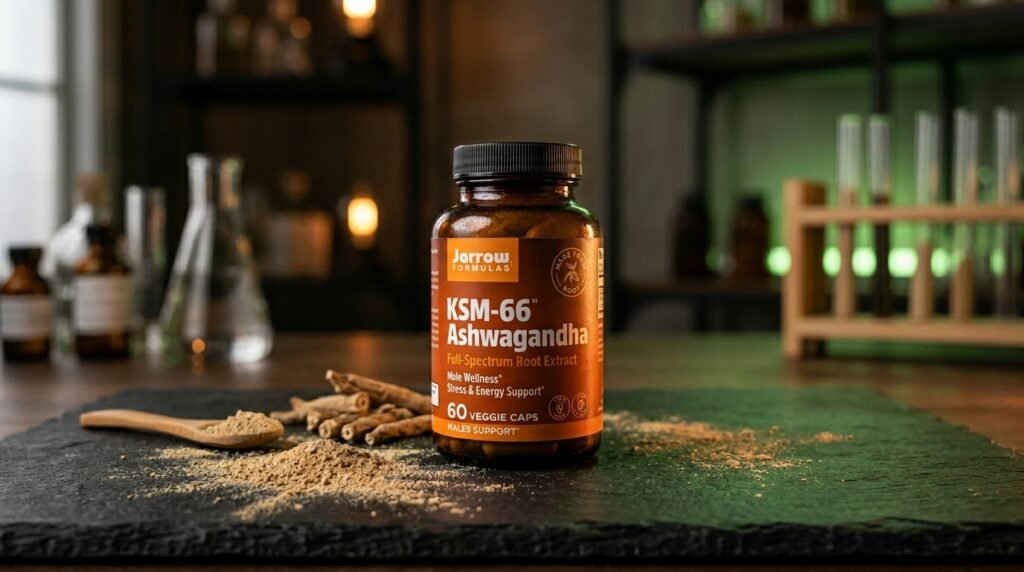
Jarrow Formulas KSM-66 is the most affordable clinical-dose KSM-66 ashwagandha available — 300mg per capsule, taken twice daily for the 600mg total used in the most-cited human clinical trials. Non-GMO, vegan, GMP compliant, 60 capsules per bottle providing a 30-day supply at the correct dose.
KSM-66 at 600mg daily is the benchmark dose for cortisol reduction (27% decrease documented in multiple trials), testosterone support (10-17% increase), and sleep quality improvement. For men who want the most evidence-backed ashwagandha at the lowest price, Jarrow KSM-66 is the correct answer.
Take one capsule morning, one capsule evening — or both capsules in the evening for sleep-primary applications.
Pros: 600mg KSM-66 at clinical dose, 24+ published human trials at this dose, non-GMO, vegan, most affordable clinical-dose KSM-66, cortisol + testosterone + sleep benefits combined. Cons: Two capsules required per day for clinical dose, not NSF certified, 30-day supply per bottle at full dose.
3. Thorne Ashwagandha (Shoden) — Best Ashwagandha for Sleep Specifically (~$30-35/month)
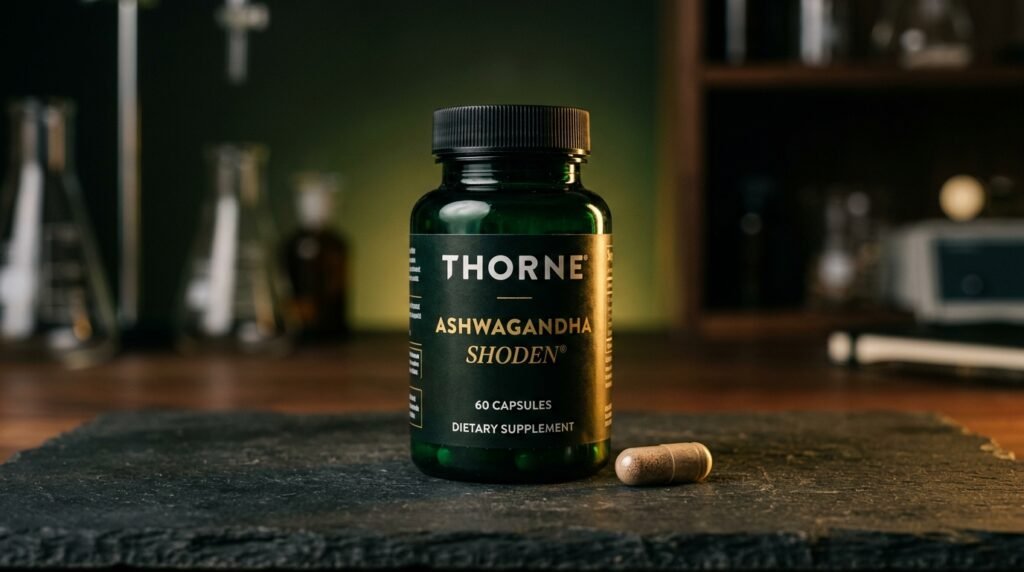
Thorne Ashwagandha uses Shoden extract — standardized to 35% withanolides versus KSM-66’s 5% — and is the extract used in the most-cited human clinical trial specifically on ashwagandha and sleep quality. NSF Certified for Sport, Thorne’s four-round testing protocol, and the #1 practitioner-recommended brand in the US.
120mg of Shoden delivers equivalent withanolide activity to approximately 840mg of KSM-66, in a single smaller capsule with the glycowithanolide profile that most directly targets the calming GABA pathway responsible for sleep improvement. For men whose primary ashwagandha goal is sleep quality rather than testosterone, Shoden is more targeted.
Pros: NSF Certified for Sport, Shoden 35% withanolides (most clinically targeted for sleep), Thorne four-round testing, practitioner-recommended, single capsule daily. Cons: 30 caps = 30-day supply, highest price per bottle, less total research volume than KSM-66.
4. Physician’s Choice KSM-66 — Best High-Dose Ashwagandha (~$25-30/month)
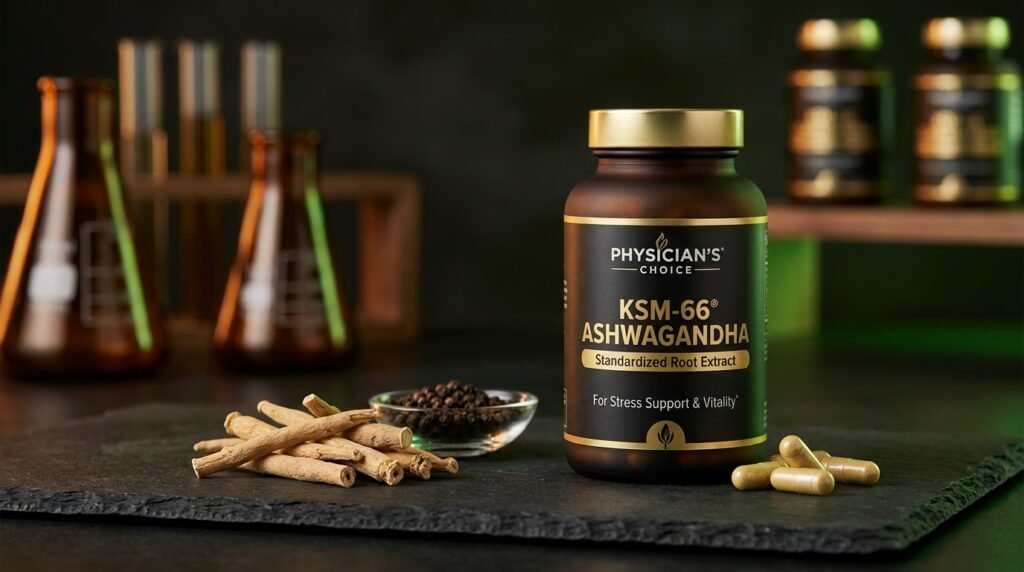
Physician’s Choice KSM-66 delivers 1,000mg of organic KSM-66 per serving with BioPerine black pepper extract for enhanced absorption — the highest KSM-66 dose on this list with an added absorption enhancer that makes it the logical choice for men who’ve tried standard 600mg dosing without significant results.
BioPerine (standardized to 95% piperine) improves absorption of fat-soluble compounds including withanolides — a meaningful formulation detail for men whose metabolism may reduce bioavailability at standard doses. Organic certified, vegan, 5% withanolide standardization, 30-day supply at full dose.
Pros: 1,000mg KSM-66 (highest dose), BioPerine for absorption, organic certified, 5% withanolides, vegan, widely available. Cons: Two capsules per serving, 60 caps = 30-day supply, no NSF certification.
5. Natgrown Rhodiola + Ashwagandha — Best Stack Option (~$20-25/month)
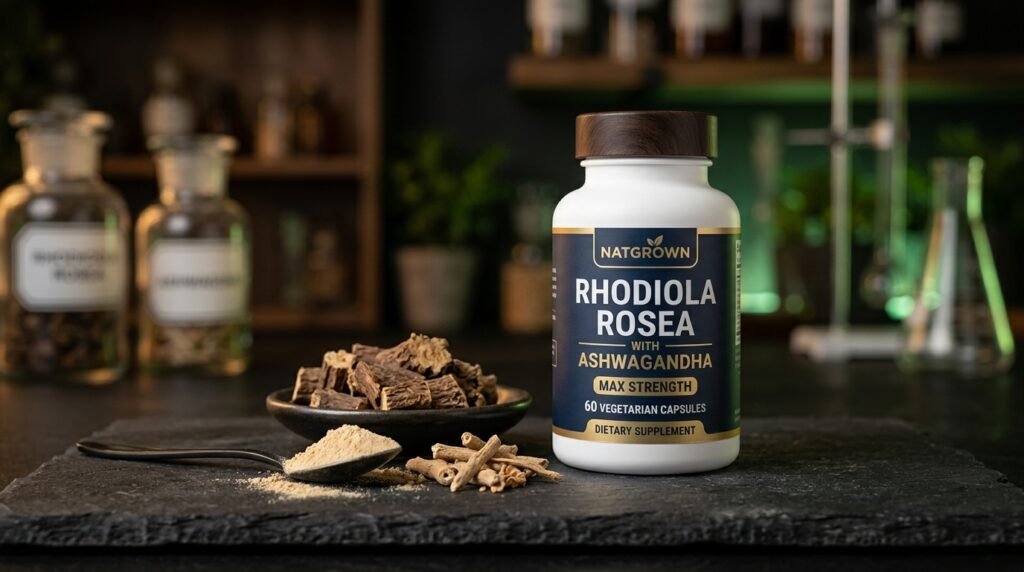
Natgrown Rhodiola Rosea with Ashwagandha combines rhodiola extract standardized to 3% rosavins and 1% salidrosides with ashwagandha root 10:1 extract and organic black pepper for absorption — in a single two-capsule daily serving. For men who’ve decided they want both adaptogens and prefer single-product convenience over separate purchases, this is the most practical entry point.
The honest caveat: combination products always compromise on individual ingredient doses versus buying each separately. The rhodiola and ashwagandha doses in this product are not disclosed at the same clinical specificity as standalone products. For men who want maximum dose control and extract quality, buying Nutricost Rhodiola and Jarrow KSM-66 separately produces better-documented outcomes. For men who want both adaptogens in one daily capsule at an accessible price point, Natgrown is a practical solution.
Pros: Both adaptogens in one product, standardized rhodiola (3% rosavins + 1% salidrosides), black pepper for absorption, non-GMO, gluten-free, dairy-free, soy-free, 120 caps per bottle. Cons: Lower dose transparency than separate products, ashwagandha is 10:1 extract (not named brand like KSM-66), not NSF certified, less clinical specificity than standalone options.
Comparison Table
| Product | Price/Month | Type | Best For | Rating |
|---|---|---|---|---|
| Nutricost Rhodiola 500mg | ~$15 | Rhodiola | Acute mental fatigue, energy | 9/10 |
| Jarrow KSM-66 | ~$18 | Ashwagandha | Chronic stress, testosterone, sleep | 9/10 |
| Thorne Shoden | ~$32 | Ashwagandha | Sleep quality specifically | 9.5/10 |
| Physician’s Choice KSM-66 | ~$28 | Ashwagandha | High-dose with absorption | 8.5/10 |
| Natgrown Rhodiola + Ashwagandha | ~$22 | Stack | Convenience, both adaptogens | 7.5/10 |
What to Look for When Choosing Between Rhodiola and Ashwagandha
1. Match the adaptogen to your primary symptom Daytime cognitive fatigue, reduced mental stamina under pressure, acute stress before demanding situations → rhodiola. Chronic cortisol elevation, poor sleep quality, low testosterone, long-term stress normalization → ashwagandha. If both apply, consider starting with ashwagandha for 8 weeks to address the hormonal foundation before adding rhodiola for acute performance.
2. Timing requirements Rhodiola must be taken in the morning — its mild stimulatory effect disrupts sleep in sensitive individuals when taken after 2pm. Ashwagandha is flexible — morning, evening, or split dosing all work, with evening timing slightly better for sleep applications. If your schedule makes morning-only supplementation difficult, ashwagandha is more practical.
3. Standardized extract over raw powder Rhodiola must specify minimum 3% rosavins and 1% salidrosides on the label. Unstandardized rhodiola root powder has unpredictable active compound content. Ashwagandha must specify a branded extract (KSM-66, Sensoril, or Shoden) with withanolide percentage. Generic “ashwagandha root powder” without standardization data is clinically unreliable regardless of milligram amount.
4. Timeline commitment Rhodiola: meaningful effects within 5-14 days. Full effect at 4-6 weeks. Ashwagandha: first noticeable effects at 2-3 weeks (sleep improvements earliest). Full effect at 8-12 weeks. Set realistic timelines before evaluating — ashwagandha users who evaluate at week 2 consistently underestimate the supplement’s potential.
5. Can you take both together? Yes — rhodiola and ashwagandha operate through different mechanisms with no documented negative interactions. The combination is rational: ashwagandha normalizes the chronic stress baseline while rhodiola optimizes acute performance within that normalized baseline. Take rhodiola in the morning and ashwagandha in the evening for the cleanest separation of their timing requirements.
FAQ
Can I take rhodiola rosea and ashwagandha together?
Yes — they work through different mechanisms and have no documented negative interactions at standard doses. The combination is complementary: ashwagandha normalizes chronic cortisol over 8-12 weeks while rhodiola provides acute cognitive performance support within days. Take rhodiola in the morning and ashwagandha in the evening to avoid rhodiola’s mild stimulatory effect interfering with ashwagandha’s sleep support.
Which is better for testosterone — rhodiola or ashwagandha?
Ashwagandha. Multiple published RCTs document testosterone increases of 10-17% in men taking KSM-66 at 600mg daily for 8+ weeks. Rhodiola has no comparable published evidence for testosterone support. For testosterone as a primary goal, ashwagandha is the only adaptogen with meaningful clinical backing. For the full picture on natural testosterone support, see our guide on the best testosterone booster without side effects.
Which adaptogen works faster — rhodiola or ashwagandha?
Rhodiola works faster by a significant margin. Most men notice rhodiola’s effects within 3-7 days of consistent morning use. Ashwagandha typically requires 2-3 weeks for initial sleep improvements and 6-8 weeks for the full cortisol and testosterone effects documented in clinical trials. If you need results within two weeks, rhodiola is the better choice. If you’re investing in a 3-month protocol, ashwagandha’s long-term effects are more comprehensive.
Is rhodiola or ashwagandha better for anxiety?
Both reduce anxiety symptoms through different pathways. Ashwagandha’s HPA axis normalization reduces the chronic cortisol burden that drives persistent low-grade anxiety more effectively over time. Rhodiola’s acute nervous system support reduces stress perception and cognitive anxiety under immediate pressure more rapidly. For generalized chronic anxiety, ashwagandha has more clinical evidence at the 8-12 week mark. For situational anxiety before specific stressful events, rhodiola’s faster mechanism is more practical. Neither should be treated as a replacement for professional support for clinical anxiety disorders.
Our Final Verdict
Rhodiola rosea vs ashwagandha isn’t a competition — it’s a matching problem. Nutricost Rhodiola Rosea is the correct choice for men who need acute mental fatigue support, faster results, and daytime cognitive resilience under pressure. Jarrow KSM-66 is the correct choice for men addressing chronic cortisol, poor sleep, and testosterone support with an 8-week protocol.
Thorne Shoden is the premium sleep-specific ashwagandha. Physician’s Choice is the high-dose ashwagandha for men who need more. And Natgrown’s combination covers both for men who want simplicity. Match the adaptogen to your primary symptom, commit to the correct timeline, and the right choice becomes obvious. Check current pricing on Amazon for all five options.