

This article contains affiliate links. We may earn a commission if you buy through our links, at no extra cost to you.
Caffeine Pills vs Coffee for Focus: Which Is Better in 2026?
You already know caffeine works. The question is whether you’re getting it from the right source for what you’re actually trying to accomplish. The caffeine pills vs coffee debate isn’t just about convenience — it’s about dose control, onset timing, what else comes in the cup, and whether your current caffeine delivery system is working for you or against you. Most men consume caffeine the same way they’ve always consumed it without ever asking whether a different format would produce better focus, fewer crashes, and less cortisol stress on their hormonal system.
After researching the clinical evidence on caffeine pharmacology, comparing caffeine pill formulations, and evaluating how different delivery methods affect cognitive performance and cortisol, here is what actually works for men who want better focus from their caffeine in 2026.
Quick Answer
For precise, consistent focus without the cortisol spike of multiple coffees, Sports Research L-Theanine + Caffeine at 100mg caffeine + 200mg L-theanine is the best starting point — the 2:1 theanine-to-caffeine ratio produces cleaner cognitive focus than either caffeine or coffee alone. Coffee remains the better choice for men who enjoy the ritual, want the full chlorogenic acid and antioxidant profile, and can manage dose and timing correctly. The honest answer: it depends on your goals, not your habit.
The Real Difference Between Caffeine Pills and Coffee
Most comparisons between caffeine pills and coffee focus on convenience. That misses the more important differences — pharmacological precision, co-ingredient effects, and cortisol management.
Dose precision is the first meaningful difference. A cup of coffee contains 80-200mg of caffeine depending on brewing method, bean origin, grind size, and brew time — the same person using the same coffee maker can get a 40% variance between cups. A caffeine pill contains exactly what it says on the label, every time. For men who care about consistent cognitive performance rather than just “getting caffeinated,” dose precision matters. A 200mg pill is a 200mg pill. A “medium coffee” is anyone’s guess.
Onset timing is the second. Coffee, consumed as a liquid, absorbs faster than solid caffeine pills — peak blood caffeine concentration occurs approximately 30-45 minutes after drinking coffee versus 45-60 minutes after swallowing a standard caffeine pill. Extended-release caffeine pills like Genius Caffeine delay the peak further, spreading it over 4-6 hours. Each profile suits different situations.
Co-ingredients are the third and most overlooked difference. Coffee contains over 1,000 bioactive compounds including chlorogenic acids (potent antioxidants), caffeic acid (anti-inflammatory), and diterpenes like cafestol and kahweol that influence cholesterol. Caffeine pills with L-theanine contain one amino acid that directly modifies how caffeine affects the brain. Neither is universally superior — they’re doing different things alongside the caffeine.
The counterintuitive point: coffee is not the same as “caffeine plus water.” The chlorogenic acid in coffee independently improves insulin sensitivity and has cardiovascular protective effects that caffeine pills don’t replicate. Men who switch entirely from coffee to caffeine pills for purity of focus may be losing benefits they weren’t aware they were getting.
For men managing caffeine as part of a broader energy and performance stack, see our guide on the best supplements for energy and focus for men — caffeine and L-theanine are the acute layer of a stack that also includes non-stimulant compounds that compound over weeks.
What L-Theanine Does to Caffeine — The Science Behind the Stack
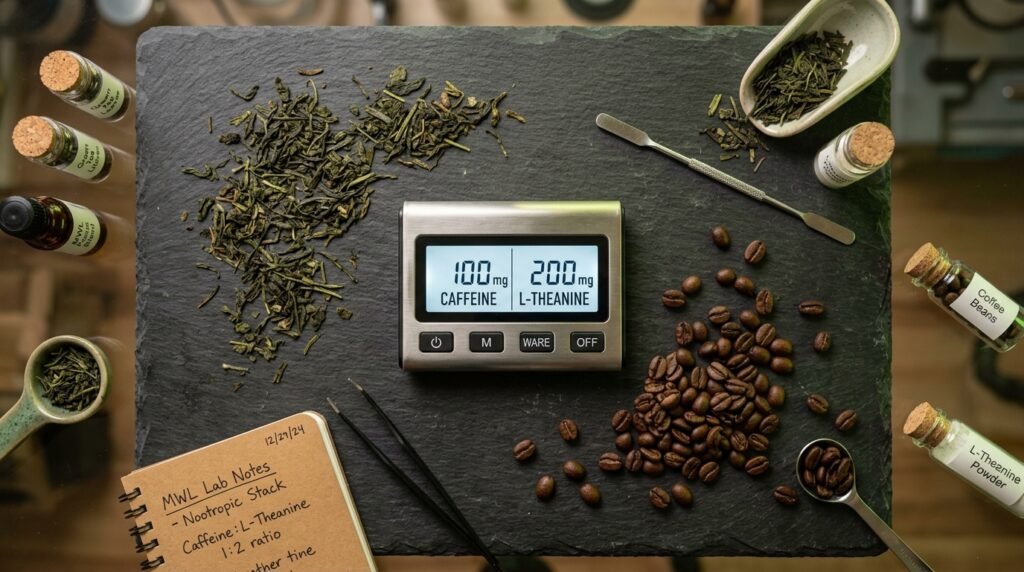
If you take one thing from this article, it’s this: caffeine works significantly better for focus when paired with L-theanine. This isn’t marketing — it’s one of the most replicated findings in cognitive supplement research.
L-theanine is an amino acid found in green tea that promotes alpha brain wave activity — the same relaxed-but-alert brainwave state associated with meditation and creative focus. On its own, L-theanine produces calm without sedation. Combined with caffeine, something more specific happens.
A 2008 study by Owen et al. in the journal Nutritional Neuroscience found that 100mg caffeine plus 200mg L-theanine improved attention switching accuracy and alertness significantly more than caffeine alone. The combination reduced susceptibility to distraction — a finding that’s been replicated multiple times since and explains why the caffeine plus L-theanine stack has become the default in serious nootropic communities.
The mechanism is intuitive: caffeine increases dopamine and norepinephrine, producing stimulation but also anxiety and jitteriness in sensitive individuals. L-theanine’s GABA-activating and alpha wave-promoting effects blunt the anxiogenic side of caffeine while preserving and enhancing the focus benefit. The result is a qualitatively different cognitive state than caffeine alone — more sustained, less jittery, and more resistant to distraction.
Coffee already contains some L-theanine if made from green tea leaves, but zero if made from coffee beans. Adding L-theanine to your morning coffee — 200mg capsule alongside the cup — produces this same compound effect from your existing coffee habit without switching to pills.
Real-world scenario: a 33-year-old product manager drinks two coffees before 10am and hits a jittery, distracted wall by noon. Switching to one coffee plus 200mg L-theanine produces sustained focus through early afternoon without the 11am anxiety spike — same caffeine, meaningfully different cognitive experience.
Caffeine Pills vs Coffee — When Each Wins
Choose caffeine pills when:
You need exact dose control. Competitive athletes, men managing total daily caffeine carefully, or anyone who has experienced anxiety or sleep disruption from their current caffeine intake benefits from knowing their precise dose to within 5mg rather than estimating from cup to cup.
You want extended release. Genius Caffeine’s microencapsulated technology releases caffeine gradually over 4-6 hours — producing a flat energy curve that eliminates the mid-morning peak and early afternoon crash that standard caffeine produces. For men with long workdays who need 9am-to-5pm cognitive performance, extended release caffeine can be more useful than two separate coffee hits.
You travel or need portability. A caffeine pill on a transatlantic flight, before a hotel gym session, or during a work conference requires no equipment, no preparation, and no 12-dollar airport coffee.
You want to optimize the L-theanine ratio precisely. Pre-formulated caffeine plus L-theanine pills give you a fixed ratio — typically 1:2 caffeine:theanine — that’s been studied for focus specifically. Matching this ratio with coffee and separate L-theanine capsules is possible but requires more tracking.
Choose coffee when:
You value the ritual. Coffee’s preparation ritual — grinding, brewing, the smell, the temperature — provides a genuine psychological transition signal for entering a focus state. That ritual has real cognitive value and shouldn’t be dismissed. A caffeine pill taken dry in the car doesn’t replicate it.
You want the full coffee compound profile. Chlorogenic acids, caffeic acid, and the antioxidant compounds in coffee have cardiovascular and metabolic benefits that caffeine pills don’t replicate. For men who drink 1-2 quality coffees daily, these co-compounds contribute meaningfully to health outcomes independent of the caffeine.
You prefer slower absorption. Drinking a hot liquid caffeine source extends the absorption window compared to swallowing a pill — the consumption time alone spreads the dose arrival by 5-10 minutes. For men who are caffeine-sensitive and want to avoid a sharp peak, slow-sipped coffee can be better than a pill.
The 5 Best Caffeine Pills for Focus in 2026
1. Sports Research L-Theanine + Caffeine — Best Overall (~$25-30/60 softgels)
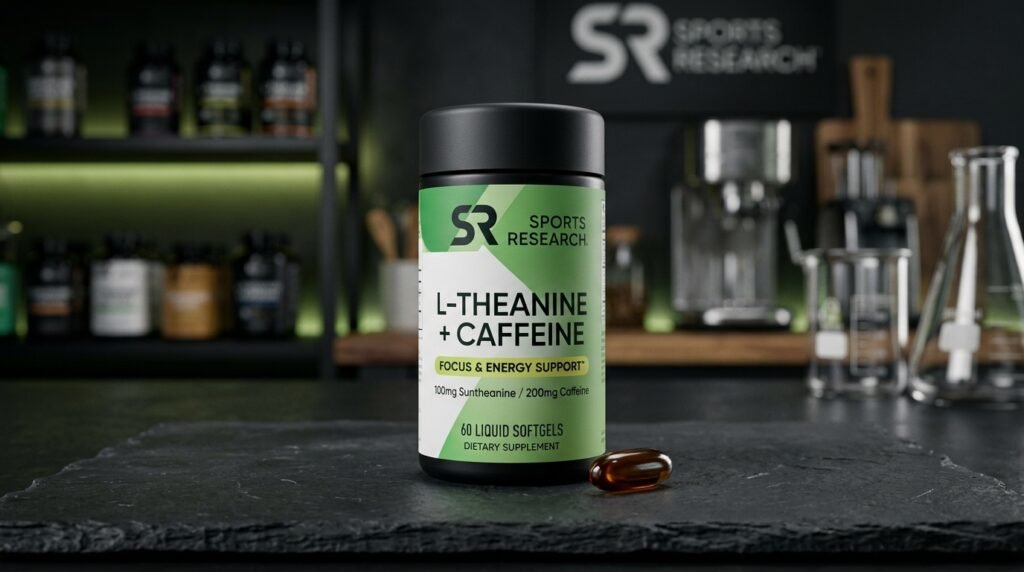
Sports Research L-Theanine + Caffeine is the best starting point for men switching from coffee to caffeine pills for focus. Each liquid softgel delivers 200mg of Alphawave L-theanine (a purified, standardized branded form) plus 100mg of PurCaf organic caffeine from green coffee beans, in a coconut MCT oil base that improves absorption of both fat-soluble compounds. The 2:1 theanine-to-caffeine ratio matches the ratio used in the Owen et al. focus research.
The liquid softgel format absorbs faster than pressed tablets — relevant for men who want the caffeine and theanine effects to arrive together rather than at different times from different capsules. Non-GMO, gluten-free, manufactured in a cGMP-compliant US facility.
Real-world detail: one softgel 45 minutes before a demanding meeting or focused work block produces the calm-alert focus profile without the coffee-induced anxiety that makes some men avoid caffeine before high-stakes conversations.
Pros: 2:1 theanine:caffeine ratio matching published research, Alphawave and PurCaf branded ingredients, MCT oil for absorption, liquid softgel faster than tablets, cGMP US manufacturing, non-GMO. Cons: 60 softgels per bottle — 60-day supply at one daily, softgel contains gelatin (not vegan), 100mg caffeine may be insufficient for high-tolerance users.
2. Genius Caffeine Extended Release — Best for All-Day Focus (~$20-25/100 caps)
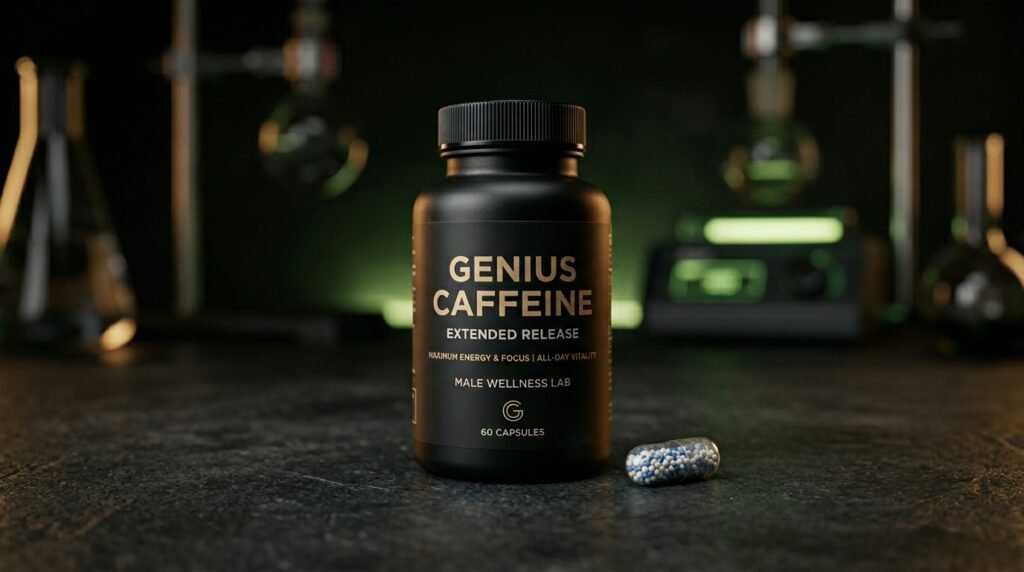
Genius Caffeine uses VitaShure — a microencapsulated caffeine technology that releases caffeine in two phases: an initial burst followed by a slow sustained release over 4-6 hours. Each capsule delivers 100mg of caffeine with no crash because the extended release maintains blood caffeine at a consistent level rather than producing a sharp peak and decline.
For men whose workday demands sustained cognitive performance from 9am to 5pm, two Genius Caffeine capsules (200mg total) taken with breakfast produces a significantly flatter energy curve than two separate coffees — without the 2pm crash that follows the metabolic clearance of morning coffee’s caffeine peak.
Vegan, no fillers, no dyes, no artificial ingredients. At 100 servings per bottle at one capsule daily, it’s one of the best value-per-dose caffeine pills available.
Pros: Extended release eliminates crash, 100 servings per bottle, vegan and clean label, 100mg per capsule allows flexible dosing, VitaShure microencapsulation technology, no jitters. Cons: No L-theanine included — requires separate purchase for the stack effect, extended release means slower initial onset than standard caffeine, not ideal for immediate pre-task use.
3. Nootropics Depot Caffeine 100mg + L-Theanine 200mg — Best Value Stack (~$20-25/180 caps)
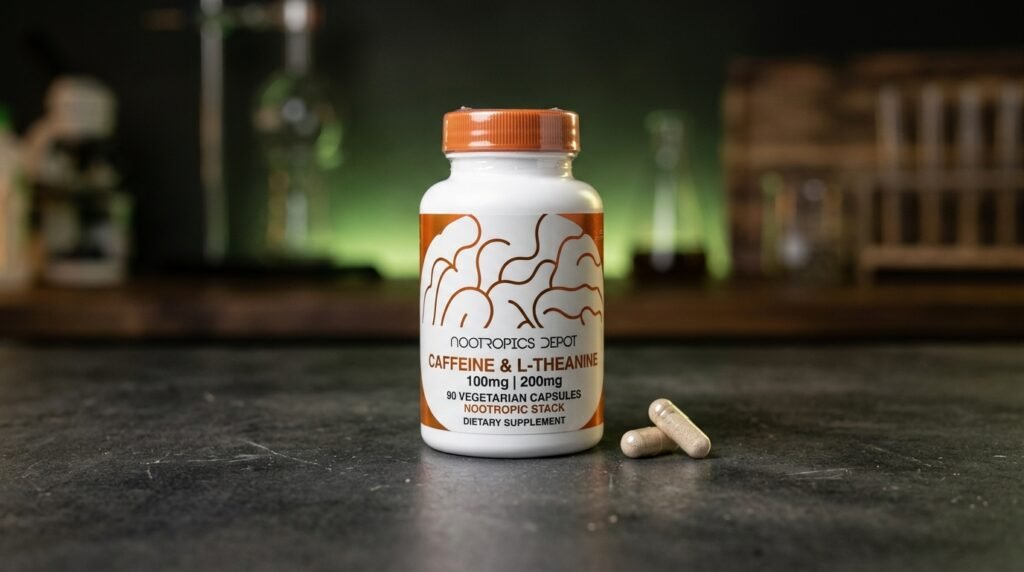
Nootropics Depot Caffeine + L-Theanine delivers 100mg caffeine and 200mg L-theanine per capsule across 180 capsules — a six-month supply at one capsule daily for men using this as a morning focus intervention. Nootropics Depot operates its own ISO-certified analytical laboratory and cGMP-certified production facility — one of the most rigorously self-tested supplement brands in the industry, with batch testing results published transparently.
At $20-25 for 180 capsules, the cost per serving is approximately $0.12-0.14 — the best value per dose of the 2:1 theanine:caffeine stack on this list. What most reviews won’t tell you about Nootropics Depot: the in-house ISO lab is a meaningful differentiator — most supplement brands outsource testing and test infrequently. Nootropics Depot tests every batch.
Pros: 180 capsules best value per dose, in-house ISO analytical lab testing every batch, 2:1 theanine:caffeine ratio, transparent quality standards, vegan capsules, well-tolerated. Cons: Less mainstream brand recognition than Sports Research, capsule form slower than liquid softgel, 100mg caffeine may need stacking for high-tolerance users.
4. Nutricost Caffeine + L-Theanine — Best Budget Option (~$15-20/240 caps)
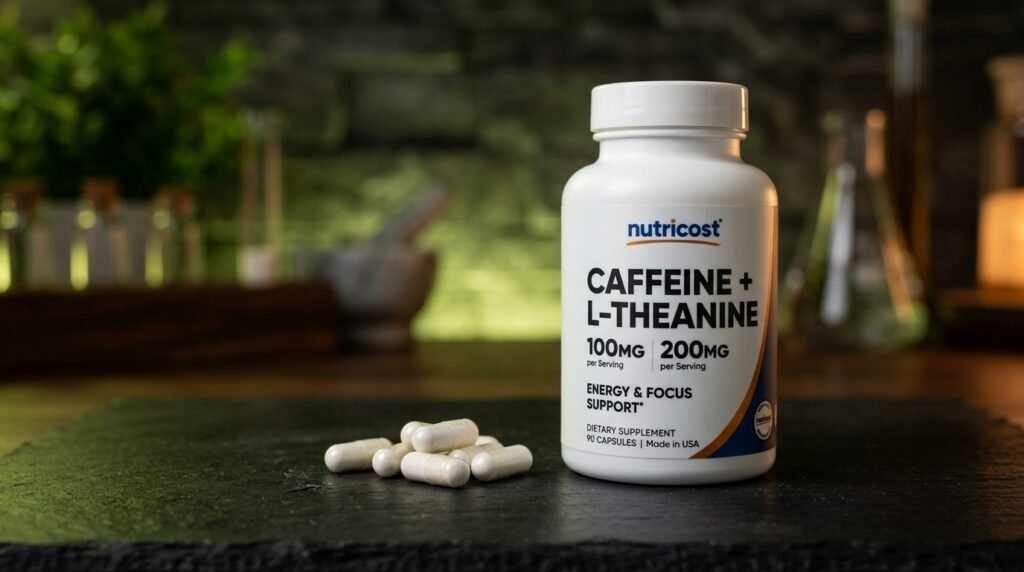
Nutricost Caffeine + L-Theanine delivers equal doses — 100mg caffeine and 100mg L-theanine per capsule — across 240 capsules per bottle, an eight-month supply at one capsule daily. Third-party tested by ISO-accredited laboratories, non-GMO, gluten-free, and manufactured in a GMP-compliant FDA-registered facility.
The 1:1 ratio is the key difference from the other options on this list. The published focus research uses 2:1 theanine:caffeine — a 1:1 ratio is less studied for the specific attention-switching improvements documented in the Owen et al. research. For men who find higher theanine doses produce too much sedation, the 1:1 ratio is worth trying. For men who want the researched focus stack, doubling the L-theanine by adding a separate capsule is the practical solution.
At $15-20 for 240 capsules, the cost per day is approximately $0.06-0.08 — the most affordable quality caffeine plus L-theanine option available.
Pros: 240 capsules best per-bottle count, ISO lab tested, GMP facility, non-GMO, gluten-free, $0.06-0.08 per day cost, flexible dosing with adjustable theanine ratio. Cons: 1:1 ratio rather than 2:1 studied for focus, lower theanine dose per capsule than research-supported, basic brand without premium differentiators.
5. Nootropics Depot Caffeine 200mg + L-Theanine 100mg — Best for High-Tolerance Users (~$10-15/60 caps)
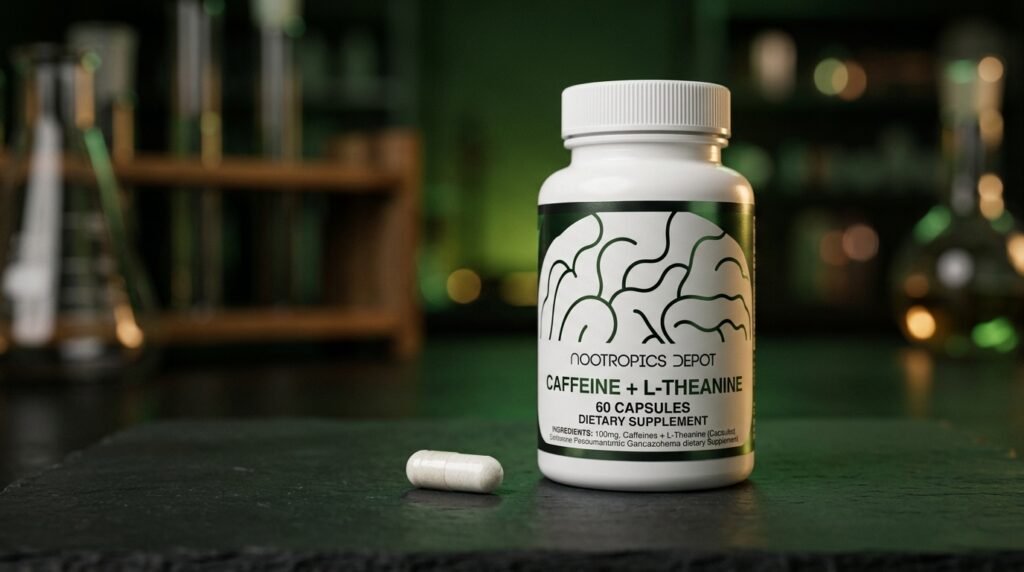
Nootropics Depot Caffeine 200mg + L-Theanine 100mg inverts the typical ratio — 200mg caffeine with 100mg L-theanine — for men with higher caffeine tolerance who need more stimulation than the standard 100mg dose provides. This matches the dose used in men who currently drink 2-3 coffees and want an equivalent in pill form.
The higher caffeine dose comes with the corresponding caution: 200mg in a single capsule is a significant acute caffeine dose for men who are not habitual high-dose users. Taking at tolerance. Not recommended for caffeine-naive users or men who are caffeine-sensitive. The same Nootropics Depot ISO lab testing and batch verification applies.
Real-world scenario: a man who currently drinks three coffees to get through his workday, wants to switch to pills for dose control, and finds 100mg caffeine pills produce no noticeable effect — the 200mg version is the correct starting point before adjusting down.
Pros: 200mg caffeine dose for high-tolerance users, same Nootropics Depot ISO lab quality, L-theanine included to smooth the higher dose, 60 capsules portable supply, transparent batch testing. Cons: 200mg single-dose may be excessive for caffeine-sensitive men, 1:2 caffeine:theanine (inverted ratio), smaller bottle requires more frequent repurchase, not appropriate as a first caffeine pill.
Comparison Table
| Product | Caffeine | L-Theanine | Price/Day | Best For | Rating |
|---|---|---|---|---|---|
| Sports Research | 100mg | 200mg | ~$0.45 | Best overall focus stack | 9.5/10 |
| Genius Caffeine | 100mg XR | None | ~$0.22 | All-day extended release | 9/10 |
| Nootropics Depot 100/200 | 100mg | 200mg | ~$0.13 | Best value focus stack | 9/10 |
| Nutricost 100/100 | 100mg | 100mg | ~$0.07 | Best budget option | 8/10 |
| Nootropics Depot 200/100 | 200mg | 100mg | ~$0.22 | High-tolerance users | 8/10 |
What to Look for When Choosing Caffeine Pills for Focus
1. L-theanine inclusion and ratio For focus specifically, caffeine plus L-theanine at a 1:2 ratio (100mg caffeine : 200mg L-theanine) is the most clinically supported formulation. Caffeine-only pills produce stimulation. Caffeine plus theanine produces the calm-alert focus profile that makes the stack worth taking over a standard coffee. If the pill doesn’t include L-theanine, budget for a separate theanine capsule alongside it.
2. Standard release vs extended release for your use case Standard release caffeine pills peak in 45-60 minutes and clear in 3-5 hours — best for specific focus windows like a morning work block or afternoon meeting. Extended release (Genius Caffeine’s VitaShure technology) peaks more gradually and maintains caffeine for 4-6 hours — best for all-day performance without multiple doses. Don’t use extended release if you train in the evening, as residual caffeine will disrupt sleep.
3. Dose matched to your current tolerance If you currently drink 2-3 coffees daily, 100mg caffeine pills will feel underwhelming — your adenosine receptors are occupied and your tolerance is built for 200-300mg of daily caffeine. Start at your equivalent dose and reduce gradually if you want to lower tolerance over time. The goal isn’t less caffeine — it’s more precise caffeine.
4. Third-party testing for a daily stimulant Caffeine is a stimulant with dose-dependent effects — taking a pill that contains 35% more caffeine than labeled (a documented issue in unverified products) is a different experience than expected. NSF certification, Informed Sport, or in-house ISO lab testing (Nootropics Depot) all provide meaningful label accuracy guarantees for a product you take daily.
5. Timing relative to sleep Caffeine has a 5-6 hour half-life, extending to 6-8 hours in some individuals. A 200mg caffeine pill taken at 3pm leaves 100mg active at 9pm — enough to delay sleep onset and reduce sleep quality. For men whose sleep is already compromised, the timing of caffeine pills is as important as the dose. As a rule, no caffeine after 1pm if you sleep at 10-11pm.
FAQ
Are caffeine pills stronger than coffee?
Not inherently — they contain what the label states, which you can match or exceed with coffee. The perceived difference is dose precision: a 200mg caffeine pill delivers exactly 200mg every time, while a large coffee delivers 150-250mg depending on preparation. Caffeine pills feel more consistent because they are more consistent, not because they’re fundamentally more potent.
Can I take caffeine pills every day?
Daily caffeine use builds tolerance within 1-4 weeks — the same dose produces less effect as adenosine receptors adapt. Cycling off caffeine for 1-2 weeks every 6-8 weeks resets tolerance effectively. The practical advantage of caffeine pills over coffee for tolerance management is that you can reduce your dose by 25mg increments — not easily done with a brewed beverage.
Will caffeine pills affect my testosterone or cortisol?
Caffeine acutely elevates cortisol — the stress hormone that operates in opposition to testosterone. Moderate caffeine use (200-300mg daily) in the morning has minimal long-term hormonal impact for most men. Chronic high-dose caffeine use (400mg+ daily) sustains cortisol elevation in ways that may suppress testosterone over time. The caffeine plus L-theanine stack reduces the acute cortisol spike of caffeine — making it a better option than caffeine alone for men managing cortisol-testosterone balance.
Should I stop drinking coffee and switch to caffeine pills?
Not necessarily. If your coffee habit is working — consistent dose, no anxiety, good sleep, stable energy — there’s no compelling reason to switch. Caffeine pills make most sense for men who: want more dose control, experience anxiety or jitters from coffee, want to add L-theanine cleanly, need portable caffeine without preparation, or are trying to reduce their total caffeine intake with measurable increments.
Our Final Verdict
The caffeine pills vs coffee debate resolves differently for every man depending on his tolerance, goals, and daily schedule. For most men who want better focus specifically, Sports Research L-Theanine + Caffeine at the 2:1 theanine:caffeine ratio is the clearest upgrade over standard coffee — cleaner focus, less jitter, no crash.
Genius Caffeine Extended Release is the answer for men who need all-day performance without multiple doses. Nootropics Depot 100/200 delivers the same researched stack at the best value. Nutricost is the budget entry point. And Nootropics Depot 200/100 serves high-tolerance users who need a stronger dose. Coffee remains valuable for its ritual and co-compound profile — but for focus specifically, the caffeine plus L-theanine stack consistently outperforms a plain cup. Check current pricing on Amazon for all five options.