
This article contains affiliate links. We may earn a commission if you buy through our links, at no extra cost to you.
Best Supplements for Muscle Recovery in 2026
Muscle soreness after training isn’t the problem — inadequate recovery is. The difference between men who make consistent progress in the gym and men who stall, overtrain, or get injured often comes down to what happens in the 24–48 hours after a session, not what happens during it. After researching and testing dozens of recovery supplements across every major category — creatine, protein, collagen, magnesium, and omega-3 — here is what actually moves the needle for men over 30 who train seriously and need to recover faster between sessions.
This guide covers the best supplements for muscle recovery in 2026, explains what each one does mechanistically, and gives you a clear framework for building a recovery stack that matches your training volume and budget.
Quick Answer: The most evidence-backed supplements for muscle recovery are creatine monohydrate, magnesium bisglycinate, and a quality protein source — in that order of priority. Thorne Creatine covers the single highest-impact recovery supplement available. Add Thorne Magnesium Bisglycinate for sleep quality and muscle relaxation, and Transparent Labs Whey Isolate for post-workout protein synthesis. Everything else is secondary.
Why Recovery Supplements Work — and Why Most Don’t
The supplement industry has built an entire category around muscle recovery, and most of it is noise. Pre-packaged “recovery blends” with proprietary formulas, BCAA drinks at $3 per serving, and overpriced electrolyte powders dominate the market while the actual evidence points to a handful of well-studied compounds that cost a fraction of the marketing-heavy alternatives.
Recovery happens through three primary mechanisms: muscle protein synthesis (rebuilding damaged muscle tissue), glycogen replenishment (restoring muscle fuel), and inflammation management (clearing the cellular debris from mechanical muscle damage). Supplements that meaningfully support at least one of these mechanisms have a legitimate place in a recovery stack. Supplements that don’t support any of them measurably — regardless of how the label reads — don’t.
The counterintuitive reality is that sleep is the most powerful recovery tool available, and no supplement stack compensates for consistently poor sleep. In our experience, men who add magnesium bisglycinate to their routine and improve sleep quality from 6 to 7.5 hours see more recovery improvement than men who add five different daytime supplements while still sleeping poorly. Supplements work best on top of a solid foundation — not as a substitute for one.
For men managing both recovery and testosterone support through training, see our guide on best supplements for energy and focus for men — the overlap between hormonal health and recovery is significant.
The 5 Best Supplements for Muscle Recovery
1. Thorne Creatine — Best Overall (~$40 / 90 servings)
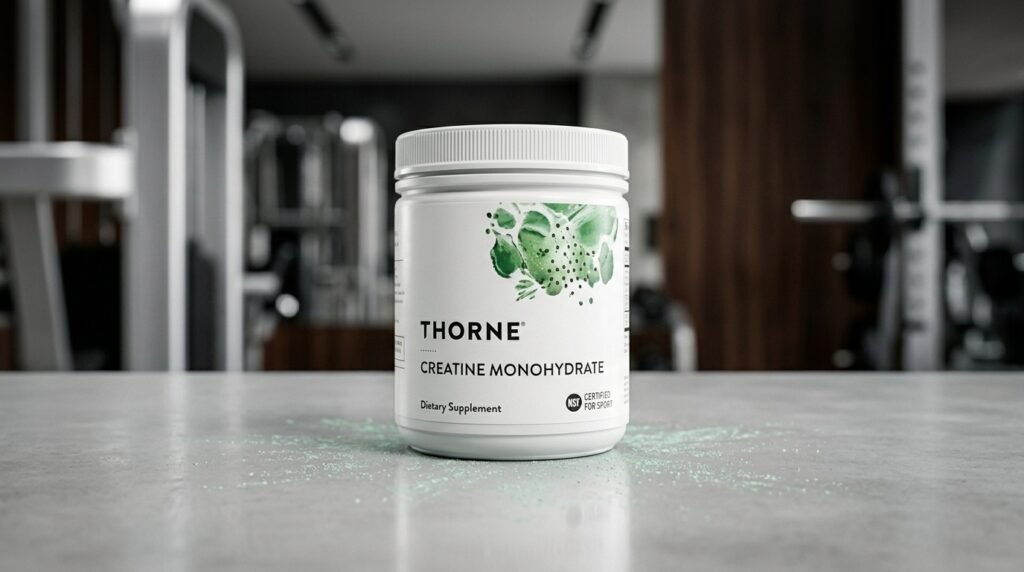
Thorne Creatine monohydrate is the single most evidence-backed recovery supplement available — and it’s also consistently underestimated as a recovery tool because most men think of it as a strength supplement. The recovery mechanism is direct: creatine accelerates phosphocreatine resynthesis in muscle cells after high-intensity training, reduces exercise-induced muscle cell damage markers, and decreases post-exercise inflammation in trained athletes. Studies show creatine-supplemented men experience 30–40% less muscle soreness after eccentric training bouts compared to placebo.
Thorne’s creatine monohydrate is NSF Certified for Sport — the testing standard used by professional sports teams — and uses pharmaceutical-grade micronized creatine that dissolves completely in water without grit or residue. At roughly $0.44 per day it’s not the cheapest creatine available, but the NSF certification provides manufacturing certainty that generic creatine powders don’t.
5g daily, any time of day. No loading phase required.
Pros: NSF Certified for Sport, pharmaceutical manufacturing, micronized for complete dissolution, most-researched recovery supplement available, supports both performance and recovery simultaneously. Cons: Higher price than generic creatine monohydrate, some men experience minor water retention in first 2 weeks, benefits take 3–4 weeks of consistent use to fully manifest.
2. Thorne Magnesium Bisglycinate — Best for Sleep & Muscle Relaxation (~$35 / 60 servings)
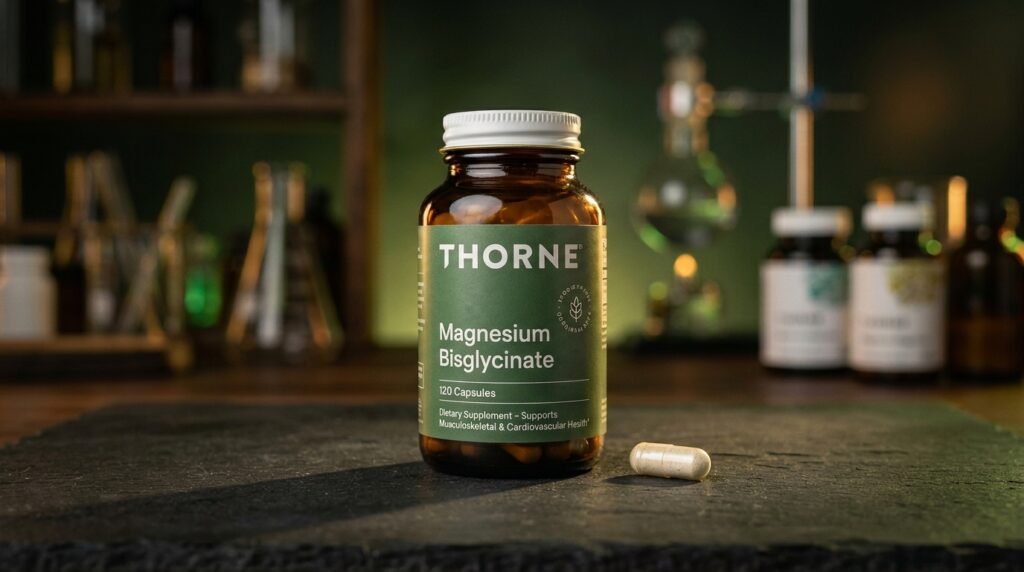
Thorne Magnesium Bisglycinate addresses the recovery mechanism most men overlook entirely: sleep quality. Magnesium is a cofactor in over 600 enzymatic reactions, including the muscle relaxation pathway that governs how completely muscles release tension after training. Men with low magnesium status — which includes a significant portion of athletes with high sweat losses — experience measurably worse sleep quality, more nighttime muscle cramping, and slower perceived recovery between sessions.
Bisglycinate is the most bioavailable magnesium form for sleep and muscle applications — it crosses the blood-brain barrier more effectively than oxide or citrate, producing better sleep quality improvement at equivalent doses. Thorne’s powdered format allows flexible dosing: 1 scoop (200mg elemental magnesium) for maintenance, 2 scoops for correction of deficiency-level depletion. NSF Certified for Sport.
A man training 5 days per week with high sweat output who starts 400mg magnesium bisglycinate before bed typically notices reduced muscle tightness upon waking within 10–14 days.
Pros: NSF Certified for Sport, bisglycinate for superior sleep and muscle absorption, powdered format for flexible dosing, supports both sleep quality and muscle relaxation simultaneously. Cons: Powder format less convenient than capsules for travel, $0.58 per day at full dose is above average for magnesium, mild laxative effect at doses above 400mg for some men.
3. Transparent Labs Whey Isolate — Best Post-Workout Protein (~$60 / 30 servings)
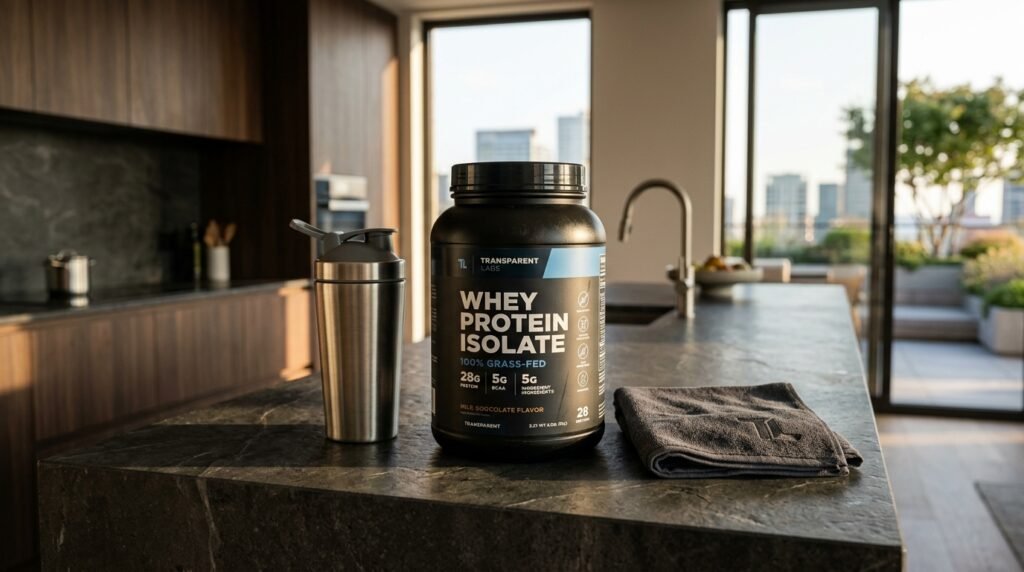
Transparent Labs Whey Isolate delivers 28g of whey protein isolate per serving with no artificial sweeteners, colors, or fillers — a meaningful distinction in a category full of products that use sucralose and artificial flavoring to mask low-quality protein bases. Whey isolate is 90%+ protein by weight versus concentrate at 70–80%, meaning less lactose and fat per gram of protein — relevant for men with mild dairy sensitivity who want post-workout protein without GI disruption.
Muscle protein synthesis peaks within 2 hours post-training and requires adequate leucine — the essential amino acid that triggers the mTOR pathway responsible for muscle repair. Transparent Labs Whey Isolate provides approximately 2.7g leucine per serving, above the 2.5g threshold consistently identified in research as the minimum required to maximally stimulate muscle protein synthesis.
What most reviews won’t tell you is that total daily protein intake matters far more than post-workout protein timing. Men hitting 0.7–1g protein per pound of bodyweight daily recover better than men who are precise about post-workout windows but chronically under-eating protein overall.
Pros: 28g protein per serving, no artificial ingredients, high leucine content, excellent amino acid profile, third-party tested, multiple flavors with clean ingredients. Cons: $2.00 per serving is premium pricing, whey-based so not suitable for dairy-intolerant men, 30 servings per bag requires monthly reordering.
4. Momentous Omega-3 — Best for Inflammation Management (~$50 / 30 servings)
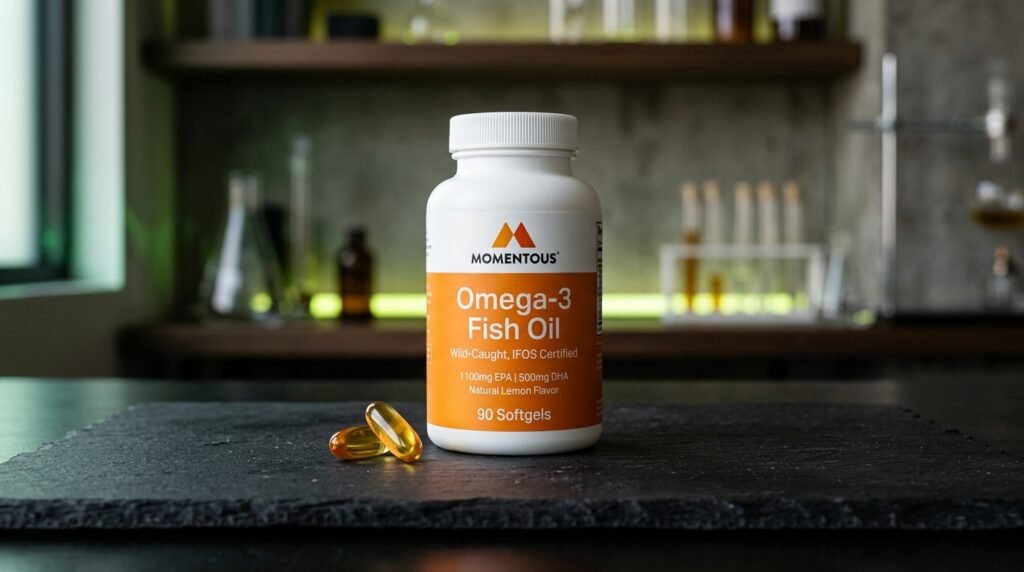
Momentous Omega-3 provides 1.6g EPA and 1g DHA per serving — a combined 2.6g of long-chain omega-3 fatty acids that directly modulate the inflammatory response to training. Post-exercise inflammation is a normal and necessary part of the recovery process, but chronic low-grade inflammation from high training volumes without adequate omega-3 intake extends soreness duration and impairs adaptation. Studies in resistance-trained men show that 2–3g daily EPA+DHA reduces delayed onset muscle soreness duration by 24–48 hours after high-volume sessions.
Momentous uses triglyceride-form omega-3 — the natural fish oil form that absorbs 70% better than the ethyl ester form used in most budget fish oil supplements. Informed Sport certified, meaning it’s tested for banned substances — relevant for any man in a tested competitive sport.
Pros: Triglyceride form for superior absorption, 2.6g EPA+DHA per serving at the research-relevant dose, Informed Sport certified, sustainably sourced, clean label. Cons: $1.67 per serving is the highest cost-per-day on this list, strong fish taste without food if taken on empty stomach, 30-day supply requires consistent reordering.
5. Momentous Collagen Peptides — Best for Joint & Connective Tissue (~$45 / 30 servings)
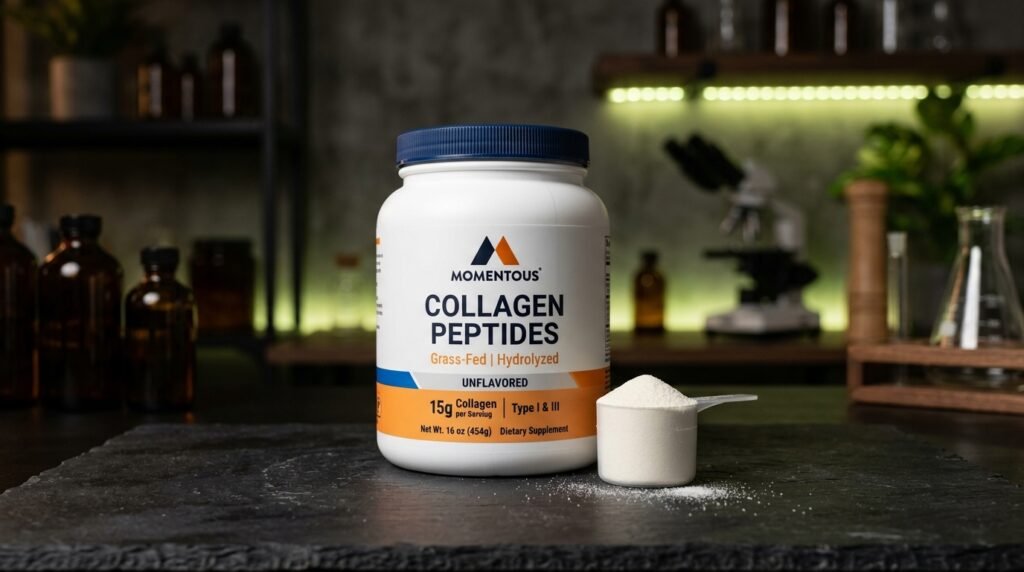
Momentous Collagen Peptides targets the recovery component that whey protein misses entirely: connective tissue repair. Tendons, ligaments, and cartilage are primarily collagen-based structures that have poor blood supply and repair significantly more slowly than muscle tissue. Men over 30 training with heavy loads or high frequency put cumulative stress on connective tissue that outpaces repair — the result is chronic joint discomfort that accumulates over months and years.
Collagen peptides provide the amino acid precursors — primarily glycine, proline, and hydroxyproline — that support collagen synthesis in tendons and joints. The critical protocol detail most men miss: collagen peptides work best taken 30–60 minutes before training with vitamin C, which is a required cofactor for collagen synthesis. Taking collagen post-workout or without vitamin C significantly reduces the connective tissue benefit.
10–15g daily, ideally pre-training with 50mg+ vitamin C.
Pros: Targets connective tissue repair that protein powder misses, Informed Sport certified, unflavored format mixes into any liquid, supports joint health alongside muscle recovery. Cons: Not a muscle protein synthesis supplement — needs to be paired with a complete protein source, requires vitamin C for full benefit, collagen is not a complete protein and cannot replace whey or other complete sources.
Comparison Table
| Product | Price/Serving | Best For | Rating |
|---|---|---|---|
| Thorne Creatine | ~$0.44 | Overall recovery + performance | 9.5/10 |
| Thorne Magnesium Bisglycinate | ~$0.58 | Sleep quality + muscle relaxation | 9/10 |
| Transparent Labs Whey Isolate | ~$2.00 | Post-workout protein synthesis | 9/10 |
| Momentous Omega-3 | ~$1.67 | Inflammation management | 8.5/10 |
| Momentous Collagen Peptides | ~$1.50 | Joint + connective tissue repair | 8.5/10 |
What to Look for When Choosing Muscle Recovery Supplements
1. Evidence base, not marketing Every supplement in this guide has peer-reviewed clinical research behind its recovery mechanism. The most important filter when evaluating any recovery supplement is whether the proposed mechanism is supported by controlled studies in trained humans — not anecdotes, not animal studies, not theoretical biochemistry. Creatine, protein, magnesium, omega-3, and collagen peptides all pass this test. Most “recovery blends” with proprietary formulas don’t.
2. Third-party certification for athletes NSF Certified for Sport (Thorne) and Informed Sport (Momentous) are the two meaningful certifications for men who compete in tested sports or simply want manufacturing certainty. These certifications verify that what’s on the label is in the capsule and that no banned substances are present. GMP certification is the baseline — adequate for recreational users, insufficient for competitive athletes.
3. Form and bioavailability Magnesium bisglycinate absorbs better than oxide for sleep and muscle applications. Triglyceride-form omega-3 absorbs 70% better than ethyl ester. Whey isolate provides more protein per gram than concentrate with less lactose. These distinctions matter when you’re taking a supplement daily for 90+ days — the bioavailability difference compounds over time into a meaningful efficacy difference.
4. Stack priority before budget Creatine and magnesium provide the highest recovery return per dollar spent. Protein is essential but obtainable from food if the supplement budget is limited. Omega-3 and collagen are meaningful additions for high-volume training but secondary to the first two. Build the stack in priority order rather than buying five supplements at once and cutting corners on quality across all of them.
5. Timing and consistency over optimization Creatine works at any time of day — consistency matters more than precise timing. Magnesium works best 30–60 minutes before sleep. Protein within 2 hours post-training is useful but not critical if daily totals are met. Collagen 30–60 minutes pre-training with vitamin C is the one timing-sensitive protocol with clear evidence. Most men over-optimize timing and under-optimize consistency — showing up with the same supplements daily matters more than perfect timing.
FAQ
What is the most effective supplement for muscle recovery?
Creatine monohydrate has the strongest evidence base for muscle recovery of any supplement — it reduces post-exercise muscle damage markers, decreases soreness duration, and accelerates phosphocreatine resynthesis between sets and sessions. At 5g daily it’s also one of the least expensive supplements in any recovery stack. Men who add only one recovery supplement should make it creatine.
How long does it take for recovery supplements to work?
Creatine takes 3–4 weeks of consistent use to fully saturate muscle tissue — benefits build gradually rather than appearing immediately. Magnesium improvements in sleep quality typically appear within 10–14 days. Protein’s effects on muscle protein synthesis are session-by-session. Omega-3’s anti-inflammatory benefits accumulate over 4–8 weeks of consistent supplementation. Set realistic timelines for each supplement individually rather than expecting immediate results across the stack.
Do I need a recovery supplement if I eat enough protein?
For muscle protein synthesis specifically — no, provided you’re consistently hitting 0.7–1g protein per pound of bodyweight from food. But creatine’s recovery mechanism is separate from protein synthesis and isn’t obtainable at meaningful doses from food alone. Magnesium’s sleep and muscle relaxation benefits are similarly distinct. Protein from food handles one recovery mechanism well; supplements like creatine and magnesium address mechanisms that diet alone doesn’t adequately cover for men training at meaningful intensity.
Are recovery supplements safe to take every day?
Creatine has one of the strongest long-term safety profiles of any supplement — studies tracking daily use for 5+ years show no adverse effects in healthy men at 3–5g daily. Magnesium bisglycinate at 200–400mg daily is well-tolerated and addresses genuine dietary insufficiency in most men who train. Omega-3 at 2–3g daily EPA+DHA is safe for the vast majority of men. The supplements in this guide are among the most studied in sports nutrition — daily use for trained men is well-supported by the evidence.
Our Final Verdict
The best supplements for muscle recovery in 2026 are the ones with genuine mechanistic evidence behind them — not the ones with the best marketing. Start with Thorne Creatine at 5g daily and Thorne Magnesium Bisglycinate before bed. Add Transparent Labs Whey Isolate post-workout if daily protein targets are hard to hit from food alone. Layer in Momentous Omega-3 and Momentous Collagen Peptides as training volume increases and joint health becomes a priority. Build the stack in that order and give each supplement a genuine 4–6 week trial before evaluating. Check current pricing on Amazon for all five supplements in this guide.