

This article contains affiliate links. We may earn a commission if you buy through our links, at no extra cost to you.
Does Magnesium Help With Anxiety in Men?
Anxiety in men rarely looks the way it does in textbooks. It shows up as irritability, difficulty switching off after work, a low-level sense of tension that never fully resolves, and sleep that doesn’t feel restorative even when duration is adequate. If that profile sounds familiar, magnesium deficiency may be a significant contributing factor — and does magnesium help with anxiety in men is a question with a more evidence-backed answer than most men expect.
After researching the clinical literature on magnesium and anxiety, including what the studies actually show and where the evidence gets overstated, here is what the science settles in 2026.
This guide is for men dealing with chronic low-grade anxiety or stress-driven tension who want to understand whether magnesium is a legitimate intervention or just another supplement industry claim.
Quick Answer: Magnesium does help with anxiety in men — specifically by supporting GABA receptor function, reducing HPA axis reactivity, and lowering the chronic cortisol output that drives anxiety symptoms. The effect is most pronounced in men who are magnesium deficient, which includes a significant portion of active, high-stress men. Thorne Magnesium Bisglycinate at 200–400mg daily is the most evidence-aligned starting point for men using magnesium specifically for anxiety and stress management.
The Neuroscience Behind Magnesium and Anxiety
Magnesium’s relationship with anxiety isn’t theoretical — it operates through three well-documented biological mechanisms that directly influence how the nervous system generates and sustains anxious states.
The first mechanism is GABA receptor function. GABA — gamma-aminobutyric acid — is the primary inhibitory neurotransmitter in the central nervous system. It’s the neurochemical brake that quiets neural activity and counteracts the excitatory signals that produce anxiety and stress responses.
Magnesium is a required cofactor for GABA receptor sensitivity — without adequate magnesium, GABA receptors become less responsive, and the nervous system’s ability to dampen anxious neural activity is compromised. This is the same receptor system targeted by benzodiazepines, which is why adequate magnesium status produces a functionally similar — though far milder — calming effect through natural mechanism.
The second mechanism is NMDA receptor modulation. NMDA receptors are glutamate receptors involved in neural excitation — they amplify signals and contribute to the hyperactivation that underlies anxiety states. Magnesium acts as a natural NMDA receptor blocker, physically occupying the receptor channel and reducing excessive excitatory signaling. Low magnesium status removes this blocking effect, leaving NMDA receptors more active and neural excitation less regulated.
The third mechanism is HPA axis regulation. The hypothalamic-pituitary-adrenal axis governs cortisol production in response to stress. Magnesium deficiency is associated with HPA axis hyperreactivity — the stress response fires more easily, produces more cortisol per stressor, and takes longer to return to baseline. Studies show magnesium supplementation reduces cortisol output in response to standardized stressors within 4–6 weeks of consistent use.
The counterintuitive point: magnesium doesn’t sedate or suppress anxiety the way pharmaceutical anxiolytics do. It restores the nervous system’s natural self-regulation capacity — which means it works gradually and the effect compounds over weeks rather than producing immediate relief.
For men managing both anxiety and sleep disruption — which frequently coexist — see our guide on how to improve sleep quality naturally — magnesium addresses both mechanisms simultaneously.
Why Men Are More Likely to Be Magnesium Deficient Than They Realize
Understanding who benefits most from magnesium supplementation for anxiety starts with understanding who is most likely to be deficient — and the answer for men is more common than most assume.
Approximately 48% of Americans consume below the 420mg RDA for magnesium daily. For active men, that number is likely higher. Physical training depletes magnesium through sweat — a man training 5 days per week in moderate heat can lose 1–2mg of magnesium per liter of sweat, adding up to 2–4mg of additional daily loss beyond dietary intake. Chronic stress itself accelerates magnesium depletion — cortisol increases urinary magnesium excretion, creating a self-reinforcing cycle where stress depletes magnesium, low magnesium amplifies the stress response, which depletes more magnesium.
Alcohol consumption increases urinary magnesium excretion significantly. Men consuming more than 7 drinks per week have measurably lower serum magnesium than non-drinkers at equivalent dietary intake. A high processed food diet — common in men who don’t actively plan their nutrition — provides very little magnesium. The richest dietary sources (pumpkin seeds, dark leafy greens, dark chocolate, legumes) are underrepresented in standard Western male eating patterns.
The result is a population of men — stressed, training, drinking moderately, eating imperfectly — who are simultaneously at highest risk for magnesium deficiency and most likely to experience the anxiety symptoms that deficiency produces. In our experience, men who address magnesium deficiency through supplementation often describe the subjective effect as feeling “less reactive” to stressors rather than “calmer” in a sedated sense — a meaningful distinction that describes restored nervous system regulation rather than pharmacological suppression.
What the Clinical Research Actually Shows
The clinical evidence on magnesium and anxiety is meaningful — not conclusive enough to replace medical treatment for clinical anxiety disorders, but robust enough to support magnesium as a legitimate first-line intervention for stress-driven anxiety in otherwise healthy men.
A 2017 systematic review published in Nutrients analyzed 18 studies on magnesium and anxiety, finding consistent evidence that magnesium supplementation reduces subjective anxiety measures in populations with mild-to-moderate anxiety and low magnesium status. The effect size was modest to moderate — significant enough to be practically meaningful, not dramatic enough to compare to pharmaceutical anxiolytics.
A 2016 randomized controlled trial found that 300mg magnesium daily for 6 weeks significantly reduced anxiety scores in mildly anxious adults compared to placebo, with the effect most pronounced in participants with lower baseline magnesium status. A 2019 study in PLOS ONE found that magnesium supplementation reduced self-reported stress and anxiety in healthy adults over 8 weeks at 400mg daily.
The consistent pattern: men with lower baseline magnesium status see more pronounced anxiety relief from supplementation. Men with already-optimal magnesium status see more modest effects. This supports the deficiency-restoration model rather than a direct pharmacological mechanism — magnesium works for anxiety in men primarily by fixing a deficit, not by producing a drug-like effect regardless of baseline status.
What most reviews won’t tell you is that the studies showing the weakest magnesium-anxiety effects are also the studies with the shortest duration — 2–3 weeks. The HPA axis modulation that drives anxiety relief requires 4–6 weeks to establish. Studies that evaluate at 3 weeks consistently underestimate the effect that emerges at 6–8 weeks of consistent use.
Magnesium Forms That Actually Work for Anxiety
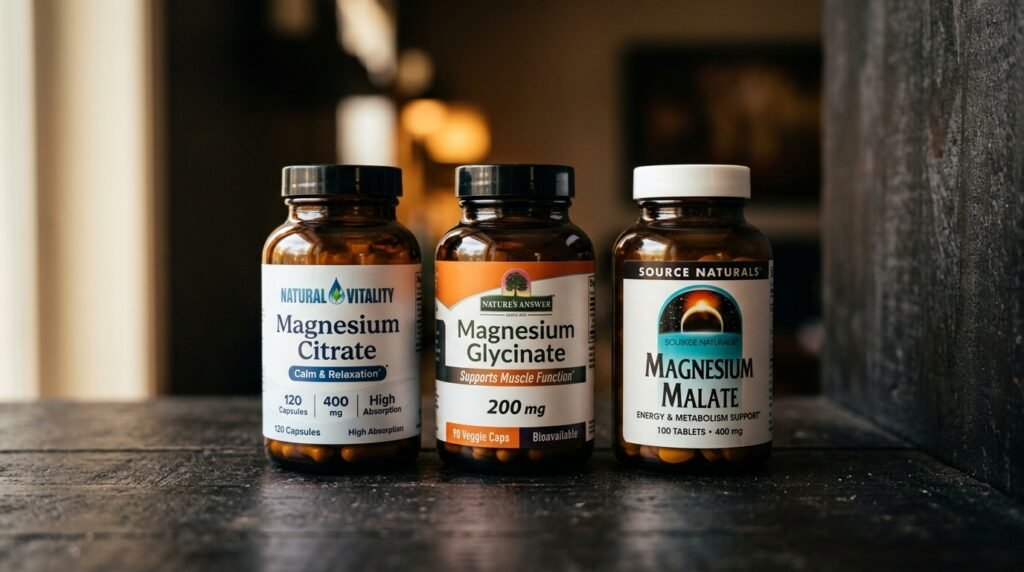
Not all magnesium supplements produce the same anxiety-relevant effects — and the form is the variable that determines whether you’re replicating the clinical protocols or taking an inert product.
Magnesium bisglycinate is the form with the strongest evidence for anxiety and sleep applications. The bisglycinate chelate — two glycine molecules per magnesium ion — absorbs through amino acid transport pathways at 40–50% bioavailability versus magnesium oxide’s 4%.
The glycine component independently promotes GABA receptor sensitivity and has mild anxiolytic properties of its own, making the bisglycinate form a genuinely synergistic combination rather than just a delivery vehicle. Clinical trials showing anxiety relief from magnesium almost exclusively use glycinate or bisglycinate forms.
Magnesium glycinate (single glycine chelate) performs comparably to bisglycinate for most men and is widely available at lower price points. The absorption advantage over oxide is similar; the bisglycinate’s slight edge comes from the additional glycine molecule’s independent GABA contribution.
Magnesium oxide — the form in most drugstore supplements and multivitamins — has approximately 4% bioavailability. At standard supplement doses, it delivers insufficient magnesium to tissues to produce meaningful GABA receptor or HPA axis effects. Men who have “tried magnesium for anxiety and felt nothing” were almost certainly using oxide. The form matters more in this category than in nearly any other supplement context.
Magnesium L-threonate is a newer form specifically designed to cross the blood-brain barrier — it raises brain magnesium levels more effectively than other forms and has preliminary evidence for cognitive and anxiety applications. It’s significantly more expensive and has less clinical research volume than bisglycinate. Worth considering for men who’ve tried bisglycinate without adequate effect; premature as a first choice given the cost-evidence ratio.
For the complete breakdown of magnesium forms and products, see our guide on magnesium glycinate vs oxide — the absorption gap between forms is the single most important variable in choosing a magnesium supplement.
The Best Magnesium Supplement for Anxiety in Men
Applying the same product criteria as the clinical research — bisglycinate or glycinate form, 300–400mg elemental magnesium daily, consistent evening dosing — narrows the field significantly.
1. Thorne Magnesium Bisglycinate — Best Overall (~$22 / 60 servings)
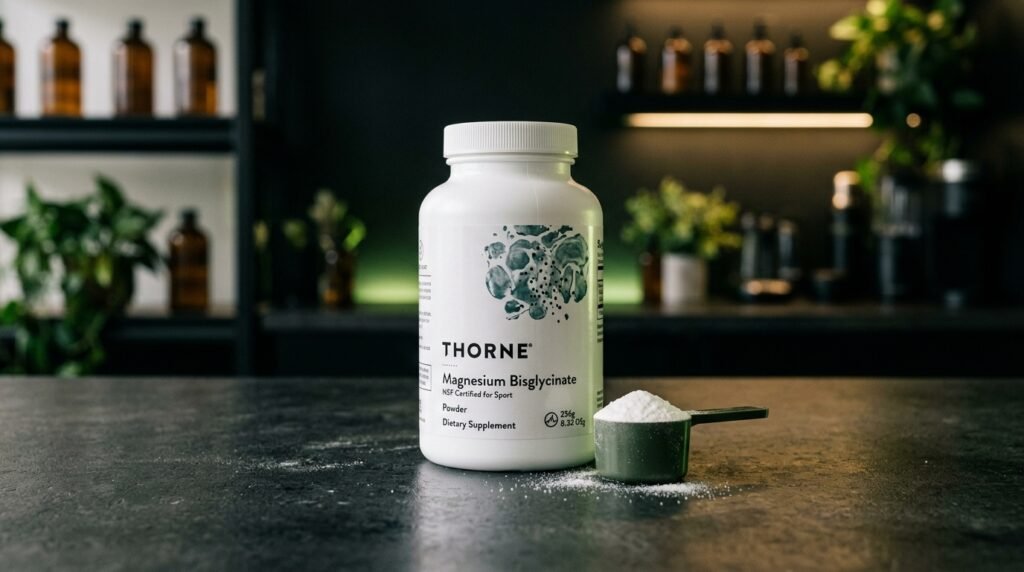
Thorne Magnesium Bisglycinate is the magnesium supplement that most directly replicates the clinical protocols showing anxiety relief. NSF Certified for Sport, pharmaceutical manufacturing standards, 200mg elemental magnesium per serving as bisglycinate chelate — the form with the strongest GABA receptor affinity and the highest bioavailability of any commonly available magnesium form.
The powdered format allows precise dosing: 1 scoop (200mg) for men starting supplementation or managing mild anxiety, 2 scoops (400mg) for men with more significant deficiency or higher training-driven magnesium losses. Take 30–60 minutes before bed — GABA receptor activation supports both the anxiety-calming effect and the sleep quality improvement that frequently accompanies it.
A man working a high-pressure job who describes himself as “always wired but tired” — the classic cortisol-driven anxiety profile — who starts Thorne Bisglycinate at 400mg before bed typically reports feeling less reactive to workplace stressors within 2–3 weeks, with more pronounced effects at 6–8 weeks as HPA axis regulation improves.
Pros: NSF certified, bisglycinate form for maximum GABA receptor effect, pharmaceutical manufacturing, flexible dosing, Thorne’s track record. Cons: Powdered format less travel-friendly than capsules, no copper supplementation at higher doses, 4–8 week timeline for full HPA axis effects.
What to Look for When Choosing Magnesium for Anxiety
1. Form first — bisglycinate or glycinate only For anxiety specifically, the form is non-negotiable. Bisglycinate and glycinate produce tissue magnesium repletion and GABA receptor support. Oxide, carbonate, and sulfate forms don’t achieve adequate tissue delivery at standard supplement doses. Check the supplement facts panel for “magnesium bisglycinate,” “magnesium glycinate,” or “magnesium glycinate chelate” before any other consideration.
2. Elemental magnesium dose of 300–400mg daily The clinical trials showing anxiety relief used 300–400mg elemental magnesium daily — not the milligrams of the compound listed on the front label. Magnesium bisglycinate at 500mg compound weight contains approximately 100mg elemental magnesium. Verify the elemental magnesium content on the supplement facts panel and calculate how many capsules or scoops reach the 300–400mg therapeutic range.
3. Evening dosing for anxiety and sleep synergy Magnesium’s GABA receptor activation is most beneficial taken 30–60 minutes before sleep — the calming effect on neural activity addresses both evening anxiety and sleep onset simultaneously. Men who take magnesium in the morning get the nutritional benefits (ATP synthesis, HPA axis support) but miss the most directly perceptible anxiety-relevant effect that evening dosing produces.
4. Consistent 6–8 week trial before evaluating The HPA axis modulation that drives anxiety relief requires 4–6 weeks of consistent daily supplementation. The NMDA receptor blocking effect begins sooner — within 1–2 weeks — but the full anxiety benefit compounds as cortisol reactivity normalizes. Men who evaluate magnesium at 2–3 weeks and conclude it isn’t working are assessing before the primary mechanism has fully operated.
5. Rule out other deficiencies Magnesium deficiency is the most common mineral deficiency in men with anxiety symptoms — but it’s not the only one. Zinc deficiency and vitamin D deficiency both independently contribute to anxiety and low mood. Men who don’t respond adequately to magnesium alone should consider testing zinc and vitamin D status before adding more supplements. The goal is identifying the deficiency driving symptoms, not stacking every mineral with anxiety associations.
FAQ
How long does it take for magnesium to reduce anxiety?
Most men notice reduced evening tension and improved sleep quality within 7–14 days of consistent magnesium glycinate or bisglycinate use at 300–400mg before bed. The deeper HPA axis effects — reduced cortisol reactivity to stressors, lower baseline anxiety throughout the day — typically emerge at 4–6 weeks of consistent supplementation. Setting a 6–8 week minimum assessment window produces a more accurate evaluation than judging at 2–3 weeks.
Can magnesium replace anxiety medication?
No. Magnesium supports the nervous system’s natural self-regulation capacity and may meaningfully reduce mild-to-moderate anxiety symptoms related to deficiency and HPA axis dysregulation. It doesn’t replace medical treatment for clinical anxiety disorders, panic disorder, or PTSD, which require professional evaluation and may require pharmacological or therapeutic intervention. Men with severe or functionally impairing anxiety should work with a healthcare provider rather than relying on supplementation alone.
What is the best magnesium dose for anxiety in men?
The dose used in clinical trials showing anxiety relief ranges from 300–400mg elemental magnesium daily as glycinate or bisglycinate. Most men start at 200mg and increase to 300–400mg if the lower dose produces no noticeable effect after 2 weeks. The NIH tolerable upper intake level for supplemental magnesium is 350mg per day — above this, digestive side effects become more common, though most men with normal kidney function tolerate 400mg glycinate without issue.
Does magnesium help with anxiety caused by caffeine or stimulants?
Partially. Caffeine increases urinary magnesium excretion and may reduce magnesium status over time in high consumers — men drinking 4+ cups of coffee daily are at higher risk of magnesium insufficiency than moderate consumers. Caffeine also directly antagonizes adenosine receptors, producing alertness and anxiety through a separate mechanism that magnesium doesn’t directly counteract.
Reducing caffeine intake after noon and supplementing magnesium glycinate addresses both the deficiency component and the timing-driven sleep anxiety, but magnesium won’t neutralize excessive caffeine’s direct stimulant effects.
Our Final Verdict
Magnesium does help with anxiety in men — through documented mechanisms involving GABA receptor function, NMDA receptor modulation, and HPA axis regulation — with the most pronounced effects in men with existing deficiency, which describes a significant portion of active, high-stress men.
The form matters more than the brand: bisglycinate or glycinate at 300–400mg elemental magnesium, taken consistently before bed for a minimum of 6–8 weeks, replicates the protocols that produce clinical results. Thorne Magnesium Bisglycinate at 200–400mg is the starting point for most men. Budget-conscious men should consider NOW Foods Magnesium Glycinate as a lower-cost alternative that covers the same mechanism. Check current pricing on Amazon for both options in this guide.