

This article contains affiliate links. We may earn a commission if you buy through our links, at no extra cost to you.
How Much Protein Do Men Need Per Day in 2026
Most men are eating the wrong amount of protein — and surprisingly, the error cuts both ways. Some are chronically under-eating protein while wondering why they’re not building muscle or staying lean. Others are consuming 300g daily based on gym folklore, spending a fortune on supplements they don’t need, and putting unnecessary stress on their kidneys in the process. How much protein men need per day is one of the most debated questions in nutrition, and the honest answer is more nuanced than any single number suggests.
After reviewing the clinical research on protein requirements across age groups, training levels, and body composition goals, here is what the evidence actually shows for men in 2026 — and how to apply it practically without overcomplicating your diet.
Quick Answer: Most active men need 0.7–1g of protein per pound of bodyweight daily (1.6–2.2g per kg) to support muscle maintenance, recovery, and body composition. Sedentary men can function adequately at 0.36g per pound (0.8g per kg), but this is the minimum to prevent deficiency — not the amount that supports performance or healthy aging. Men over 40 should target the higher end of the range to offset age-related muscle loss.
Why the RDA for Protein Is Misleading for Most Men
The official Recommended Dietary Allowance for protein is 0.36g per pound of bodyweight (0.8g per kg) per day — a number that gets cited constantly and misapplied almost as often. A 180-pound man at this RDA would eat just 65g of protein daily. That’s enough to prevent deficiency. It’s not enough to build muscle, maintain lean mass during a calorie deficit, support recovery from training, or slow the muscle loss that accelerates after 40.
The RDA was established to represent the minimum requirement for the average sedentary adult — not an optimization target for active men. The difference matters enormously in practice.
A 2017 meta-analysis in the British Journal of Sports Medicine analyzed 49 clinical trials and found that protein intakes above 1.62g per kg (0.73g per pound) produced no additional muscle gain in resistance-trained men — establishing a practical upper threshold for muscle-building purposes. Below that threshold, more protein generally means more muscle. Above it, the excess is oxidized for energy.
The counterintuitive finding: eating significantly more protein than 1g per pound doesn’t accelerate muscle building — it just increases your grocery and supplement bill. The sweet spot for most active men is 0.7–1g per pound, with the higher end reserved for men in a calorie deficit or men over 40 managing age-related muscle loss.
For men tracking protein alongside a complete supplement strategy, see our guide on best protein powder for men over 30 — the right protein source matters as much as hitting the daily number.
How Protein Requirements Change with Age
Protein requirements don’t stay static across a man’s life. They shift meaningfully at two key inflection points: around 40 and again after 60.
Men in their 20s and 30s have optimal anabolic sensitivity — their muscles respond efficiently to protein intake and training stimulus. At this stage, 0.7–0.8g of protein per pound of bodyweight covers most men’s muscle-building and maintenance needs, provided training is consistent and overall calories are appropriate. Going higher (to 1g per pound) provides a useful buffer during aggressive calorie deficits but isn’t necessary for men eating at maintenance or in a modest surplus.
Men over 40 experience a physiological shift called anabolic resistance — the muscle protein synthesis response to a given dose of protein weakens. The same 30g of protein that maximally stimulates muscle protein synthesis in a 25-year-old may produce only 60–70% of that response in a 50-year-old. The compensatory strategy supported by research is higher overall protein intake — 0.8–1g per pound — to maintain the same anabolic stimulus despite reduced per-dose efficiency.
Men over 60 face sarcopenia — the progressive age-related loss of muscle mass that accelerates significantly after 60 without intervention. Research in this population consistently shows that 1–1.2g of protein per pound of bodyweight, combined with resistance training, meaningfully slows this loss. For older men, protein isn’t just a performance nutrient — it’s a functional independence nutrient.
In our experience, men who start taking protein seriously in their late 30s rather than waiting until they notice significant muscle loss in their mid-40s have a substantially easier time maintaining body composition into their 50s.
Protein Distribution Matters as Much as Total Intake

Hitting your daily protein target is important. How you distribute that protein across meals may matter nearly as much — and this is the variable most men completely ignore.
Muscle protein synthesis — the cellular process that builds and repairs muscle — is triggered by individual protein doses rather than by total daily intake. Research consistently shows that 25–40g of high-quality protein per meal maximally stimulates muscle protein synthesis in most men. Eating 180g of protein in two large meals produces less muscle-building stimulus than distributing the same 180g across four or five meals of 35–45g each.
The practical implication: a man eating most of his protein in a single large dinner — common in men who eat light during the day — is leaving muscle protein synthesis on the table at every other meal, regardless of whether his daily total looks adequate on a tracking app.
Leucine threshold is the mechanism behind this. Leucine — the essential amino acid that acts as the primary trigger for muscle protein synthesis via the mTOR pathway — needs to reach approximately 2–3g per meal to maximally activate the signaling cascade. A 35g serving of quality protein (whey, chicken, beef, eggs) reliably delivers this. Smaller protein doses or lower-quality proteins may fall short of the leucine threshold even if the gram count looks reasonable.
Breakfast is the meal where most men fall furthest below their leucine threshold. A typical breakfast of toast, fruit, and coffee might contain 8–12g of protein — nowhere near the 25–40g required to stimulate meaningful muscle protein synthesis at that meal.
The Best Protein Sources for Meeting Daily Requirements
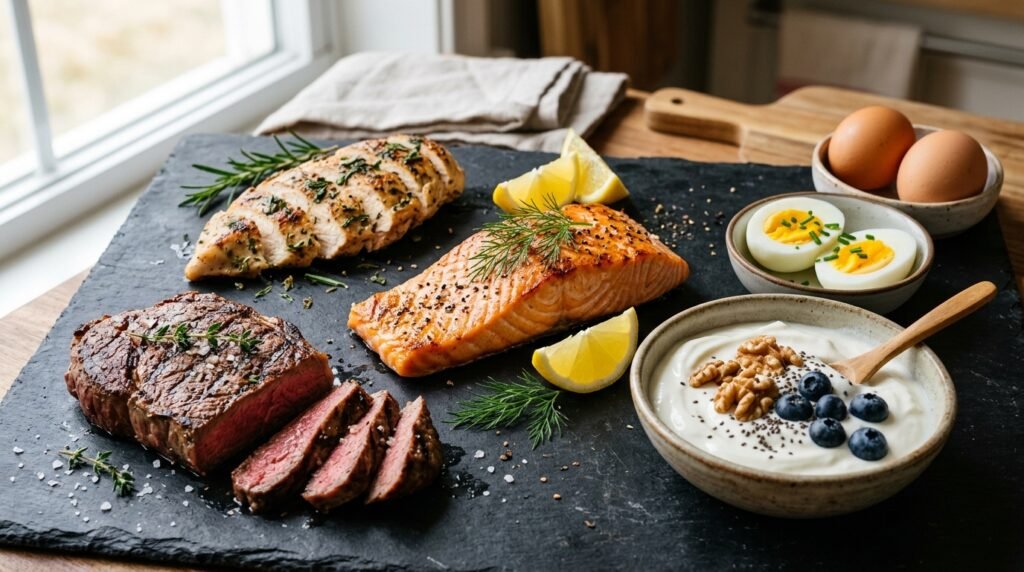
Not all protein is equivalent in its ability to support muscle protein synthesis. The quality difference between protein sources is primarily driven by amino acid profile — specifically leucine content and essential amino acid completeness.
Animal proteins — whey, eggs, chicken, beef, fish — are complete proteins containing all nine essential amino acids at ratios that efficiently support muscle protein synthesis. Whey protein specifically has the highest leucine content of any commonly consumed protein source, which is why it consistently outperforms plant proteins in head-to-head muscle-building trials at equivalent gram doses.
Plant proteins — pea, rice, soy, hemp — are typically lower in one or more essential amino acids. Soy is the most complete plant protein and performs comparably to whey in some longer-term studies. Pea and rice proteins are often combined (usually 70/30 ratio) to improve the combined amino acid profile. Plant protein sources generally require 10–15% higher gram intake to achieve the same muscle protein synthesis stimulus as equivalent whey doses.
Whole food protein sources in order of leucine content per 100g: whey protein (~10g leucine), eggs (~1g leucine), chicken breast (~1.5g leucine), salmon (~1.4g leucine), beef (~1.8g leucine), Greek yogurt (~0.7g leucine). Getting 35–40g of protein from whole food sources is entirely achievable — but for men whose schedules make consistent high-protein meal preparation difficult, a quality protein supplement covers the gap efficiently.
For men managing protein intake alongside creatine supplementation for recovery, see our guide on best supplements for muscle recovery — protein and creatine address complementary recovery mechanisms that work better together than either does alone.
When a Protein Supplement Actually Makes Sense
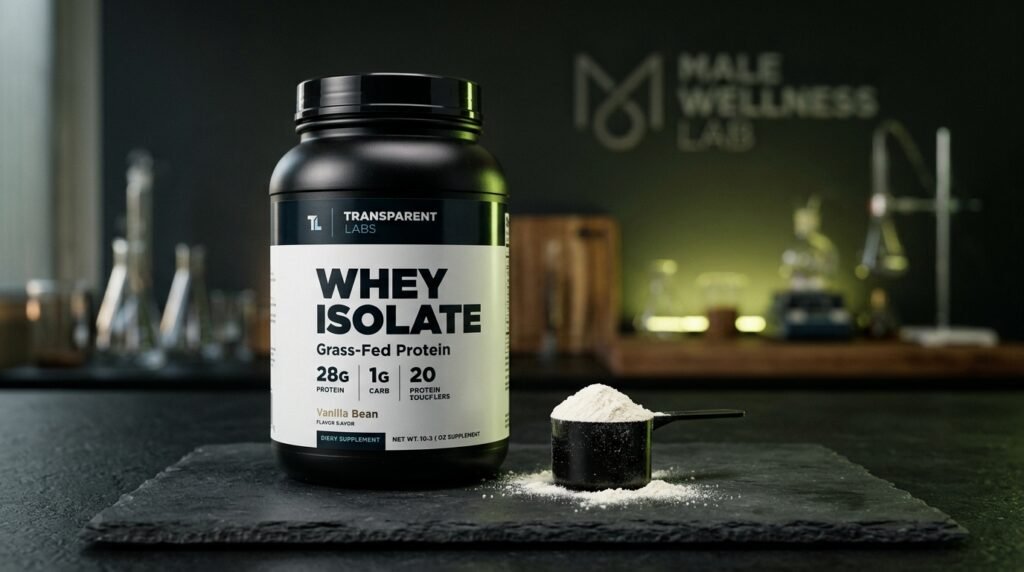
Whole food protein is almost always preferable to supplemental protein — it comes with micronutrients, satiety, and metabolic benefits that isolated protein powder doesn’t replicate. The case for protein supplements is practical, not biological.
A man who needs 160g of protein daily and can realistically hit that number from chicken, eggs, fish, and Greek yogurt without tracking obsessively should do exactly that. A man who consistently lands at 90–110g by dinner and faces the choice of cooking another full meal or having a protein shake makes the sensible call when he picks the shake.
The honest truth about protein supplements is that they’re a convenience tool, not a magic muscle builder. The men who see the best results from protein powder are those using it to reliably close a genuine gap in their daily intake — not those replacing whole food meals with supplements under the assumption that isolated whey is somehow superior to a chicken breast.
Transparent Labs Whey Isolate is the protein supplement that makes the most sense for most men. 28g protein per serving, 2.7g leucine (above the threshold for maximal muscle protein synthesis stimulation), no artificial sweeteners, and a clean ingredient label. At roughly $2.00 per serving it’s not the cheapest option available — but the leucine content, ingredient quality, and third-party testing justify the premium for men who are serious about hitting their daily protein target consistently. Use it as the last 30–50g of a day when whole food sources haven’t covered the full requirement, not as a meal replacement.
Practical Framework for Hitting Your Protein Target
Knowing how much protein men need per day is straightforward. Building a daily eating pattern that reliably delivers it is where most men fall short.
Step 1: Set your target. Use 0.8g per pound as your baseline if you train 3–4 times per week. Adjust to 1g per pound if you’re in a calorie deficit, training 5+ times per week, or over 40.
Step 2: Distribute across 4–5 meals or eating occasions. Each meal should contain 30–45g of protein from a quality source. Breakfast is typically the hardest — eggs, Greek yogurt with added protein powder, or cottage cheese are the most practical high-protein breakfast options.
Step 3: Anchor protein in every meal before adding carbohydrates or fats. Men who build meals around their protein source rather than adding protein to a carbohydrate-centered meal reliably hit higher daily totals without conscious tracking.
Step 4: Track for 2 weeks, then adjust. Most men significantly overestimate their protein intake before they track it. Two weeks of accurate tracking establishes a realistic baseline and identifies the specific meals where protein is consistently low — almost always breakfast and lunch.
A 185-pound man targeting 185g daily could structure it as: breakfast 40g (Greek yogurt + eggs), lunch 45g (chicken breast + cottage cheese), afternoon snack 30g (protein shake), dinner 50g (beef or salmon), evening 20g (Greek yogurt). Practical, not complicated.
FAQ
Is 1g of protein per pound of bodyweight really necessary?
For most active men, 0.7–0.8g per pound covers muscle maintenance and moderate training recovery adequately. The 1g per pound guideline provides a useful buffer — particularly during calorie deficits, high training volumes, or for men over 40 with reduced anabolic sensitivity. It’s not a hard biological requirement but a practical target that ensures you’re not leaving muscle protein synthesis on the table.
Can you eat too much protein?
For healthy men with normal kidney function, protein intakes up to 2.2g per pound of bodyweight daily show no adverse effects in clinical research. The concern about protein damaging healthy kidneys is not supported by current evidence — that restriction applies to men with pre-existing kidney disease. The practical upper limit isn’t a health concern for most men; it’s a financial one. Above 1g per pound, additional protein produces diminishing returns for muscle building.
Does protein timing matter — specifically eating protein immediately after training?
The “anabolic window” — the idea that protein must be consumed within 30 minutes of training or results suffer — is largely overstated. Research shows the muscle protein synthesis elevation from training persists for 24–48 hours, meaning protein consumed throughout the day contributes to recovery, not just protein consumed immediately post-workout. Getting protein within 2 hours of training is a reasonable practice. Missing a post-workout shake by an hour won’t meaningfully affect your results if your daily total is on target.
How much protein do men need per day to lose weight?
Men in a calorie deficit should increase protein intake, not maintain or reduce it. Higher protein during fat loss — 0.8–1g per pound of bodyweight — preserves lean muscle mass that would otherwise be lost alongside fat during calorie restriction. Protein also has the highest thermic effect of any macronutrient (25–30% of calories consumed are burned in digestion) and the strongest satiety effect per calorie, making higher protein intake a practical tool for managing hunger during a deficit.
Our Final Verdict
How much protein men need per day comes down to a simple framework: 0.7–0.8g per pound for active men under 40 maintaining or building, 0.8–1g per pound for men over 40, men in a calorie deficit, or men training at high volume. Distribute that intake across 4–5 meals of 30–45g each rather than backloading into one or two large meals.
Prioritize whole food protein sources — chicken, eggs, beef, fish, Greek yogurt — and use a quality supplement like Transparent Labs Whey Isolate to close the gap when whole food sources fall short. Check current pricing on Amazon for protein supplements that meet the leucine and ingredient quality standards in this guide.