
This article contains affiliate links. We may earn a commission if you buy through our links, at no extra cost to you.
Does Zinc Increase Testosterone?
Zinc increases testosterone — but only under a specific condition that most articles bury in paragraph eight or skip entirely. That condition determines whether zinc supplementation will move your testosterone meaningfully or do essentially nothing. If you’re already getting adequate zinc from your diet, no amount of additional supplementation will push testosterone above your genetic baseline. If you’re deficient — which is more common than most men assume — restoring zinc status can raise testosterone by 20–50% over 6 months based on clinical data.
After reviewing the research on zinc and testosterone, including the studies supplement companies cite and the context those companies leave out, here is what the evidence actually shows in 2026.
Quick Answer: Zinc increases testosterone in zinc-deficient men by restoring the enzymatic processes that deficiency suppresses — studies document 20–50% testosterone improvements in severely deficient men over 6 months. In zinc-sufficient men, supplementation does not raise testosterone above baseline. Before spending money on zinc, the most useful step is determining whether you’re actually deficient. If you are, Thorne Zinc Bisglycinate at 15mg is the cleanest starting point for most men.
What the Research Actually Shows
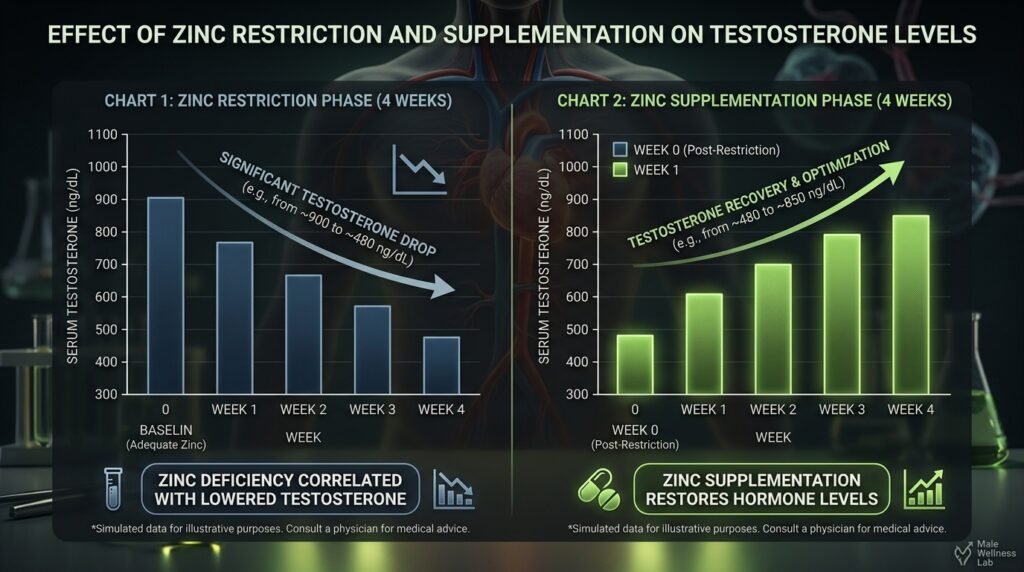
The most cited study on zinc and testosterone is a 1996 trial published in Nutrition — researchers restricted dietary zinc in young men for 20 weeks and watched testosterone fall by 75%. Then they supplemented elderly men with marginal zinc deficiency for 6 months and observed testosterone nearly double. Supplement companies have been citing this study ever since.
What they don’t mention is the mechanism. Testosterone didn’t increase because zinc is a testosterone booster. It increased because zinc deficiency was suppressing testosterone production, and fixing the deficiency removed the suppression. The men went from deficient to sufficient — not from sufficient to supraphysiological.
A 2010 study in the Journal of Exercise Physiology found that wrestlers supplementing with zinc during an intensive training camp maintained testosterone levels while the placebo group experienced significant declines — consistent with the hypothesis that heavy sweat losses create zinc deficiency that then suppresses testosterone.
The counterintuitive conclusion: zinc isn’t a testosterone booster. It’s a testosterone deficiency preventer. For men already getting adequate zinc, additional supplementation won’t push testosterone higher. The supplement works for the men who need it and does essentially nothing for the men who don’t.
For a broader picture of what actually moves testosterone through lifestyle and nutrition, see our guide on how to increase testosterone naturally — zinc is one piece of a larger framework that includes sleep, training, body composition, and stress.
Why Zinc Deficiency Is More Common Than Men Realize

If zinc only increases testosterone in deficient men, the logical question is: how many men are actually deficient? More than most assume.
Roughly 12% of Americans are clinically zinc deficient, but marginal deficiency — low enough to impair zinc-dependent enzymatic processes without hitting the clinical threshold — affects a much larger population. The highest-risk groups are identifiable.
Vegetarians and vegans absorb significantly less zinc. Plant-based zinc is bound to phytates in grains and legumes that reduce absorption by 15–30% compared to animal sources. A vegetarian eating the same total dietary zinc as a meat eater absorbs meaningfully less of it — plant-forward men often need 50% higher dietary intake to achieve equivalent zinc status.
High-volume athletes lose approximately 1mg of zinc per liter of sweat. A man training 2 hours daily in hot conditions can lose 2–3mg through sweat alone — 20–25% of the RDA in a single session. Studies consistently show lower zinc status in endurance and combat sport athletes compared to sedentary men at equivalent dietary intake.
Heavy drinkers have impaired zinc absorption and increased urinary zinc excretion. Men consuming more than 14 drinks per week are at meaningful risk of marginal deficiency.
Men on highly processed diets low in red meat, shellfish, and legumes often fall well below the 11mg RDA. The zinc-rich whole foods — oysters, beef, pumpkin seeds — are underrepresented in standard Western processed diets.
How Zinc Affects Testosterone Biologically
Understanding the mechanism sets realistic expectations for what supplementation can and can’t do.
Zinc functions as a cofactor in Leydig cell function — the specialized cells in the testes responsible for testosterone synthesis. The enzymatic conversion of cholesterol into testosterone precursors requires zinc at multiple steps. When zinc is insufficient, this conversion becomes less efficient and testosterone output decreases.
Zinc also inhibits aromatase — the enzyme that converts testosterone into estradiol. In zinc-deficient men, reduced aromatase inhibition allows more testosterone to convert to estrogen, compounding the production deficit.
The third mechanism involves luteinizing hormone (LH) receptor sensitivity. Zinc deficiency impairs how efficiently Leydig cells respond to the pituitary signal telling them to produce testosterone. Restoring zinc status improves receptor sensitivity and the entire hormonal signaling chain.
These three mechanisms explain why zinc deficiency specifically suppresses testosterone — and why going above sufficient zinc status doesn’t continue to boost it. The enzymatic pathways are already running efficiently. Additional zinc can’t make them faster.
For men looking at the full supplement picture for hormonal and energy support, see our guide on best supplements for energy and focus for men — adaptogenic compounds that reduce cortisol work through a complementary mechanism to zinc’s role in testosterone production.
How to Know If Zinc Is Suppressing Your Testosterone
Before supplementing, knowing your actual zinc status is more useful than guessing from symptoms.
A serum zinc blood test costs $15–40 through direct-to-consumer labs like Any Lab Test Now or LabCorp. Optimal serum zinc is 70–120 mcg/dL. Below 70 mcg/dL indicates deficiency. Men in the 70–80 mcg/dL range are marginal — likely experiencing some enzymatic impairment even without a clinical diagnosis.
Symptoms that correlate with marginal zinc deficiency include reduced libido, slower wound healing, frequent minor infections, taste and smell changes, and fatigue that doesn’t resolve with adequate sleep. None are specific to zinc alone, but a cluster of these alongside a high-risk lifestyle — vegetarian, heavy trainer, high alcohol intake — is reasonable grounds to test.
In our experience, the men most likely to see meaningful testosterone improvement from zinc are those with two or more risk factors: vegetarian or low red-meat diet, high training volume with heavy sweating, alcohol above 10 drinks per week, or chronic high stress. Men eating red meat 3–4 times weekly, not training heavily, and not drinking much are less likely to be deficient and more likely to see minimal response.
The Best Zinc Supplement for Testosterone Support
If your risk profile suggests deficiency or testing confirms low zinc status, the molecular form matters — it determines how much zinc actually reaches tissue.
For a full breakdown of every option across budget, dose, and form, see our dedicated guide on the best zinc supplement for testosterone. For most men starting out, one product covers the bases cleanly.
1. Thorne Zinc Bisglycinate — Best Overall (~$15–18 / 60 servings)
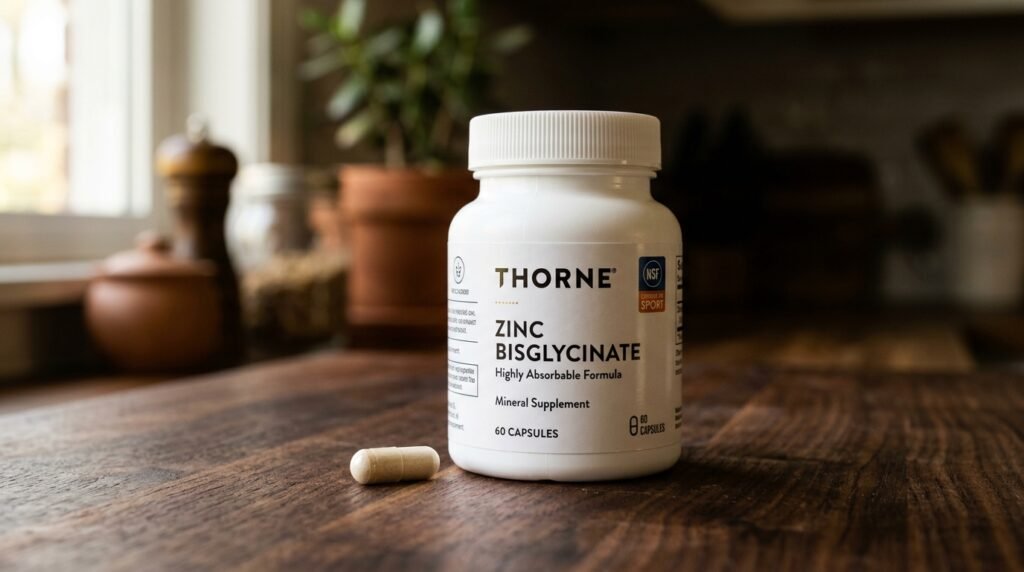
Thorne Zinc Bisglycinate at 15mg elemental zinc per capsule is where most men should start. Bisglycinate chelate absorbs through amino acid transport pathways rather than competing mineral channels, producing approximately 43% better absorption than zinc oxide in head-to-head studies. NSF certified, pharmaceutical manufacturing standards, clean label with no unnecessary fillers.
15mg per capsule allows precise dosing — one capsule for maintenance, two for deficiency correction — without approaching the 40mg upper tolerable intake limit from a single serving. At roughly $0.28 per day it’s the most cost-effective quality zinc option available. Athletes and heavy trainers depleting both zinc and magnesium through sweat should consider pairing it with a magnesium supplement or switching to ZMA JYM, which addresses both deficiencies in one product.
Pros: Pharmaceutical manufacturing, NSF certified, bisglycinate for superior absorption, minimal GI side effects, flexible dosing. Cons: No copper included — add 1–2mg copper separately if running two capsules daily for more than 8 weeks.
What to Look for When Choosing Zinc for Testosterone Support
1. Confirm deficiency before choosing a high dose The therapeutic dose for correcting zinc deficiency is 25–45mg elemental zinc daily. The appropriate maintenance dose for zinc-sufficient men is 10–15mg. Choosing a correction dose without knowing your baseline risks chronic over-supplementation — above 40mg total daily zinc from all sources, copper depletion becomes a real concern over months of use.
2. Bisglycinate, monomethionine, or picolinate — not oxide Zinc oxide is cheap and poorly absorbed — roughly half the bioavailability of chelated forms at equivalent doses. For a supplement taken specifically to restore tissue zinc status, the absorption difference is too large to ignore. Always check the molecular form on the supplement facts panel before purchasing.
3. Add copper at higher doses At 25–30mg daily zinc, copper supplementation at 1–2mg becomes important to prevent depletion over months of use. Copper depletion symptoms — fatigue, anemia, joint pain — take months to appear, which is why most men never connect them to their zinc supplementation.
4. Timing and food interactions Take zinc with food to reduce nausea — the main side effect of zinc on an empty stomach. Avoid taking it with coffee, black tea, or calcium-rich foods — tannins and calcium both reduce zinc absorption meaningfully. A 1–2 hour gap between zinc and these foods maintains absorption efficiency.
5. Reassess after 90–180 days Tissue zinc repletion takes 3–6 months of consistent supplementation. Blood zinc normalizes faster than tissue stores — a blood test at 4 weeks showing normal serum zinc doesn’t mean tissue stores are restored. Plan for a full 90–180 day period before retesting and deciding whether to reduce to maintenance dose.
FAQ
How long does it take for zinc to increase testosterone?
In genuinely zinc-deficient men, measurable testosterone improvement typically appears within 3–6 months of consistent supplementation at 25–45mg daily. The timeline reflects how long tissue zinc repletion takes — blood zinc normalizes faster, but testosterone improvement tracks with tissue restoration rather than blood levels. Expecting changes at 2–4 weeks is unrealistic. The relevant assessment window is 90–180 days.
How much zinc should I take to increase testosterone?
The dose that produces testosterone improvements in clinical research is 25–45mg elemental zinc daily — in men with documented deficiency. The tolerable upper intake level from all sources combined is 40mg per day, meaning supplementation should account for dietary zinc. Most men eating a standard diet with some animal protein get 8–12mg from food, leaving room for 15–30mg supplemental zinc before approaching the upper limit.
Can I get enough zinc for testosterone from food alone?
Yes, if your diet consistently includes zinc-rich foods. Oysters are the highest zinc source at 74mg per 3oz serving — a single serving covers nearly a week’s RDA. Red meat provides 4–7mg per serving. Pumpkin seeds provide 2–3mg per ounce. Men eating red meat 3–4 times weekly with legumes and seeds likely maintain adequate zinc without supplementation. Vegetarians, heavy drinkers, and high-volume athletes are the populations where food alone reliably fails.
Does zinc work better for testosterone when combined with magnesium?
The ZMA combination has specific research support for athletes and men with high sweat losses who are simultaneously depleting both minerals. Since both zinc and magnesium deficiency independently suppress testosterone through different mechanisms, addressing both simultaneously produces a combined effect that neither supplement achieves alone in men deficient in both. For men deficient in only one mineral, the combination doesn’t add testosterone benefit beyond the deficient nutrient alone.
Our Final Verdict
Does zinc increase testosterone? Yes — specifically in men whose testosterone is being suppressed by zinc deficiency, which is a real and common condition in vegetarians, heavy trainers, and men with high alcohol intake. For zinc-sufficient men, supplementation maintains the status quo rather than pushing testosterone higher. The most useful action before buying anything is a serum zinc test — $15–40 that tells you whether zinc supplementation will actually move your testosterone or just empty your wallet.
If deficiency is confirmed, Thorne Zinc Bisglycinate at 15–30mg daily is the cleanest starting point. Athletes depleting both zinc and magnesium through sweat should look at ZMA JYM to address both deficiencies simultaneously. Give it 90–180 days before evaluating results. Check current pricing on Amazon for the zinc supplements mentioned in this guide.