

This article contains affiliate links. We may earn a commission if you buy through our links, at no extra cost to you.
Melatonin vs Magnesium for Sleep in 2026
Most men trying to fix their sleep reach for melatonin first — it’s in every drugstore, it’s cheap, and it feels like a logical solution. The problem is that melatonin and magnesium fix entirely different sleep problems, and picking the wrong one means weeks of supplementation that produces minimal improvement while the actual issue goes unaddressed. Melatonin vs magnesium for sleep is not a question of which is better overall — it’s a question of which one matches your specific sleep problem.
After researching the clinical evidence on both compounds and comparing how they actually perform for different sleep complaint profiles, here is what the science settles in 2026.
This guide is for men who’ve tried one or both without satisfying results, or who want to choose correctly from the start rather than cycling through trial and error.
Quick Answer: Melatonin fixes sleep timing problems — difficulty falling asleep at your intended bedtime, jet lag, shift work disruption. Magnesium fixes sleep quality problems — light sleep, nighttime waking, unrefreshing sleep, and muscle tension. Most men over 30 struggling with sleep quality benefit more from magnesium than melatonin. Start with Thorne Magnesium Bisglycinate at 300–400mg before bed unless your primary complaint is specifically falling asleep too late.
They Solve Different Problems — This Is the Core of the Comparison
The melatonin vs magnesium debate gets muddled because people treat it as a general “sleep supplement” comparison when the two compounds work through completely different mechanisms on completely different aspects of sleep.
Melatonin is a hormone — specifically, the hormone that signals to the brain that darkness has arrived and sleep should begin. Your pineal gland produces it naturally in response to light reduction in the evening. Supplemental melatonin advances or delays the body clock, making it easier to fall asleep at a specific time. Its primary clinical use is for circadian rhythm disruption: jet lag, shift work, delayed sleep phase syndrome, and helping the blind maintain sleep-wake cycles. It does not improve sleep quality, increase deep sleep, or reduce nighttime waking — it changes when you fall asleep, not how well you sleep once you do.
Magnesium is a mineral that supports the neurological inhibitory systems that enable deep sleep. It activates GABA receptors — the neurotransmitter system that quiets neural activity — and blocks NMDA receptors that drive hyperactivation and anxiety. It also regulates the parasympathetic nervous system shift required for deep slow-wave sleep. Its clinical use is for sleep quality and depth: reducing sleep onset time through GABA activation, increasing deep sleep duration, reducing nighttime waking, and improving sleep continuity.
The counterintuitive conclusion: men who wake at 3am, sleep lightly, or feel unrefreshed despite 8 hours of sleep almost certainly have a sleep quality problem, not a timing problem. Melatonin doesn’t help them. Magnesium does.
For the complete picture of natural sleep improvement beyond supplementation, see our guide on how to improve sleep quality naturally — both supplements work best on top of foundational behavioral changes.
When Melatonin Is the Right Choice
Melatonin has a specific and valid use case — and men who fit that use case see genuine, rapid benefit from even low doses.
Jet lag is melatonin’s strongest evidence category. Taking 0.5–1mg at the target destination’s bedtime for 3–4 nights advances the circadian clock to the new time zone measurably faster than the body adjusts naturally. A man flying from New York to London who takes 0.5mg melatonin at 10pm UK time for three nights experiences significantly less daytime fatigue and nighttime wakefulness than without supplementation. This is one of the most well-replicated findings in sleep research.
Delayed sleep phase — the inability to fall asleep before 1–2am despite wanting to sleep at 11pm — responds to melatonin taken 2–3 hours before the desired sleep time at very low doses (0.5mg). The key is using it to shift the clock, not to sedate — the dose required for clock-shifting is far lower than the doses sold in American supplement aisles.
Occasional sleep onset difficulty related to travel, schedule disruption, or unusual stress responds to melatonin at 0.5–1mg taken 30–60 minutes before the intended sleep time. Short-term use for defined circadian disruption is melatonin’s appropriate application.
What most reviews won’t tell you is that American melatonin doses are wildly excessive. The effective dose for circadian effects is 0.1–1mg. Products selling 5–10mg doses aren’t more effective — they produce higher next-day grogginess without proportional sleep benefit and can suppress endogenous melatonin production with regular use.
When Magnesium Is the Right Choice
Magnesium addresses the sleep problems that affect the majority of men in their 30s and 40s — and it addresses them through mechanisms that melatonin simply doesn’t touch.
Light, unrefreshing sleep is the most common sleep complaint in men over 30 and the one most directly responsive to magnesium supplementation. The age-related decline in slow-wave deep sleep that begins in the late 20s is accelerated by magnesium deficiency, which impairs the GABA receptor activation that facilitates the transition into and maintenance of deep sleep stages. Men supplementing 300–400mg magnesium bisglycinate before bed consistently show increased slow-wave sleep duration in studies — the exact stage that produces testosterone, growth hormone, and cellular repair.
Nighttime waking — particularly waking at 2–4am and struggling to return to sleep — often reflects magnesium-deficient HPA axis dysregulation that produces cortisol elevation at the wrong time of night. Magnesium’s role in regulating cortisol rhythm through HPA axis modulation makes it directly relevant for this specific complaint. Men with this pattern who start magnesium supplementation consistently report fewer nighttime wakings within 7–14 days.
Muscle tension and restless legs that disrupt sleep respond specifically to magnesium — the mineral that governs the calcium-magnesium balance required for complete muscle relaxation. Magnesium deficiency keeps muscles in a partially contracted state that prevents the physical relaxation required for quality sleep.
The honest truth about magnesium for sleep is that its effects are slower than melatonin’s — they build over 1–3 weeks as tissue magnesium stores replete — but they’re more comprehensive and don’t carry melatonin’s risk of tolerance or circadian disruption with regular use.
For men tracking sleep quality improvement with objective data, see our guide on the best sleep tracker for men — HRV and deep sleep percentage data make the magnesium effect measurable rather than subjective.
Can You Take Both? The Combination Approach
For men with both timing and quality problems — common in men with disrupted schedules, shift work, or significant jet lag alongside underlying sleep quality issues — combining melatonin and magnesium addresses both mechanisms simultaneously without interaction risk.
The combination protocol that produces the best outcomes: Magnesium bisglycinate at 300–400mg taken 60 minutes before bed as the foundation for sleep quality. Melatonin at 0.5–1mg taken 30 minutes before the intended sleep time for timing support when needed — not nightly, but on an as-needed basis for circadian disruption.
What doesn’t work is using high-dose melatonin (5–10mg) nightly as a substitute for addressing sleep quality issues with magnesium. Men who take 10mg melatonin and still wake at 3am are experiencing this failure mode — the melatonin is addressing timing while the sleep quality problem (which is a GABA/magnesium issue) goes unaddressed. They fall asleep faster and still sleep poorly.
In our experience, the most common mistake is using melatonin as a sedative — taking high doses expecting it to keep you asleep — when magnesium is the compound that actually improves sleep maintenance and depth. Melatonin is a clock signal, not a sleep quality intervention.
The Best Products for Each Approach
1. Thorne Magnesium Bisglycinate — Best Magnesium for Sleep (~$22 / 60 servings)

Thorne Magnesium Bisglycinate is the magnesium product that most directly replicates the clinical protocols showing sleep quality improvement. NSF Certified for Sport, pharmaceutical manufacturing, 200mg elemental magnesium per serving as bisglycinate chelate — the form with the strongest GABA receptor affinity and the highest bioavailability of any magnesium form. The bisglycinate chelation adds glycine’s independent calming effect, making this a genuinely synergistic compound rather than just magnesium in a carrier.
Take 1–2 scoops (200–400mg elemental magnesium) 30–60 minutes before bed. Most men with magnesium deficiency notice reduced nighttime waking within 7–14 days and improved morning alertness within 2–3 weeks. The powder format allows flexible dosing — start at 200mg and increase to 400mg if needed.
Pros: NSF certified, bisglycinate for maximum GABA receptor activation, pharmaceutical manufacturing, flexible dosing, addresses sleep quality not just timing. Cons: Powder less convenient than capsules for travel, takes 7–14 days for noticeable sleep improvement, add copper separately at higher doses long-term.
2. NOW Foods Magnesium Glycinate — Best Budget Magnesium (~$18 / 90 servings)

NOW Foods Magnesium Glycinate at 100mg elemental magnesium per tablet is the budget-friendly glycinate option for men who want the sleep quality mechanism without Thorne’s premium price. GMP certified, passes independent Labdoor testing for label accuracy, and requires 3–4 tablets to reach the 300–400mg therapeutic range. At $0.10–0.20 per day at the 200mg dose, it’s the lowest-cost quality magnesium option available.
The tablet format is slightly less convenient than Thorne’s powder for precise dosing but more portable for travel. A man who has never supplemented magnesium and wants to confirm the sleep quality effect before committing to a premium brand should start here — $18 to confirm the mechanism is a rational starting point before upgrading.
Pros: Excellent value, GMP certified, glycinate form for superior absorption, passes independent testing, 90-tablet supply. Cons: 100mg per tablet requires multiple tablets for therapeutic dose, GMP rather than NSF certification, tablet format less convenient for precise dosing.
3. Thorne Melaton-3 — Best Melatonin Overall (~$15 / 60 servings)
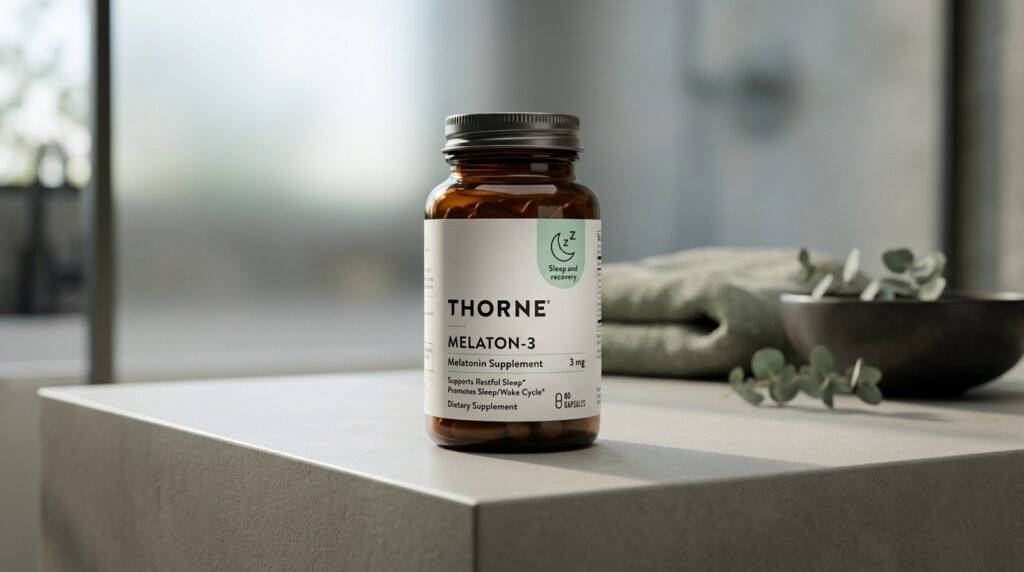
Thorne Melaton-3 at 3mg per capsule is the melatonin product for men who need circadian support at a dose that’s clinically relevant without being excessive. 3mg sits at the upper end of effective circadian dosing while remaining below the 5–10mg range that produces next-day grogginess without proportional benefit. NSF certified, pharmaceutical manufacturing, no fillers.
For jet lag, take one capsule at the destination’s target bedtime for 3–4 nights. For delayed sleep phase, take half a capsule (open and split) 2–3 hours before the intended bedtime for 2–3 weeks. For occasional sleep onset difficulty, one capsule 30–60 minutes before bed when needed. Not for nightly indefinite use — use on a targeted, as-needed basis for defined circadian disruption.
Pros: NSF certified, pharmaceutical manufacturing, 3mg dose avoids excessive grogginess, Thorne quality, appropriate for targeted circadian use. Cons: 3mg still above the 0.5–1mg optimal circadian dose for some uses, not appropriate for nightly indefinite use, doesn’t improve sleep quality only timing.
4. Life Extension Melatonin 1mg — Best Low-Dose Melatonin (~$8 / 60 servings)
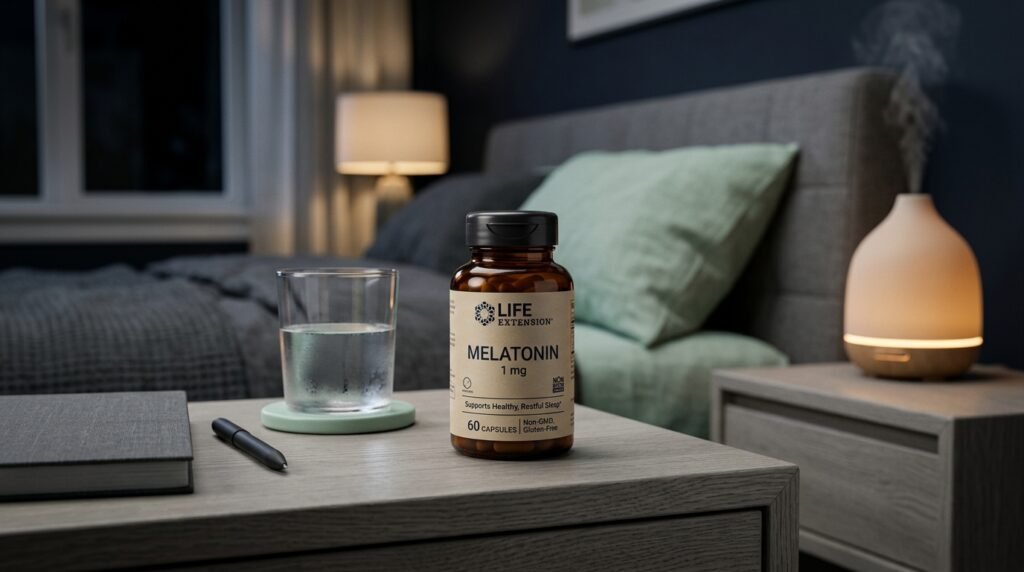
Life Extension Melatonin 1mg is the melatonin product that most closely matches the dose used in the strongest clinical research — 0.5–1mg for circadian timing effects. At 1mg per capsule, it allows precise low-dose use that produces circadian clock advancement without the grogginess that 5–10mg products cause. For men who have tried higher-dose melatonin and found it left them groggy the next morning, this is the product that delivers the timing benefit without the side effect.
At $8 for 60 capsules — $0.13 per serving — it’s also the most affordable option on this list. Life Extension is a well-established supplement company with a long track record of quality manufacturing. The 1mg dose is the right starting point for any new melatonin user before considering higher doses.
Pros: 1mg matches research-relevant low-dose protocol, affordable at $0.13 per serving, Life Extension quality track record, minimizes next-day grogginess. Cons: Not NSF certified, 1mg may be insufficient for severe jet lag requiring stronger circadian intervention, capsule must be swallowed whole (no splitting).
Comparison Table
| Product | Price/Month | Mechanism | Best For | Rating |
|---|---|---|---|---|
| Thorne Magnesium Bisglycinate | ~$11–22 | GABA + deep sleep | Sleep quality and maintenance | 9.5/10 |
| NOW Foods Magnesium Glycinate | ~$6–12 | GABA activation | Budget sleep quality option | 8.5/10 |
| Thorne Melaton-3 | ~$8 | Circadian timing | Jet lag and schedule shifts | 9/10 |
| Life Extension Melatonin 1mg | ~$4 | Circadian timing | Low-dose targeted timing | 8.5/10 |
What to Look for When Choosing Between Melatonin and Magnesium
1. Identify your actual sleep problem first Melatonin and magnesium solve different problems. Before buying either, identify which complaint dominates: can’t fall asleep at intended bedtime (timing problem → melatonin) or sleep lightly, wake during the night, or feel unrefreshed (quality problem → magnesium). Most men over 30 have a quality problem. Most men who think they have a falling-asleep problem actually have a circadian disruption problem that behavioral changes fix better than either supplement.
2. Melatonin dose matters more than brand The effective circadian dose of melatonin is 0.1–1mg. Products selling 5–10mg doses aren’t more effective — they’re just American supplement culture overshooting the therapeutic window. For jet lag and circadian shifting, 0.5–1mg is the clinically validated dose. For acute sleep onset difficulty, 1–3mg covers the range. Avoid 10mg products unless under medical supervision for specific sleep disorders.
3. Magnesium form determines whether it works Magnesium oxide — the form in most cheap supplements and multivitamins — has approximately 4% bioavailability and doesn’t deliver sufficient magnesium to tissue for meaningful sleep quality improvement. Bisglycinate and glycinate forms absorb at 40–50% bioavailability. Men who have “tried magnesium for sleep and felt nothing” were almost certainly using oxide. Check the supplement facts panel before purchasing.
4. Timing optimization for each compound Melatonin works best taken 30–60 minutes before intended sleep time (or at destination bedtime for jet lag). Magnesium works best taken 30–60 minutes before sleep — the GABA receptor activation facilitates the neurological shift from wakefulness to sleep during the wind-down period. Both benefit from consistent timing as part of a pre-sleep routine that becomes a behavioral circadian cue.
5. Duration of use expectations Melatonin produces effects immediately — within 30–60 minutes of ingestion. Its appropriate use is short-term and targeted: 3–7 nights for jet lag, 2–4 weeks for delayed sleep phase correction. Indefinite nightly melatonin use risks tolerance and potential suppression of endogenous production. Magnesium builds over 1–3 weeks as tissue stores replete — it’s appropriate for indefinite daily use at therapeutic doses, and its sleep quality benefits compound rather than diminish over time.
FAQ
Which is better for sleep — melatonin or magnesium?
For most men over 30 with sleep quality complaints — light sleep, nighttime waking, unrefreshing sleep — magnesium is better. For men with circadian timing complaints — can’t fall asleep before midnight, jet lag, shift work disruption — melatonin is better. The correct answer depends entirely on which sleep problem the man is experiencing. Using melatonin for a sleep quality problem produces minimal benefit regardless of dose.
Can you take melatonin and magnesium together?
Yes — they work through different mechanisms with no interaction risk. The combination is appropriate for men with both timing and quality problems, or for men using melatonin short-term for jet lag while maintaining magnesium as a long-term sleep quality foundation. Magnesium bisglycinate at 300–400mg plus melatonin at 0.5–1mg is the combination used by men managing both issues simultaneously.
How long does melatonin take to work?
Melatonin’s circadian effects begin within 30–60 minutes of ingestion — it’s one of the fastest-acting sleep supplements available. The key distinction is that “working” for melatonin means advancing the sleep clock and making falling asleep at the intended time easier, not producing sedation or improving sleep quality once asleep. Men who take melatonin and still sleep poorly are experiencing this distinction in practice.
Does magnesium cause morning grogginess like melatonin?
No — magnesium at appropriate doses (300–400mg bisglycinate) does not cause next-day grogginess or sedation. It improves sleep quality through neurological inhibitory support without pharmacological sedation. Melatonin at excessive doses (5–10mg) commonly causes next-day grogginess in many men — the primary reason to use the lowest effective dose. At 0.5–1mg, melatonin’s grogginess side effect is minimal for most men.
Our Final Verdict
Melatonin vs magnesium for sleep resolves clearly when you understand the mechanism: melatonin moves the clock, magnesium improves what happens once you’re asleep. For most men — those with light sleep, nighttime waking, or unrefreshing sleep despite adequate duration — Thorne Magnesium Bisglycinate at 300–400mg before bed is the correct first choice.
Budget-conscious men get the same mechanism from NOW Foods Magnesium Glycinate. For jet lag, schedule disruption, or genuine delayed sleep phase, Thorne Melaton-3 or Life Extension Melatonin 1mg at the lowest effective dose handles the timing problem specifically. Use magnesium every night. Use melatonin when you actually need it. Check current pricing on Amazon for all four options in this guide.