

This article contains affiliate links. We may earn a commission if you buy through our links, at no extra cost to you.
Does Ashwagandha Increase Testosterone?
Ashwagandha is one of the most heavily marketed supplements for male hormonal health — and unlike most testosterone-adjacent supplements, the research behind it is actually worth reading. The question of whether ashwagandha increases testosterone has a more nuanced answer than either the enthusiastic supplement companies or the skeptical mainstream health sites tend to give. It does appear to support testosterone levels in men, but through a mechanism that’s different from what most people assume, and with results that vary significantly based on a man’s baseline hormonal and stress profile.
After reviewing the clinical trials on ashwagandha and testosterone — including the studies most supplement brands cite and the context they leave out — here is what the evidence actually shows in 2026.
Quick Answer: Ashwagandha appears to increase testosterone in men primarily by reducing cortisol — the stress hormone that directly suppresses testosterone production. Clinical trials using KSM-66 ashwagandha at 600mg daily show testosterone increases of 15–22% in stressed and infertile men over 8–12 weeks. Men with already low cortisol and optimal testosterone are less likely to see significant hormonal change from ashwagandha alone. For men who fit the deficiency profile, Jarrow Formulas KSM-66 Ashwagandha at 300mg twice daily is a well-priced entry point backed by the right extract.
What the Clinical Research Actually Shows
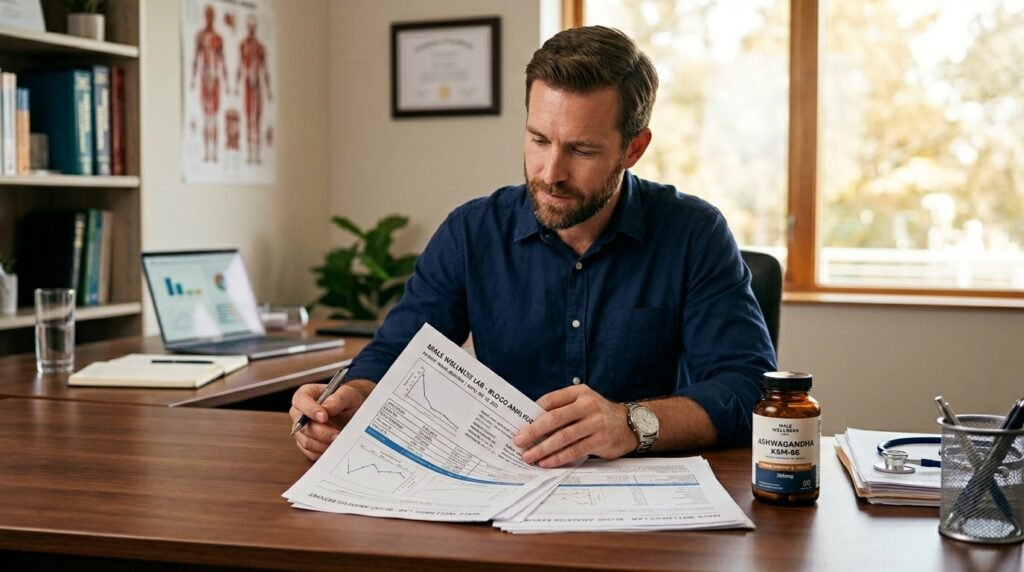
The most cited ashwagandha testosterone study is a 2019 randomized controlled trial published in Medicine — 43 overweight men aged 40–70 with mild fatigue received 600mg KSM-66 ashwagandha daily for 8 weeks. Testosterone increased by approximately 15% in the ashwagandha group versus no significant change in placebo. DHEA-S — a testosterone precursor — increased by 18%.
A second frequently cited trial from 2010 in Fertility and Sterility found that infertile men taking 5g of ashwagandha root powder daily for 3 months showed testosterone increases of 14–22% alongside significant reductions in cortisol. A 2015 study in the Journal of the International Society of Sports Nutrition found men doing resistance training who supplemented with 300mg KSM-66 twice daily showed significantly greater testosterone increases and muscle recovery improvements compared to placebo over 8 weeks.
The pattern across these trials is consistent — ashwagandha produces real, measurable testosterone improvements in men with elevated cortisol, high stress loads, or documented testosterone suppression from chronic fatigue or infertility.
The counterintuitive finding: the men who benefit most from ashwagandha for testosterone are not the men who feel fine and want optimization. They’re the men who are chronically stressed, sleep-deprived, or dealing with sustained cortisol elevation that directly suppresses the hypothalamic-pituitary-gonadal axis. Ashwagandha works better as a hormonal recovery tool than as a testosterone booster for already-healthy men.
For men wanting the full framework of natural testosterone support beyond individual supplements, see our guide on how to increase testosterone naturally — ashwagandha fits into a broader strategy that includes sleep, training, and body composition.
The Cortisol-Testosterone Connection

Understanding why ashwagandha affects testosterone requires understanding the cortisol-testosterone relationship — one of the most clinically important hormonal dynamics in men’s health and one that rarely gets explained clearly.
Cortisol and testosterone are produced from the same precursor: pregnenolone. When the adrenal glands are producing high cortisol in response to chronic stress — work pressure, poor sleep, high training volume without recovery, psychological stress — they divert pregnenolone toward cortisol production. Less pregnenolone is available for the testosterone synthesis pathway. The result is measurable testosterone suppression that compounds over weeks and months of chronic stress.
This is called the pregnenolone steal hypothesis, and while the biochemistry is more complex than a simple diversion, the functional outcome is well documented: chronically elevated cortisol correlates with measurably lower testosterone in men across multiple population studies.
Ashwagandha’s primary mechanism for testosterone support is cortisol reduction. As a classified adaptogen, it modulates the HPA axis — the hypothalamic-pituitary-adrenal system that governs cortisol output — reducing the magnitude of cortisol spikes in response to stressors. Studies using KSM-66 at 300–600mg daily consistently show cortisol reductions of 15–30% in stressed populations over 60–90 days.
When cortisol comes down, the pregnenolone diversion diminishes, and testosterone production has more substrate available. The testosterone increase from ashwagandha is therefore a downstream consequence of cortisol reduction rather than direct stimulation of testosterone synthesis — a meaningful mechanistic distinction that explains why the supplement works better for stressed men than for relaxed ones.
For men managing energy and focus alongside hormonal support, see our guide on best supplements for energy and focus for men — adaptogens and cortisol management fit into a broader stack that supports both performance and testosterone.
KSM-66 vs Sensoril — Which Extract Actually Works for Testosterone
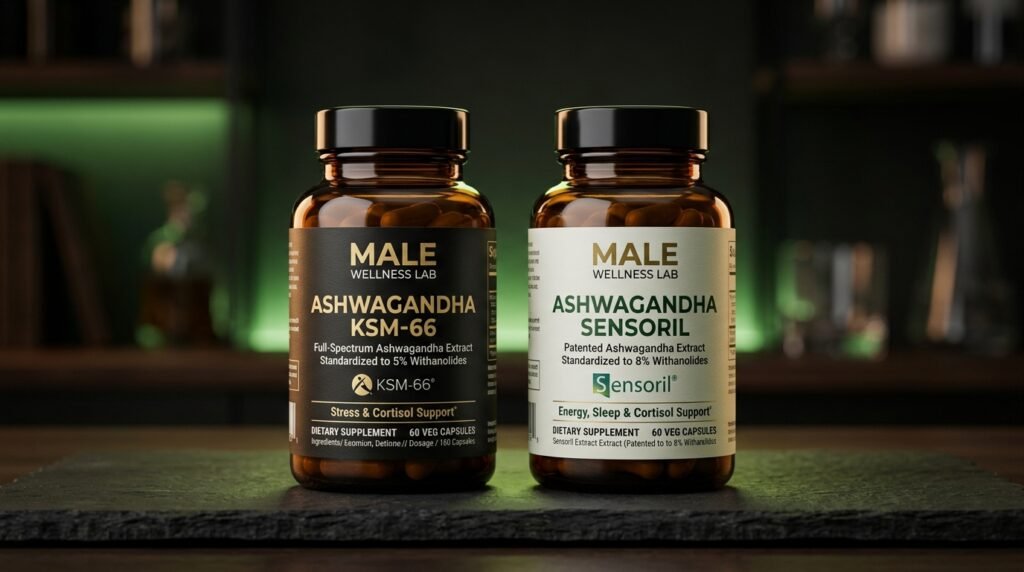
Not all ashwagandha supplements are equivalent. The clinical trials showing testosterone benefits used specific standardized extracts — and the majority used KSM-66, which has become the benchmark for ashwagandha research.
KSM-66 is a root-only extract standardized to at least 5% withanolides — the active compounds responsible for ashwagandha’s adaptogenic effects. It’s produced using a proprietary extraction process without alcohol or synthetic solvents, and it has the largest body of clinical research of any ashwagandha extract. The testosterone trials cited above used KSM-66 at 300–600mg daily. If testosterone support is your primary goal, KSM-66 is the extract with direct clinical evidence.
Sensoril is a root and leaf extract standardized to 10% withanolides — a higher withanolide percentage than KSM-66, which sounds superior until you consider that leaf-derived withanolides differ in composition from root-derived withanolides and may not produce identical effects. Sensoril has good clinical evidence for stress and anxiety reduction but less direct testosterone research than KSM-66. It’s a legitimate extract — but not the one with the strongest testosterone-specific evidence.
Generic ashwagandha powder with no standardization — common in budget supplements and bulk powders — has unpredictable withanolide content that varies by harvest, source, and processing. The dose-response relationship established in clinical research doesn’t reliably translate to unstandardized products.
The difference between a KSM-66 product at 600mg and a generic ashwagandha capsule at the same labeled dose is significant enough to matter for men using ashwagandha specifically for hormonal support.
The Best Ashwagandha Supplement for Testosterone Support
If your stress and hormonal profile suggests ashwagandha is worth trying, the extract and dose are what determine whether you’re replicating the clinical protocol or just taking an herb capsule. For a full breakdown of every option across budget, certification level, and extract type, see our dedicated guide on best ashwagandha supplement for men. For most men starting out, one product covers the bases cleanly.
1. Jarrow Formulas KSM-66 Ashwagandha — Best Overall (~$18–22 / 120 servings)
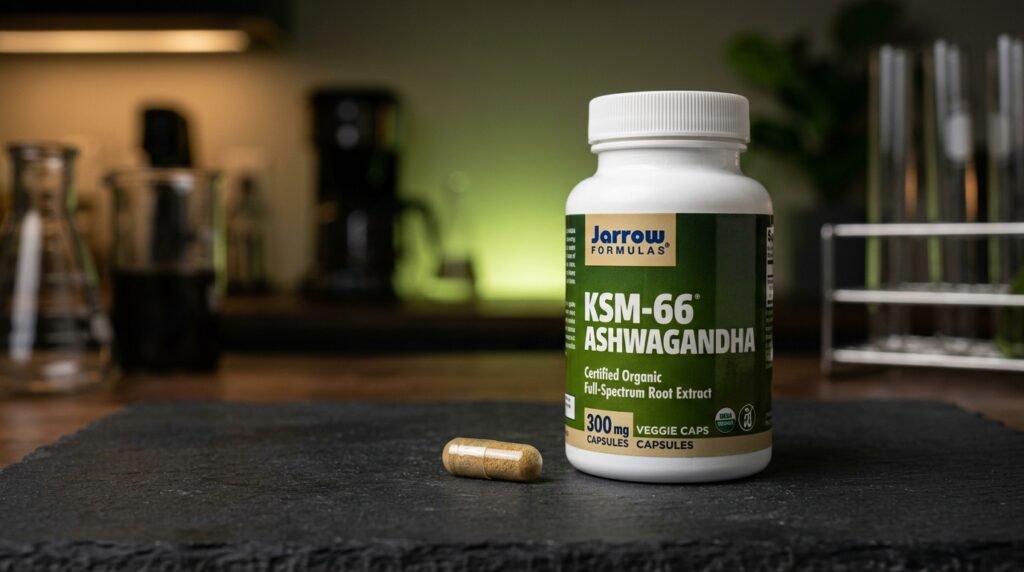
Jarrow Formulas KSM-66 Ashwagandha delivers 300mg KSM-66 per capsule — two capsules reaches the 600mg daily dose used in the clinical trials showing testosterone improvement. At 120 capsules per bottle that’s a full 60-day supply at the research dose, or 120 days at the 300mg stress-management dose. Jarrow is a well-established supplement brand with a long track record, and the KSM-66 extract means you’re taking the same form of ashwagandha used in the testosterone research rather than a generic standardized root powder.
At roughly $0.15–0.18 per day at the full 600mg dose, it’s one of the most cost-effective quality KSM-66 options available. A man with a demanding job, disrupted sleep, and chronically elevated stress who takes two Jarrow KSM-66 capsules consistently for 90 days is following exactly the protocol that produced testosterone improvements in the clinical literature — at well under $20 per month.
Pros: Genuine KSM-66 extract at clinical dose, 120 capsules for extended supply, established brand, excellent value, flexible dosing between 300mg and 600mg daily. Cons: GMP rather than NSF certified — less rigorous than pharmaceutical-grade brands, no BioPerine for enhanced absorption, two capsules required for the full research dose.
What to Look for When Choosing Ashwagandha for Testosterone
1. KSM-66 extract specifically for testosterone support The clinical trials showing testosterone improvement used KSM-66 at 300–600mg daily. For men whose primary goal is testosterone support through cortisol reduction, replicating the research protocol means using KSM-66 at the same dose. Products using generic ashwagandha powder without extract standardization don’t allow you to verify you’re taking a clinically equivalent amount of active compounds.
2. Full 600mg daily dose The research showing 15–22% testosterone increases used 600mg KSM-66 daily. Products dosed at 300mg or less are in the range studied for stress and sleep — meaningful benefits, but below the dose used in the testosterone-specific trials. If testosterone support is the primary goal, verify the total daily dose reaches 600mg of standardized KSM-66.
3. Third-party testing matched to your needs NSF Certified for Sport provides the strongest overall quality assurance for competitive athletes. GMP certification is adequate for recreational users. For ashwagandha specifically, contamination with heavy metals and adulteration are documented concerns in the unverified market segment — some form of third-party testing matters.
4. Realistic timeline expectations Ashwagandha’s testosterone effects in clinical trials appeared at 8–12 weeks of consistent daily use. The cortisol reduction mechanism requires sustained supplementation to downregulate HPA axis reactivity. Men who evaluate ashwagandha at 4 weeks and conclude it isn’t working are assessing before the primary mechanism has had time to fully operate. Set a 90-day minimum assessment window.
5. Morning versus evening dosing For stress management and cortisol reduction throughout the workday, morning dosing makes more sense. For sleep quality improvement — which indirectly supports testosterone through better deep sleep — evening dosing 30–60 minutes before bed is more appropriate. Some research protocols split the dose morning and evening. Consistency matters more than timing precision.
FAQ
How long does ashwagandha take to increase testosterone?
Clinical trials showing testosterone improvements ran for 8–12 weeks of daily supplementation. The cortisol-reduction mechanism that drives testosterone improvement requires sustained HPA axis modulation — a process that takes weeks rather than days to establish. Most men who see testosterone-relevant benefits report noticing subjective improvements in energy, libido, and mood at week 6–8 before the 12-week blood marker improvements documented in research.
Does ashwagandha work for testosterone in men with normal cortisol?
The evidence is weaker for men with already-optimal cortisol and testosterone levels. The clinical trials showing the strongest testosterone improvements enrolled men with elevated stress markers, documented fatigue, or fertility challenges — populations with cortisol-driven testosterone suppression that ashwagandha’s mechanism directly addresses. Men with genuinely low cortisol and optimal testosterone are less likely to see significant hormonal changes from supplementation.
Can women take ashwagandha for hormonal support?
Ashwagandha has clinical evidence for stress reduction, thyroid support, and sexual function in women as well as men. The testosterone-specific research is conducted in male populations, but the cortisol-reduction and adaptogenic mechanisms apply across sexes. Women with PCOS should consult a doctor before using ashwagandha given its potential effects on androgen levels — the same mechanism that supports testosterone in men could be counterproductive for women managing androgen excess.
Is it safe to take ashwagandha every day long-term?
Modern clinical trials running up to 12 weeks show a strong safety profile at 300–600mg KSM-66 daily. Long-term safety data beyond 12 weeks is more limited in formal clinical research. Most functional medicine practitioners recommend cycling ashwagandha — 8–12 weeks on, 4 weeks off — rather than indefinite continuous use. Men with thyroid conditions or autoimmune diseases should consult a doctor before starting, as ashwagandha has documented effects on thyroid hormone levels.
Our Final Verdict
Ashwagandha does increase testosterone — specifically in men whose testosterone is being suppressed by chronic cortisol elevation, stress, or documented hormonal disruption. The mechanism is cortisol reduction rather than direct testosterone stimulation, which means results are most meaningful for men with high stress loads, poor sleep, or chronically elevated cortisol.
For those men, Jarrow Formulas KSM-66 Ashwagandha at 600mg daily is the most cost-effective path to the clinical dose with a credible brand behind it. Give it a full 90 days before evaluating results — the cortisol-testosterone mechanism doesn’t operate on a two-week timeline. Check current pricing on Amazon and commit to the full protocol before judging the results.