
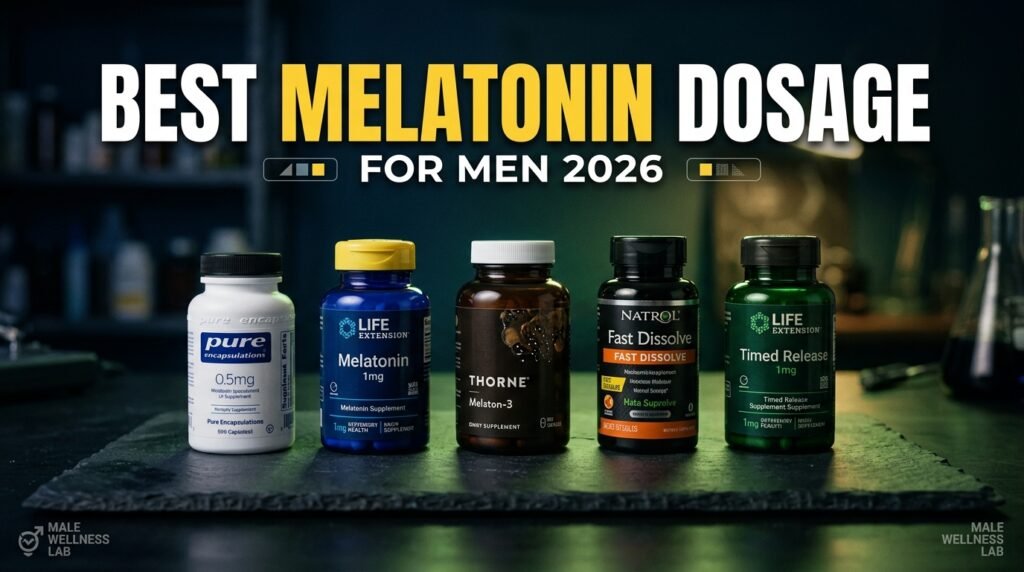
This article contains affiliate links. We may earn a commission if you buy through our links, at no extra cost to you.
Best Melatonin Dosage for Men in 2026
The melatonin aisle is one of the most misleading sections in any supplement store. You’ll find bottles ranging from 0.5mg to 10mg — and the vast majority of what’s sold is dramatically overdosed relative to what the research actually supports. Most men grab a 5mg or 10mg bottle because it looks more effective. It isn’t. In fact, taking more melatonin than your body needs produces the opposite of the intended effect — next-day grogginess, hormonal disruption with consistent use, and a sleep onset timing effect that plateaus well below the doses most products sell.
After researching the clinical literature on melatonin pharmacology and comparing the products that actually match evidence-based dosing, here is what actually works for men in 2026.
This guide is for men who want to use melatonin correctly — matching dose to purpose, choosing the right format, and understanding when melatonin helps versus when it doesn’t.
Quick Answer
The best melatonin dosage for men is 0.5mg to 1mg for most sleep timing situations — significantly lower than what most products sell. Start with Pure Encapsulations Melatonin 0.5mg for the most physiologically accurate dose, or Life Extension Melatonin 1mg for a slightly stronger option that remains within the evidence-supported range. For shift work, jet lag, or men who’ve used higher doses without grogginess issues, Thorne Melaton-3 at 3mg NSF certified is the quality benchmark.
Why the Standard Melatonin Dose Is Too High
Walk into any pharmacy and the smallest melatonin bottle you’ll typically find is 3mg. Most products sit at 5mg. Many go to 10mg. None of these doses are supported by the clinical research as optimal for healthy adult men with normal melatonin production.
Your pineal gland produces approximately 0.1mg to 0.3mg of melatonin nightly at peak — a fraction of what the average melatonin supplement delivers. The research on melatonin’s sleep-timing effects consistently shows that 0.3mg to 1mg is sufficient to shift circadian phase and improve sleep onset in most healthy adults. Doses above 1mg produce higher blood melatonin concentrations but not proportionally better sleep outcomes.
What does increase with higher doses is next-day grogginess. A 2021 review in JAMA found that most melatonin supplements examined contained significantly more melatonin than their labels stated — some up to 478% more. At 5-10mg, you’re flooding your system with a hormone at concentrations that have nothing to do with the physiological levels your body recognizes as the natural sleep signal.
The counterintuitive point: the strongest melatonin supplement is not the most effective one. A 0.5mg dose taken 60-90 minutes before bed achieves the same sleep-timing effect as a 10mg dose for most men — without the morning grogginess, without the hormonal disruption that concerns endocrinologists with extended high-dose use, and without the tolerance that develops when melatonin receptors are repeatedly saturated.
For men whose sleep problems go beyond circadian timing, see our guide on the best supplements for sleep for men — melatonin addresses timing, not sleep quality, and the distinction matters for choosing the right intervention.
When Melatonin Actually Helps — And When It Doesn’t
This is the section most melatonin articles skip — because acknowledging that melatonin has a narrow use case is bad for sales.
Melatonin works for:
Jet lag — the most well-documented use case. Crossing multiple time zones disrupts the circadian clock, and melatonin at the correct local bedtime of the destination accelerates resynchronization. Multiple RCTs show it reduces jet lag symptoms meaningfully. 0.5-3mg at destination bedtime for 2-5 days is the protocol.
Shift work sleep disruption — men who work nights or rotating shifts and need to sleep at unusual times benefit from melatonin’s circadian phase-shifting effect. 0.5-3mg before the intended sleep time, regardless of clock time.
Delayed sleep phase — men who can’t fall asleep before 1-2am and want to shift their sleep window earlier. 0.5mg taken 5-6 hours before habitual sleep onset is the clinically supported protocol for phase-advancing — counterintuitively, later in the day produces an earlier shift the following night.
Melatonin doesn’t meaningfully help with:
General insomnia in men with normal circadian rhythms — if you go to bed at a consistent time, your pineal gland is already producing melatonin at that time. Supplementing adds concentration but doesn’t improve sleep depth, duration, or the 3am wake issue that affects many men over 30.
Stress-driven insomnia — cortisol-driven inability to fall asleep doesn’t respond to melatonin because the problem isn’t circadian timing. It’s hormonal overactivation. Ashwagandha and magnesium glycinate address this better.
Poor sleep quality — melatonin doesn’t increase slow-wave sleep or REM sleep percentage. It adjusts timing. If you fall asleep fine but wake unrefreshed, melatonin isn’t the right tool.
The Right Dose by Situation
Matching dose to purpose is more important than choosing the right brand.
0.3mg to 0.5mg — Daily use and circadian maintenance This is the physiologically appropriate dose for men who want melatonin support without exceeding natural concentrations. Suitable for consistent use when traveling frequently or managing mild sleep timing irregularity. Minimal next-day grogginess at this range. The dose most sleep medicine researchers use personally when they use melatonin at all.
0.5mg to 1mg — Standard sleep timing support The sweet spot for most men using melatonin occasionally for sleep onset timing. Sufficient to achieve the circadian signal effect. Some men notice a slight difference between 0.5mg and 1mg in terms of sleep onset speed — if 0.5mg produces no noticeable effect after 2 weeks, 1mg is the next step before going higher.
3mg — Jet lag and shift work The dose where clinical evidence for jet lag specifically is strongest. Appropriate for acute use (2-5 days) when crossing 3+ time zones or starting a new shift schedule. Not the dose for nightly general use — tolerance to the sleep-timing effect develops faster at 3mg with daily use than at lower doses.
5mg+ — Not recommended for most men No meaningful clinical evidence showing superior outcomes over 3mg for sleep timing. Higher grogginess risk. Endocrinologists express concern about extended high-dose melatonin use and testosterone — there is some evidence, not definitive, that supraphysiological melatonin doses over long periods may influence luteinizing hormone patterns. The risk isn’t well-characterized, but the benefit over lower doses isn’t established either. Men under 35 with testosterone concerns should default to the lowest effective dose.
Real-world scenario: a 32-year-old executive flying from New York to London (5 time zones) takes 1mg melatonin at 10pm London time for 3 nights. He resynchronizes by night 4 without grogginess the following mornings. The same man taking 10mg nightly back home for “better sleep” is producing no additional benefit over 1mg and saturating melatonin receptors unnecessarily.
The 5 Best Melatonin Products for Men in 2026
1. Pure Encapsulations Melatonin 0.5mg — Best Low-Dose Option (~$15-20/180 caps)
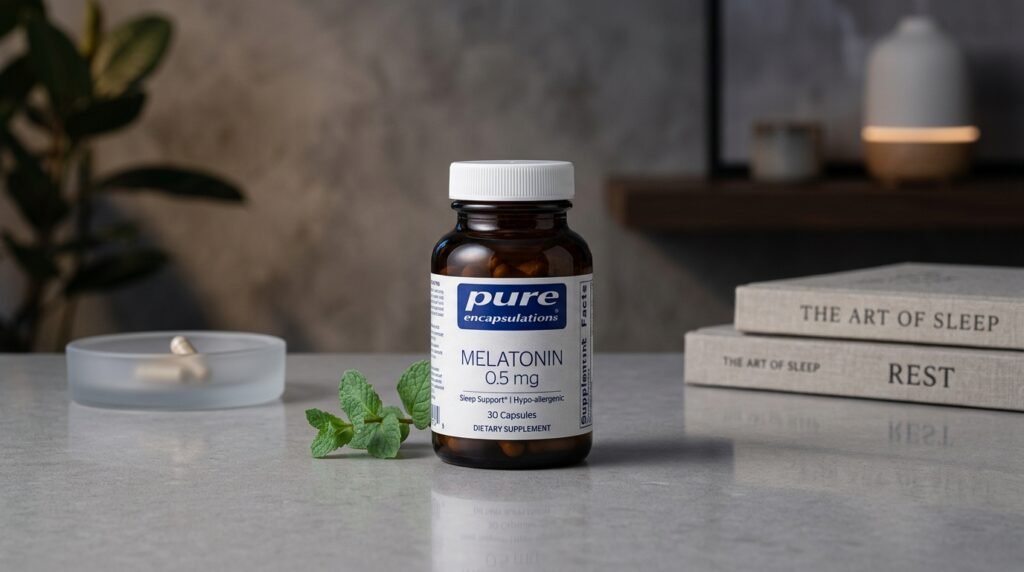
Pure Encapsulations Melatonin 0.5mg is the most physiologically accurate melatonin supplement available for men — 0.5mg per capsule in a hypoallergenic formula with zero unnecessary excipients. This is the dose that matches natural pineal gland output most closely and produces the sleep-timing effect without receptor saturation or grogginess. 180 capsules per bottle makes it the best value per dose for men who use melatonin consistently.
The clean formula matters for a supplement taken regularly before bed — no artificial sweeteners, no gelatin, no common allergens. Manufactured in an NSF-certified facility with independent potency verification. For men new to melatonin or concerned about next-day grogginess, this is the correct starting point.
Real-world detail: at 180 capsules per bottle for $15-20, the cost per dose is approximately $0.09 — the most affordable quality melatonin per effective dose on this list.
Pros: Most physiologically accurate dose (0.5mg), hypoallergenic formula, 180 caps per bottle, NSF-certified facility, no fillers or artificial sweeteners, vegan, non-GMO. Cons: 0.5mg may be insufficient for severe jet lag or shift work disruption where 1-3mg is more appropriate, capsule form requires water, no fast-dissolve option.
2. Life Extension Melatonin 1mg — Best Standard Dose (~$8-12/60 caps)
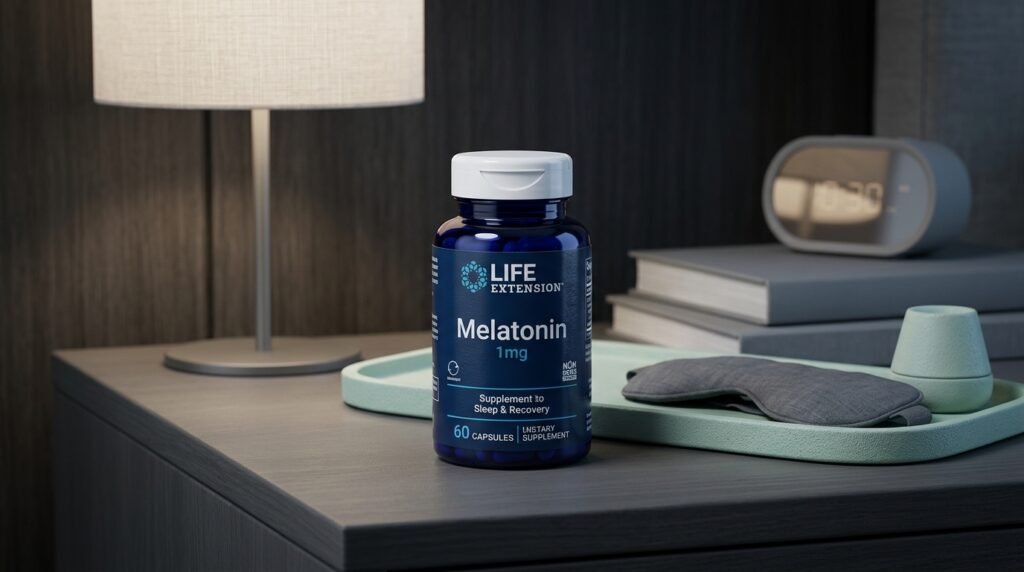
Life Extension Melatonin 1mg delivers the upper end of the evidence-supported low-dose range — 1mg immediate release, non-GMO, gluten-free, manufactured to Life Extension’s 40+ year quality standard with a certificate of analysis available for every batch. 60 capsules per bottle at $8-12 makes it the most accessible quality 1mg option on Amazon.
For men who’ve tried 0.5mg without noticeable sleep onset improvement, 1mg is the rational next step before considering higher doses. The immediate-release formulation acts within 30-60 minutes and clears the system in 4-6 hours — appropriate for men who need help falling asleep without affecting early-morning sleep quality.
In our experience, 1mg is the dose where most men notice a clear effect without the foggy morning that 5-10mg commonly produces. That’s the dose worth staying at unless there’s a specific reason to go higher.
Pros: 1mg evidence-supported dose, immediate release for fast onset, Life Extension 40+ year quality standard, COA available per batch, non-GMO, gluten-free, affordable per dose. Cons: 60 capsules only — shorter supply than Pure Encapsulations, no NSF certification (COA available but different standard), immediate release only — no extended option for sleep maintenance.
3. Thorne Melaton-3 — Best 3mg Option for Jet Lag (~$15-18/60 caps)
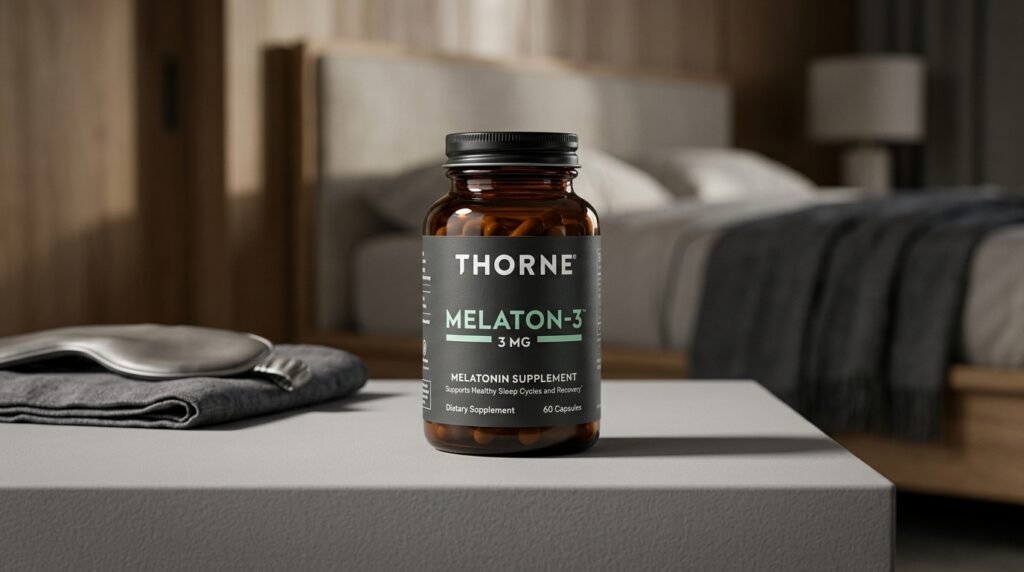
Thorne Melaton-3 is the quality benchmark for the 3mg dose — NSF Certified for Sport, manufactured to Thorne’s four-round testing protocol, and the product most recommended by healthcare practitioners who recommend melatonin at all. 3mg is appropriate for jet lag, shift work disruption, and men who’ve established that 1mg doesn’t produce sufficient sleep onset acceleration for their specific situation.
The NSF Certified for Sport status means every batch is independently verified for label accuracy and absence of banned substances — meaningful for a hormone supplement where label accuracy matters and where some melatonin products have been found to contain significantly more or less than stated.
At 60 capsules per bottle at 1 capsule daily, it provides a 60-day supply. For jet lag use at 3-5 days per trip, a single bottle covers 12-20 travel periods.
Pros: NSF Certified for Sport, Thorne four-round testing protocol, 3mg dose appropriate for jet lag and shift work, practitioner recommended, gluten-free, dairy-free, soy-free. Cons: 3mg is higher than daily maintenance dose for most men, $15-18 for 60 capsules is higher per-dose cost than lower-quality alternatives, immediate release only.
4. Natrol Fast Dissolve Melatonin 1mg — Best Fast-Acting Format (~$8-12/90 tabs)
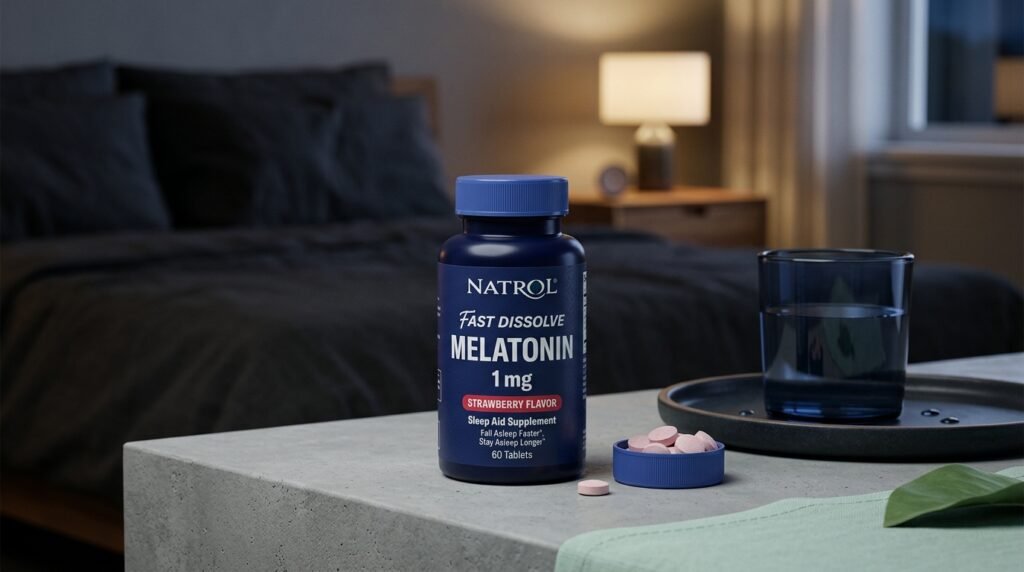
Natrol Fast Dissolve Melatonin 1mg is the fast-dissolve format recommendation for men who want the fastest possible sleep-onset timing effect. The strawberry-flavored tablet dissolves on the tongue in under 60 seconds and requires no water — melatonin absorbs sublingually and through the buccal mucosa, reaching blood concentration faster than a swallowed capsule. Natrol is the #1 drug-free sleep aid brand in America by sales volume.
For men who travel frequently and want the most convenient melatonin format — no water needed on a plane, no capsule to open in a dark hotel room — the fast-dissolve format is the practical winner. 90 tablets per bottle at $8-12 provides a 90-day supply at one tablet daily.
What most reviews won’t tell you: the sublingual absorption advantage of fast-dissolve is most relevant at doses of 1mg or less. At higher doses, the first-pass metabolism advantage is less significant because there’s more than enough melatonin in swallowed capsules to produce the effect regardless of absorption route.
Pros: Fast-dissolve sublingual absorption, no water needed, strawberry flavor, 90 tablets per bottle, 100% drug-free, non-habit forming, #1 drug-free sleep aid brand, convenient travel format. Cons: Contains sweeteners and flavoring agents (not hypoallergenic), no extended-release option, not NSF certified, not ideal for men with artificial sweetener sensitivity.
5. Life Extension Melatonin 6 Hour Timed Release 300mcg — Best Ultra-Low Extended-Release (~$10-15/100 tabs)
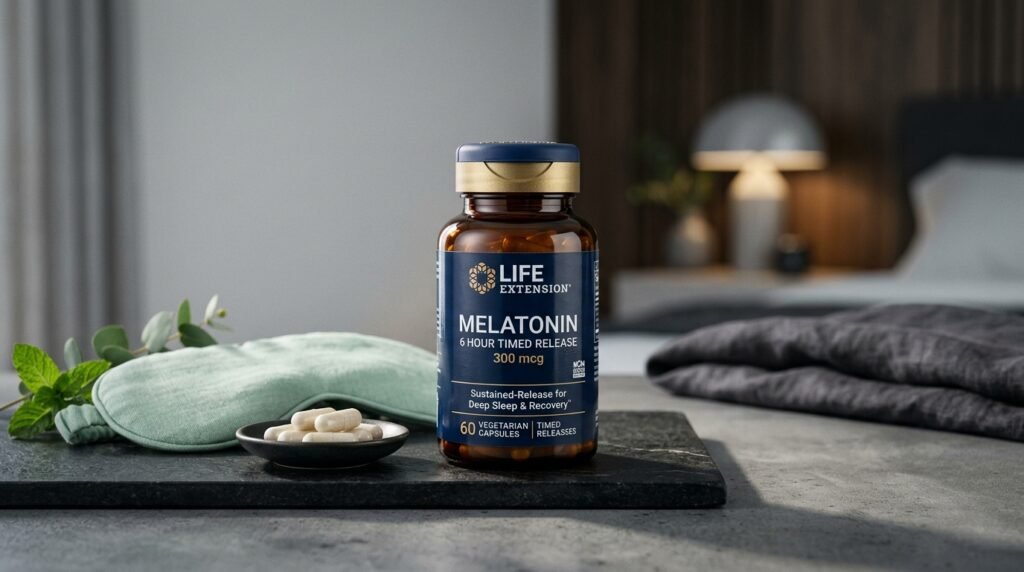
Life Extension Melatonin 6 Hour Timed Release 300mcg is the recommendation for men who want the most physiologically minimal melatonin dose — 0.3mg released gradually over 6 hours, designed to maintain modest melatonin elevation throughout the sleep window rather than producing a sharp peak. This product is specifically designed for men concerned about receptor saturation, testosterone interactions, or grogginess.
0.3mg is the dose most commonly used in clinical research when researchers want to study melatonin’s circadian effects at minimal pharmacological doses. The timed-release format extends the effect window — useful for men who fall asleep adequately but want light support through the early morning hours when melatonin naturally begins to decline.
100 tablets per bottle at $10-15 makes the cost per dose extremely accessible — approximately $0.12 per night.
Pros: 0.3mg ultra-low dose minimizes grogginess and receptor saturation risk, 6-hour timed release maintains melatonin elevation through sleep, 100 tablets per bottle, Life Extension quality standard, non-GMO, gluten-free, vegetarian. Cons: 0.3mg may be insufficient for jet lag or significant circadian disruption, timed-release not appropriate if you need to wake earlier than planned, no NSF certification.
Comparison Table
| Product | Dose | Format | Best For | Price | Rating |
|---|---|---|---|---|---|
| Pure Encapsulations 0.5mg | 0.5mg | Capsule | Daily low-dose maintenance | ~$18 | 9.5/10 |
| Life Extension 1mg | 1mg | Capsule | Standard sleep timing support | ~$10 | 9/10 |
| Thorne Melaton-3 | 3mg | Capsule | Jet lag and shift work | ~$17 | 9/10 |
| Natrol Fast Dissolve 1mg | 1mg | Fast dissolve | Travel, fastest onset | ~$10 | 8.5/10 |
| Life Extension 300mcg Timed Release | 0.3mg | Extended release | Ultra-low dose, sleep maintenance | ~$12 | 8.5/10 |
What to Look for When Choosing a Melatonin Supplement
1. Dose matched to your specific use case This is the most critical criterion and the most frequently ignored. 0.3-0.5mg for daily maintenance and mild timing adjustment. 1mg for standard occasional use. 3mg for jet lag and shift work. 5mg+ produces no proven advantage over 3mg for sleep timing and adds meaningful grogginess risk. Start low, assess effect after two weeks, and only increase if there’s no noticeable improvement.
2. Immediate release vs extended release Immediate release peaks within 1-2 hours and clears within 4-6 hours — best for sleep onset difficulty. Extended or timed release maintains melatonin elevation for 6-8 hours — better for men who fall asleep fine but experience early morning waking. Matching the release format to your specific sleep problem produces meaningfully different outcomes.
3. Third-party testing for label accuracy Melatonin is a hormone and label accuracy matters more than for general supplements. A 2023 JAMA study found melatonin products containing anywhere from 74% to 478% of their stated dose. NSF Certified for Sport products (Thorne) provide the strongest label accuracy guarantee. Life Extension publishes COAs per batch. Pure Encapsulations is manufactured in NSF-certified facilities. Avoid unlisted brands without any third-party verification.
4. Clean formula for nightly use For a supplement taken every night, the inactive ingredients matter. Artificial sweeteners, titanium dioxide, and unnecessary fillers are worth avoiding in a product with frequent use. Pure Encapsulations is the hypoallergenic gold standard. Thorne and Life Extension use clean minimal formulas. Fast-dissolve tablets require sweeteners and flavoring agents by design — an acceptable tradeoff for men who prioritize convenience.
5. Extended use considerations for men Melatonin is appropriate for short-term use and periodic use without significant concern. Consistent long-term nightly use at doses above 1mg has not been studied thoroughly enough to characterize all risks — endocrinologists generally recommend the lowest effective dose and suggest cycling off periodically. Men with testosterone concerns should default to 0.3-1mg and avoid 5-10mg products for daily use until the long-term hormonal picture is better characterized.
FAQ
What is the best melatonin dose to start with for men?
Start at 0.5mg taken 60-90 minutes before your intended sleep time. This matches the physiological melatonin concentration your brain already produces and is sufficient to produce the sleep-timing effect in most men. If you notice no improvement after two weeks of consistent use at 0.5mg, increase to 1mg. The common mistake is starting at 5-10mg because it “looks stronger” — it produces grogginess without proportionally better sleep.
Does melatonin affect testosterone in men?
The research on melatonin and testosterone is preliminary and not definitive. Some animal studies and limited human data suggest supraphysiological melatonin doses may influence luteinizing hormone patterns, which could theoretically affect testosterone production over time. The clinical significance in humans at doses of 0.5-3mg taken occasionally is not established. Men with active testosterone concerns should use the lowest effective dose and avoid nightly 5-10mg use as a precaution.
Can I take melatonin every night?
Short-term and periodic use at low doses (0.5-1mg) appears safe based on available evidence. Daily nightly use for years at higher doses hasn’t been studied thoroughly enough to make confident safety claims. Most sleep medicine practitioners recommend melatonin for specific situational use — jet lag, shift work, circadian adjustment — rather than as a permanent nightly supplement. For men who feel they need melatonin every night to sleep, the underlying issue is likely cortisol, magnesium status, or sleep hygiene rather than melatonin deficiency.
What time should men take melatonin for best results?
60-90 minutes before your intended sleep time produces the most consistent results. The timing matters more than the dose for melatonin’s circadian effect. Taking it immediately before bed produces less sleep-timing benefit because melatonin needs time to reach peak blood concentration. For phase advancement (shifting sleep earlier), some research supports taking 0.5mg 5-6 hours before habitual sleep time — a counterintuitive timing that actually works better than the pre-bed window for men trying to become earlier risers.
Our Final Verdict
The best melatonin dosage for men in 2026 is lower than what most products sell — start at Pure Encapsulations 0.5mg for the most physiologically accurate daily option, or Life Extension 1mg for a standard effective dose without grogginess risk. Use Thorne Melaton-3 at 3mg specifically for jet lag and shift work where higher doses have the strongest evidence. Choose Natrol Fast Dissolve 1mg for travel convenience. And consider Life Extension 300mcg Timed Release if minimizing dose is the priority while supporting sleep maintenance. Match the dose to the situation, take it 60-90 minutes before bed, and resist the marketing pressure to take more than you need. Check current pricing on Amazon for all five options.