

This article contains affiliate links. We may earn a commission if you buy through our links, at no extra cost to you.
Best Supplements for Men in Their 30s in 2026
Your 30s are when the gap between men who invest in their health and men who don’t starts becoming visible. Testosterone begins declining at approximately 1% per year from age 30. Recovery takes longer. Sleep feels less restorative. The energy that felt effortless at 25 requires more deliberate management by 35. The best supplements for men in their 30s don’t reverse aging — nothing does — but they address the specific physiological shifts that begin in this decade with meaningful, evidence-backed interventions.
After researching the clinical literature on male health supplementation specifically for the 30–40 age range and comparing the products with the strongest evidence, here is what actually works in 2026.
This guide is for men in their 30s who want a clear, prioritized supplement stack — not a $400/month pharmaceutical-grade protocol, but a focused set of interventions that address the changes happening right now.
Quick Answer: The most impactful supplements for men in their 30s are creatine monohydrate for muscle and cognitive function, magnesium bisglycinate for sleep and testosterone support, and vitamin D3+K2 for hormonal and cardiovascular health. These three address the highest-priority physiological gaps for most men in this decade. Start with Thorne Creatine, Thorne Magnesium Bisglycinate, and Thorne D3+K2 before adding anything else.
Why Your 30s Are the Most Important Decade for Supplement Strategy
The physiological changes that begin in your 30s are real, measurable, and largely preventable with the right interventions — but they’re subtle enough that most men don’t notice them until they’ve accumulated for several years.
Testosterone decline starts at approximately 30 and proceeds at 1–2% annually. The cumulative effect by 38–40 is a 10–20% reduction from peak levels — enough to produce noticeable changes in muscle recovery, libido, body composition, and motivation without being severe enough to trigger a clinical hypogonadism diagnosis. Most men in their late 30s experiencing these changes attribute them to “just getting older” without recognizing that nutritional deficiencies in zinc, magnesium, and vitamin D are frequently compounding the natural decline.
Anabolic resistance begins emerging in the early 30s — the muscle protein synthesis response to training and protein intake becomes slightly less efficient than it was at 25. Men in their 30s need to be more deliberate about training stimulus and protein intake to maintain the same muscle mass they built effortlessly in their 20s.
Sleep architecture shifts — the proportion of deep slow-wave sleep decreases with age starting in the late 20s, and the testosterone produced during deep sleep decreases proportionally. Men who slept 7 hours and woke refreshed at 24 often find that same 7 hours feels qualitatively different at 34.
The counterintuitive point: the most impactful supplements for men in their 30s are not testosterone boosters or hormone optimizers. They’re the foundational micronutrients — magnesium, vitamin D, zinc — that are commonly deficient and whose deficiency directly suppresses testosterone and recovery. Fix the deficiencies first. Stack the optimizers second.
For men wanting the complete framework for natural testosterone support beyond supplements, see our guide on how to increase testosterone naturally — supplements are one component of a broader strategy that includes sleep, training, and body composition management.
The Priority Stack — What to Take and in What Order
Not all supplements are equal in their impact for men in their 30s. The following priority framework prevents the common mistake of spending $200/month on a supplement protocol that addresses tier-3 concerns before tier-1 deficiencies are corrected.
Tier 1 — Fix deficiencies first: Vitamin D3+K2, Magnesium Bisglycinate, Zinc. These three are the most commonly deficient micronutrients in men in their 30s and have the most direct evidence for testosterone support, sleep quality, and immune function. Cost: approximately $40–60/month combined. Impact: high, particularly for men who are deficient — which describes the majority of men eating standard Western diets with limited sun exposure.
Tier 2 — Performance and recovery: Creatine Monohydrate, Omega-3. These two have the strongest evidence base of any supplements for muscle performance, cognitive function, and inflammation management. Neither requires deficiency to produce benefit — they work through mechanisms that optimize function above baseline. Cost: approximately $30–50/month combined. Impact: high for men who train and do sustained cognitive work.
Tier 3 — Stress and hormonal optimization: Ashwagandha KSM-66. Relevant for men with elevated cortisol, poor stress resilience, or HPA axis dysregulation driving hormonal suppression. Cost: approximately $15–20/month. Impact: significant for men who fit the stress-cortisol profile; modest for men with already-optimal cortisol management.
Tier 4 — Insurance: Multivitamin. Covers micronutrient gaps that diet misses, but shouldn’t replace Tier 1 specific supplementation — a multivitamin’s vitamin D, magnesium, and zinc doses are typically too low to correct genuine deficiencies. Cost: approximately $20–30/month. Impact: modest as a standalone, meaningful as a gap-filler alongside targeted Tier 1 supplementation.
The 6 Best Supplements for Men in Their 30s
1. Thorne Creatine — Best Overall Performance Supplement (~$40 / 90 servings)
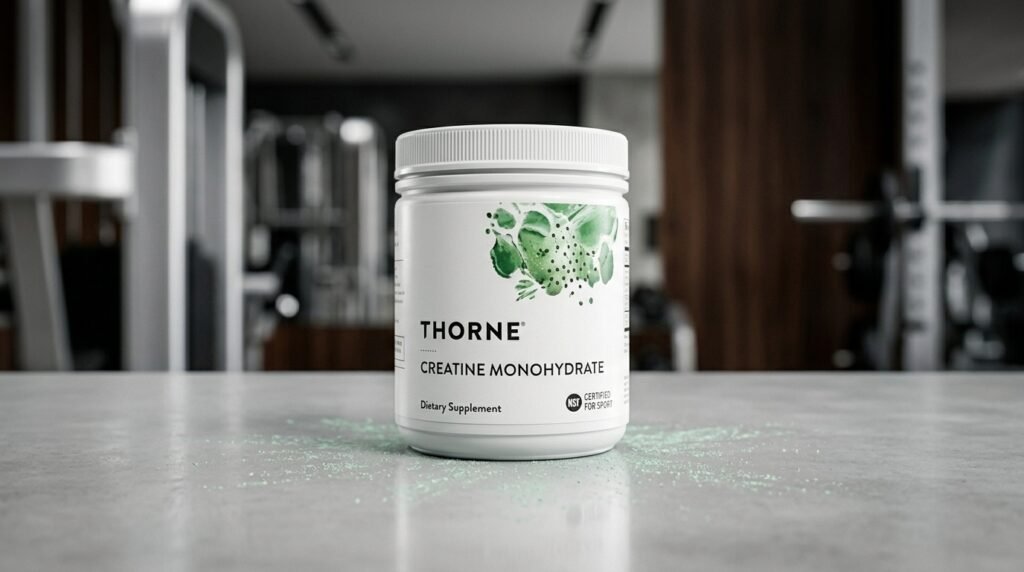
Thorne Creatine monohydrate is the supplement with the strongest evidence base of any compound on this list — and the most underappreciated beyond the gym community. At 5g daily, creatine monohydrate increases phosphocreatine availability for ATP resynthesis, reducing post-exercise muscle damage by 30–40%, accelerating recovery between sessions, and — less commonly discussed — improving working memory and cognitive performance under sleep deprivation by 20–30% in clinical trials.
For men in their 30s managing high-demand careers alongside training, the cognitive benefits of creatine are as relevant as the physical ones. NSF Certified for Sport, pharmaceutical-grade micronized creatine, complete dissolution in water. At $0.44 per day, it’s the highest evidence-per-dollar supplement available.
Pros: NSF certified, strongest evidence base of any supplement, improves both physical and cognitive performance, 5g daily with no loading phase required, pharmaceutical manufacturing. Cons: Takes 3–4 weeks for full muscle saturation, minor water retention in first 2 weeks, higher price than generic creatine monohydrate.
2. Thorne Magnesium Bisglycinate — Best for Sleep & Testosterone (~$22 / 60 servings)
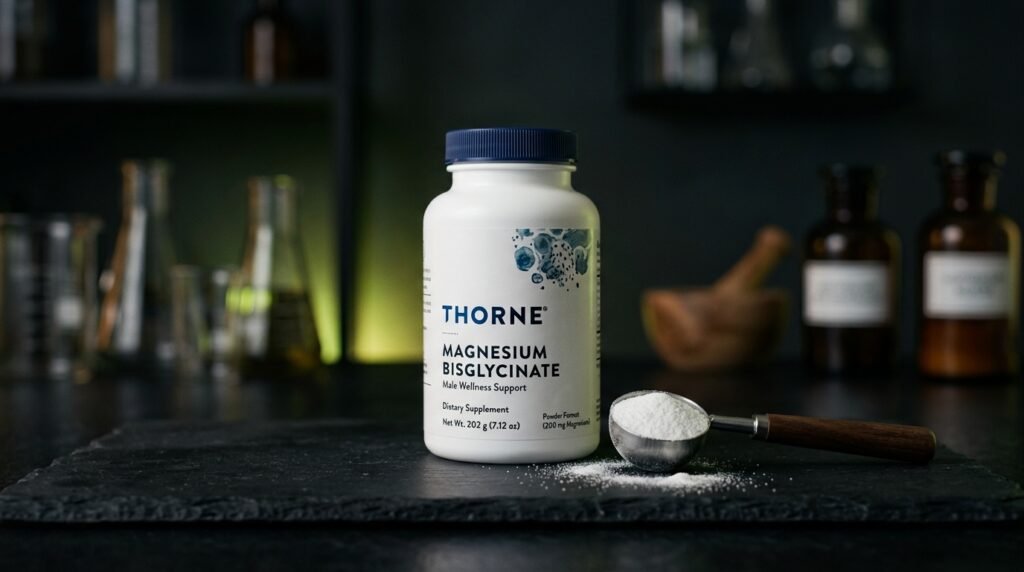
Thorne Magnesium Bisglycinate addresses the most common and most consequential micronutrient deficiency in men in their 30s who train, experience work stress, or don’t eat a diet rich in leafy greens, legumes, and seeds. Magnesium is a cofactor in over 300 enzymatic reactions including testosterone synthesis in Leydig cells, GABA receptor activation for sleep quality, and muscle relaxation post-training.
200–400mg bisglycinate before bed consistently produces reduced sleep onset time, improved deep sleep duration, and reduced nighttime waking in deficient men within 7–14 days. NSF Certified for Sport, pharmaceutical manufacturing, flexible powder dosing.
Pros: NSF certified, bisglycinate for superior absorption, addresses testosterone, sleep, and muscle recovery simultaneously, flexible dosing, Thorne quality. Cons: Powder format less convenient for travel, takes 4–8 weeks for full hormonal effects, add copper separately at higher doses.
3. Thorne D3+K2 Liquid — Best for Hormonal & Cardiovascular Health (~$28 / 30ml)
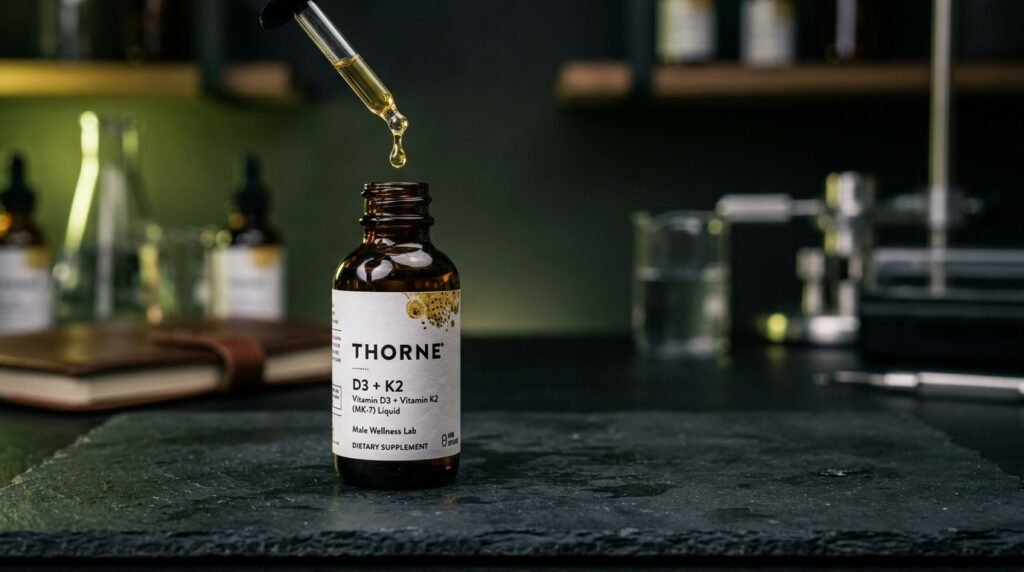
Thorne D3+K2 Liquid delivers vitamin D3 and vitamin K2 MK-7 in a single liquid drop — the combination that addresses both the testosterone-support mechanism of vitamin D and the cardiovascular safety mechanism of K2. Vitamin D3 at 1000–5000 IU daily supports testosterone production, immune function, mood regulation, and bone density. K2 MK-7 directs calcium to bones rather than arterial walls — the critical safety co-factor that most standalone vitamin D supplements omit.
Approximately 42% of Americans are vitamin D deficient, and men with limited sun exposure, darker skin, or office-bound work schedules are at highest risk. Getting a baseline 25(OH)D blood test before supplementing allows precise dosing rather than guessing. Most men in their 30s with deficient baseline levels need 2000–4000 IU daily to reach optimal range (50–70 ng/mL).
Pros: D3+K2 combination in one product, liquid drop allows precise dose adjustment, pharmaceutical manufacturing, NSF certified, addresses testosterone and cardiovascular health simultaneously. Cons: Liquid format less convenient than capsules, requires refrigeration after opening, K2 dose may need supplementing separately at higher D3 doses.
4. Momentous Omega-3 — Best for Inflammation & Cognitive Function (~$50 / 30 servings)
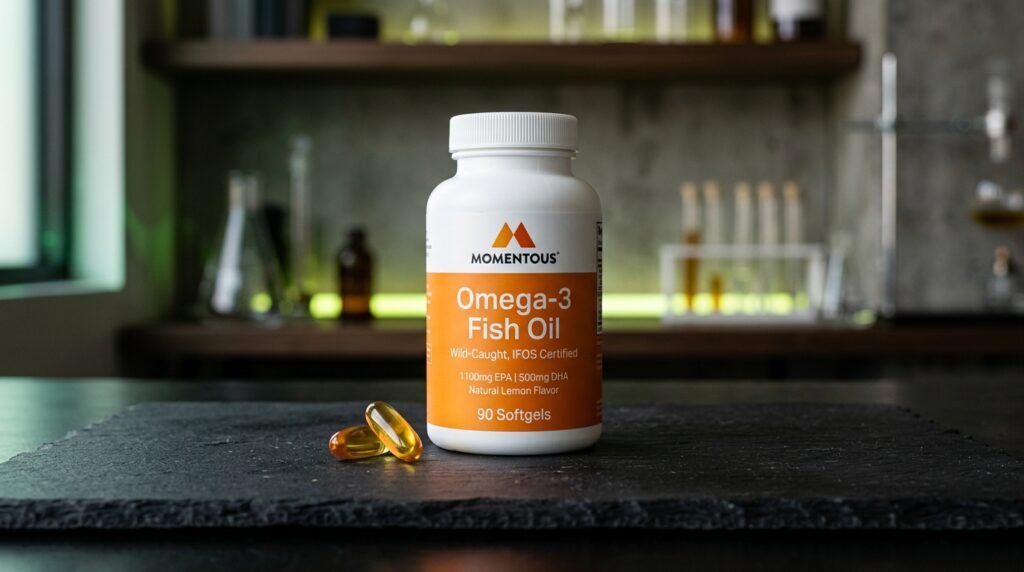
Momentous Omega-3 provides 2.6g combined EPA+DHA per serving in triglyceride form — the natural fish oil form that absorbs 70% better than the ethyl ester form used in most budget supplements. For men in their 30s managing training loads, work stress, and the early stages of age-related inflammatory increase, 2–3g daily EPA+DHA reduces training soreness duration by 24–48 hours and supports the anti-inflammatory signaling that protects cardiovascular and cognitive health long-term.
DHA specifically is the primary structural fatty acid in brain cell membranes — adequate DHA intake supports cognitive processing speed and memory consolidation, both of which are relevant for men managing high cognitive demands alongside training recovery. Informed Sport certified.
Pros: Triglyceride form for 70% better absorption, 2.6g EPA+DHA at research-relevant dose, Informed Sport certified, sustainably sourced, supports both physical recovery and cognitive function. Cons: $1.67 per serving is premium pricing, strong fish aftertaste without food, 30-day supply requires consistent reordering.
5. Jarrow Formulas KSM-66 Ashwagandha — Best for Stress & Cortisol (~$20 / 120 servings)
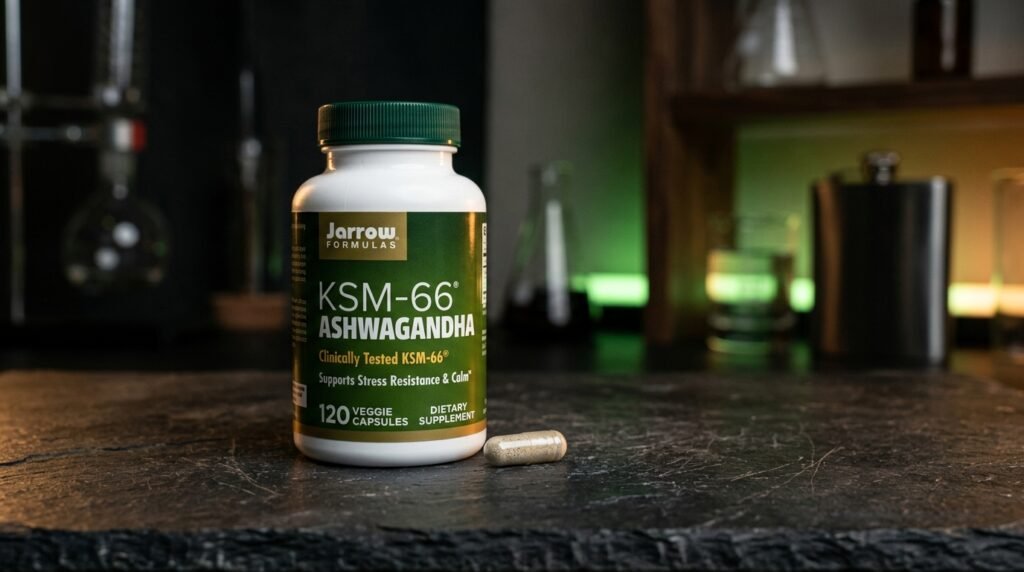
Jarrow Formulas KSM-66 at 300mg per capsule — two capsules reaches the 600mg research dose — is the cortisol management supplement most relevant for men in their 30s dealing with sustained work pressure, disrupted sleep from professional demands, or the HPA axis dysregulation that produces chronically elevated evening cortisol. Since cortisol and testosterone share a precursor (pregnenolone), chronically elevated cortisol directly suppresses testosterone production through the pregnenolone steal mechanism.
KSM-66 at 600mg daily consistently reduces cortisol by 15–30% in stressed populations over 60–90 days and shows testosterone improvements of 15–22% in men with stress-driven hormonal suppression. At ~$0.17 per day at the full 600mg dose, it’s the most affordable intervention on this list per day of use.
Pros: KSM-66 extract matching clinical research protocols, 120 capsules for 60-day supply at full dose, Jarrow quality track record, excellent value at $0.17/day. Cons: GMP rather than NSF certification, 8–12 week timeline for full cortisol-reduction effect, some men prefer morning dosing if evening ashwagandha feels stimulating.
6. Thorne Zinc Bisglycinate — Best for Testosterone Support (~$15 / 60 servings)
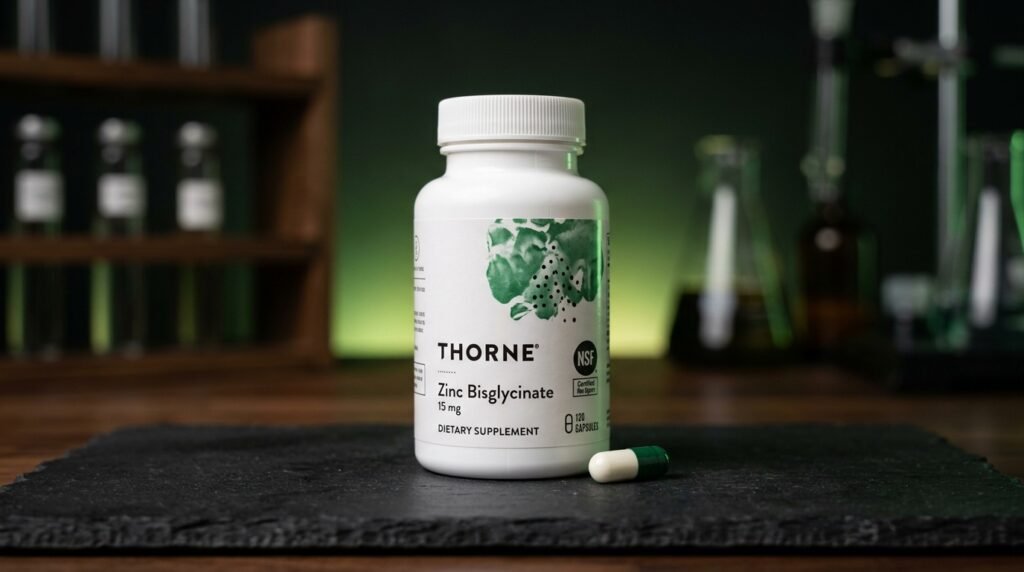
Thorne Zinc Bisglycinate at 15mg elemental zinc targets the mineral deficiency most directly linked to testosterone suppression in men in their 30s who train heavily, sweat significantly, or eat a diet low in red meat and shellfish. Zinc is a cofactor in Leydig cell testosterone synthesis and an aromatase inhibitor — deficiency reduces testosterone production and increases the conversion of remaining testosterone to estrogen simultaneously.
Bisglycinate form absorbs through amino acid transport pathways at approximately 43% better bioavailability than zinc oxide. NSF certified, one capsule daily provides 15mg — appropriate for maintenance, two capsules for deficiency correction. Add 1–2mg copper separately if running two capsules daily for more than 8 weeks.
Pros: NSF certified, bisglycinate for superior absorption, pharmaceutical manufacturing, flexible dosing, affordable at $0.25–0.50/day. Cons: No copper included — add separately at higher doses, 15mg requires two capsules for deficiency correction protocol.
Comparison Table
| Product | Price/Month | Primary Benefit | Tier | Rating |
|---|---|---|---|---|
| Thorne Creatine | ~$13 | Performance + cognition | 2 | 9.5/10 |
| Thorne Magnesium Bisglycinate | ~$11–22 | Sleep + testosterone | 1 | 9.5/10 |
| Thorne D3+K2 Liquid | ~$14 | Hormonal + cardiovascular | 1 | 9/10 |
| Momentous Omega-3 | ~$50 | Inflammation + cognition | 2 | 9/10 |
| Jarrow KSM-66 Ashwagandha | ~$10 | Cortisol + testosterone | 3 | 8.5/10 |
| Thorne Zinc Bisglycinate | ~$8–15 | Testosterone support | 1 | 9/10 |
What to Look for When Choosing Supplements for Men in Their 30s
1. Address deficiencies before optimizing The single most common supplement mistake men in their 30s make is spending $150/month on testosterone boosters and adaptogens while being deficient in vitamin D, magnesium, and zinc — the micronutrients that most directly drive the testosterone and recovery decline they’re trying to address. Get a basic blood panel (vitamin D, magnesium RBC, zinc, testosterone) before spending money on optimization-tier supplements.
2. Third-party certification for daily supplements NSF Certified for Sport (Thorne) and Informed Sport (Momentous) verify that what’s on the label is in the capsule, at the stated dose, without contamination. For supplements taken daily for years — which is the correct approach for foundational micronutrients — manufacturing quality compounds over time. GMP certification is the minimum baseline; NSF is the standard worth paying for.
3. Bioavailable forms over cheap alternatives Magnesium bisglycinate absorbs 10x better than magnesium oxide. Zinc bisglycinate absorbs 43% better than zinc oxide. Vitamin D3 is 87% more potent than D2. Triglyceride-form omega-3 absorbs 70% better than ethyl ester. These aren’t marginal differences — they determine whether the supplement actually reaches tissue or exits as expensive urine.
4. Build the stack incrementally Starting five new supplements simultaneously makes it impossible to identify which one is producing benefit or causing side effects. Start with magnesium bisglycinate before bed and creatine at any time of day — the two highest-impact interventions for most men in their 30s. Add vitamin D3+K2 at week 3. Add omega-3 at week 6. Add ashwagandha and zinc at month 3 if the foundational stack is established and consistent.
5. Total monthly cost sustainability A supplement stack you take inconsistently for 2 months produces less benefit than a focused stack you take consistently for 12 months. The Tier 1 + Tier 2 stack in this guide costs approximately $75–100/month — sustainable for most men who are serious about their health. The Tier 3 additions bring the total to $90–120/month. Build what you can maintain rather than what looks comprehensive on paper.
FAQ
What supplements should every man in his 30s take?
The non-negotiable foundation is vitamin D3+K2, magnesium bisglycinate, and creatine monohydrate. These three address the most common deficiencies and provide the strongest evidence-backed performance benefits for men in this decade. If budget is limited, these three produce more measurable impact than any other combination at equivalent cost.
Do testosterone boosters actually work for men in their 30s?
Most commercial testosterone boosters contain proprietary blends of ingredients at doses too low to produce measurable effects. The legitimate testosterone-supporting supplements — zinc, magnesium, vitamin D, and ashwagandha — work by correcting deficiencies and reducing cortisol that suppresses natural production, not by directly stimulating testosterone synthesis. Men in their 30s see the most meaningful testosterone support from fixing deficiencies first rather than adding boosters on top of an already-deficient foundation.
How long before supplements produce noticeable results for men in their 30s?
Creatine reaches full muscle saturation and produces noticeable performance benefits at 3–4 weeks. Magnesium bisglycinate produces sleep improvements within 7–14 days for deficient men. Vitamin D normalization takes 8–12 weeks at therapeutic doses. Ashwagandha’s cortisol and testosterone effects emerge at 8–12 weeks. Plan for a 90-day consistent supplementation period before evaluating the full impact of any stack.
Is a multivitamin enough for men in their 30s?
No — for two reasons. First, most multivitamins contain vitamin D, magnesium, and zinc at doses too low to correct genuine deficiencies. A typical multivitamin contains 400–600 IU vitamin D (versus 2000–4000 IU needed for deficiency correction), 50–100mg magnesium (versus 300–400mg for sleep and hormonal benefit), and 8–11mg zinc (versus 15–30mg for deficiency correction). Second, a multivitamin doesn’t include creatine or omega-3 — two of the highest-impact supplements for men in their 30s. Use a multivitamin as a gap-filler alongside targeted supplementation, not as a replacement for it.
Our Final Verdict
The best supplements for men in their 30s in 2026 follow a clear priority order — fix deficiencies first, optimize second. Start with Thorne Magnesium Bisglycinate before bed and Thorne Creatine at any time of day — the two highest-impact interventions for most men in this decade. Add Thorne D3+K2 and Thorne Zinc Bisglycinate to address the hormonal deficiency layer.
Layer in Momentous Omega-3 for inflammation and cognitive support and Jarrow KSM-66 Ashwagandha if cortisol and stress are driving hormonal suppression. Build the stack incrementally, take it consistently for 90 days, and measure the difference. Check current pricing on Amazon for all six supplements in this guide.