

This article contains affiliate links. We may earn a commission if you buy through our links, at no extra cost to you.
Best Vitamin D Supplement for Men in 2026
Vitamin D deficiency is the most prevalent nutritional deficiency in the developed world — and men are disproportionately affected. Approximately 42% of American adults are deficient in vitamin D, with rates climbing to 70%+ in men living above the 37th parallel who spend most of their daylight hours indoors. The consequences for male health are specific and significant: vitamin D receptors are present in Leydig cells, the same cells that produce testosterone, and low vitamin D status is consistently associated with lower testosterone levels, reduced bone density, impaired immune function, and worse mood outcomes in men over 30.
After researching the clinical evidence on vitamin D supplementation for men and comparing the available products across form, dose, and third-party testing quality — here is what actually works in 2026.
This guide is for men who want to correct vitamin D deficiency effectively, not for men chasing a supplement trend.
Quick Answer
Thorne Vitamin D/K2 at 1000-5000 IU D3 daily paired with vitamin K2 as MK-7 is the best vitamin D supplement for most men — D3 is the biologically active form, K2 ensures calcium from vitamin D absorption goes to bone rather than arteries, and Thorne’s pharmaceutical manufacturing standards mean the dose on the label is the dose in the capsule. For men who want a higher-dose option with the same K2 pairing, Designs for Health Vitamin D Supreme at 5000 IU is the clinical-grade alternative.
Why Vitamin D Deficiency Is So Common in Men
The indoor lifestyle explanation is real but incomplete. Understanding why men are particularly vulnerable to vitamin D deficiency helps explain why food sources and minimal sun exposure don’t solve the problem for most men.
Vitamin D synthesis in skin requires UVB radiation — specifically wavelengths between 290-315nm. Above approximately 37° north latitude (a line running through San Francisco, Denver, and Washington DC), UVB intensity is insufficient for significant vitamin D synthesis from October through March regardless of how much time you spend outdoors. Men living above this latitude who don’t supplement are functionally unable to maintain adequate vitamin D status through winter months from sun exposure alone.
Skin pigmentation compounds this. Melanin reduces UVB penetration, meaning darker-skinned men produce less vitamin D per unit of sun exposure than lighter-skinned men. In northern latitudes, even optimal sun exposure often can’t overcome this biological reality.
Body fat is the third variable. Vitamin D is fat-soluble and gets sequestered in adipose tissue, reducing its bioavailability in the bloodstream. Men with higher body fat percentages have lower circulating vitamin D despite equivalent synthesis and dietary intake — the fat tissue acts as a vitamin D sink.
The counterintuitive implication: outdoor men at northern latitudes can have worse vitamin D status than indoor men who supplement correctly. Sun exposure alone is not a reliable vitamin D strategy above the 37th parallel for half the year. For men who’ve also addressed testosterone through lifestyle factors, see our guide on how to increase testosterone naturally — vitamin D’s role in testosterone production is one of the strongest dietary supplement-hormone connections in the clinical literature.
D3 vs D2 — This Is Not a Close Call
Vitamin D supplementation comes in two forms: D3 (cholecalciferol) and D2 (ergocalciferol). The evidence resolves this clearly.
Vitamin D3 is the form produced in human skin through UVB exposure. It raises serum 25(OH)D — the storage form measured in blood tests — approximately twice as effectively as D2 per unit of dose, and the elevation lasts longer between doses. D3 converts to the active hormone form more efficiently in the liver and kidneys. Every quality vitamin D supplement for men uses D3.
Vitamin D2 is derived from plant sources — primarily irradiated mushrooms and yeast. D2 raises 25(OH)D levels less reliably, has a shorter half-life, and requires larger doses to produce equivalent blood level increases. Still used in some prescription vitamin D products and vegan D2 supplements, but the inferior choice for men correcting deficiency efficiently.
The dose question is where men most commonly go wrong. The RDA of 600-800 IU was established to prevent rickets in healthy people — not to optimize vitamin D status in deficient adults. Research consistently shows that most vitamin D-deficient men need 2000-5000 IU daily to reach the 40-60 ng/mL blood level range associated with optimal health outcomes.
The Vitamin D and K2 Connection
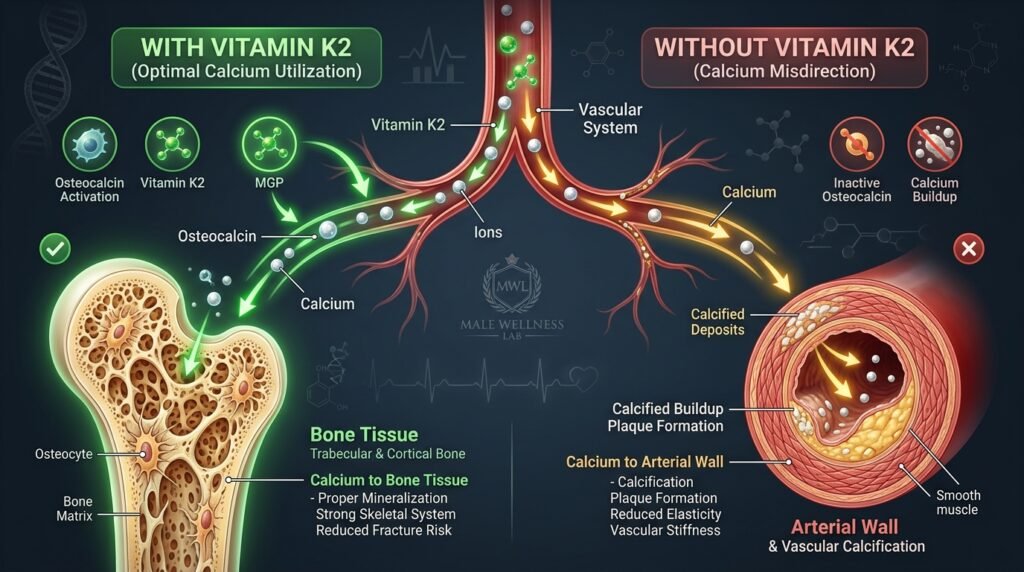
This is where most vitamin D guides stop short — and it’s a meaningful omission for men over 30 who care about long-term cardiovascular and bone health.
Vitamin D increases calcium absorption from the gut significantly — the primary mechanism behind its bone health benefits. The problem is that calcium needs to go to bone, not to arterial walls. Vitamin K2 (specifically the MK-7 form) activates osteocalcin and matrix GLA protein — proteins that direct calcium into bone tissue and prevent its deposition in arteries and soft tissues.
Without adequate K2, higher vitamin D intake increases calcium absorption without ensuring that calcium goes where it belongs. The concern — arterial calcification — is particularly relevant for men over 40 supplementing at higher vitamin D doses long-term.
For any man taking 2000 IU or more of vitamin D daily, pairing it with 90-200mcg of vitamin K2 as MK-7 is the standard recommendation in functional medicine and increasingly in conventional clinical practice. Men focused on cardiovascular health alongside vitamin D status should also see our guide on the best supplements for men’s heart health — K2 appears in both contexts for the same mechanistic reason.
The 5 Best Vitamin D Supplements for Men in 2026
1. Thorne Vitamin D/K2 Liquid — Best Overall (~$18-22/60 servings)
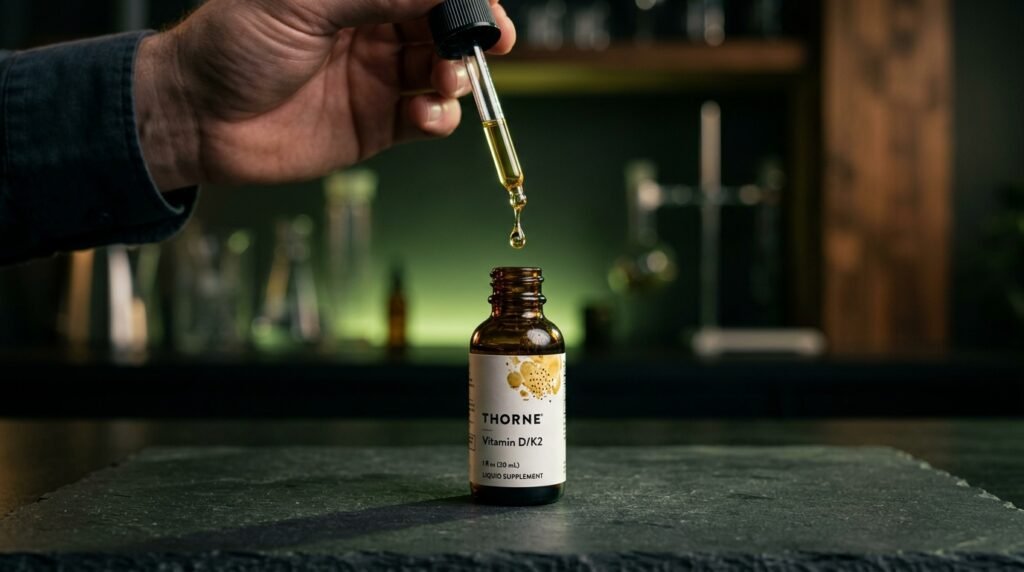
Thorne Vitamin D/K2 delivers 1000 IU D3 with 200mcg K2 as MK-7 per drop — a liquid format that makes dose adjustment straightforward and absorbs well with any fatty meal. The liquid format is the key differentiator: men who need 2000, 3000, or 5000 IU can adjust drops precisely rather than being locked into fixed-dose capsules.
Thorne’s pharmaceutical manufacturing standards mean the IU on the label matches what’s in the product — not a given in the supplement industry, where vitamin D potency variance in independent testing is among the highest of any vitamin category. The MK-7 form of K2 has the longest half-life of any K2 form — approximately 72 hours — making once-daily dosing effective for maintaining K2 status consistently.
Real-world scenario: a 38-year-old in Chicago who works indoors and gets blood work showing 25(OH)D at 22 ng/mL starts 3 drops of Thorne D/K2 daily (3000 IU + 600mcg K2) — at his 12-week retest he’s at 48 ng/mL, adjusts to 2 drops for maintenance.
Pros: Liquid format for precise dose adjustment, MK-7 for longest K2 half-life, NSF certified, pharmaceutical manufacturing standards, flexible dosing from 1000 to 5000+ IU, olive oil base enhances absorption. Cons: Liquid format requires careful dispensing, multiple drops needed for higher doses, olive oil base may not suit all preferences.
2. Designs for Health Vitamin D Supreme — Best High-Dose Option (~$28-32/60 servings)
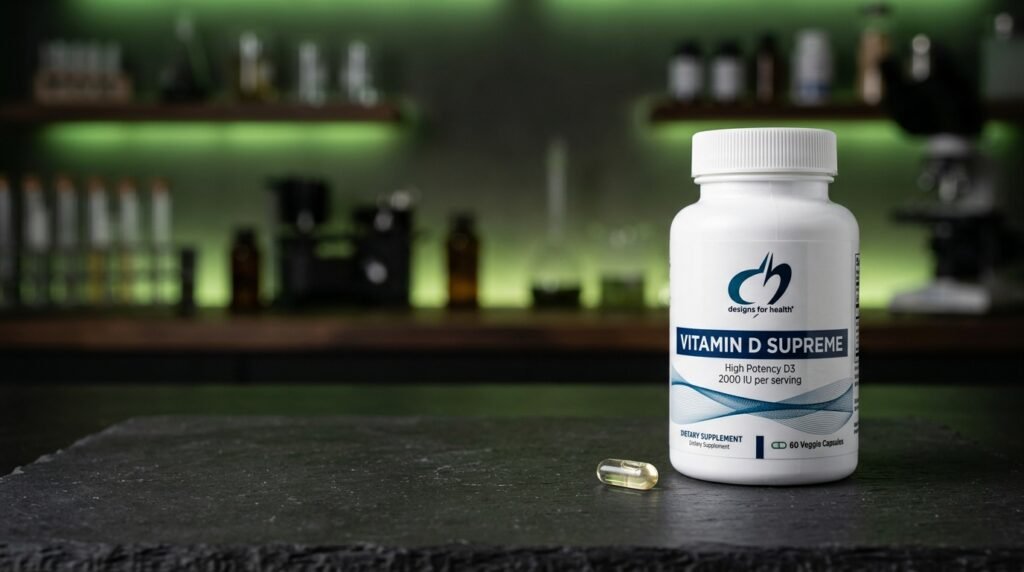
Designs for Health Vitamin D Supreme delivers 5000 IU D3 with 2000mcg vitamin K (as both K1 and MK-4) in a single capsule — the most comprehensive vitamin D/K combination formula on this list and the recommendation for men with confirmed significant deficiency or those living at high latitudes with minimal outdoor exposure through winter months.
The dual K form approach provides both K1 for general cardiovascular support and MK-4 for fast-acting tissue uptake. At 5000 IU, this product should not be used without baseline blood work confirming deficiency — men with 25(OH)D below 20 ng/mL can use it to restore levels efficiently within 8-12 weeks before dropping to a maintenance dose.
Designs for Health is a practitioner-grade brand — their supplements are formulated to clinical standards and the Vitamin D Supreme is among their most consistently recommended products by functional medicine practitioners for deficiency correction in men.
Pros: 5000 IU D3 for significant deficiency correction, vitamin K1 plus MK-4 dual K formula, single capsule convenience, practitioner-grade manufacturing, GG (geranylgeraniol) included for additional bone and cardiovascular support. Cons: 5000 IU requires confirmed deficiency — not for casual supplementation without blood work, $0.47-0.53 per day at the higher end of this list, capsule format doesn’t allow dose adjustment.
3. NOW Foods Vitamin D3 5000 IU — Best Budget High-Dose (~$10-12/120 servings)
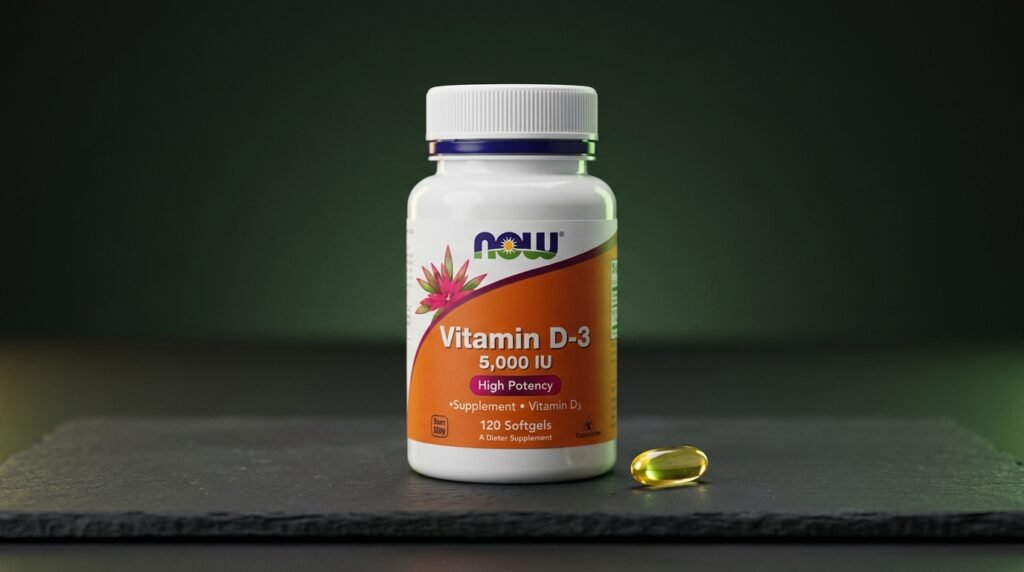
NOW Foods Vitamin D3 5000 IU is the recommendation for men who need a high-dose vitamin D supplement at a price that makes daily 12-month supplementation economically sustainable. 5000 IU D3 per softgel in an olive oil base for fat-soluble vitamin absorption — GMP certified, regularly passing independent third-party testing through Labdoor for label accuracy and purity.
The absence of K2 is the main limitation. At $10-12 for 120 softgels — approximately $0.08-0.10 per day — it’s the most affordable quality vitamin D3 on this list. Men who supplement K2 separately or who already take a multivitamin containing K2 will find this the most cost-effective daily vitamin D option available.
What most reviews won’t tell you is that NOW Foods consistently passes independent potency testing at accuracy rates comparable to much more expensive brands. The GMP certification rather than NSF is a real step down in testing rigor, but NOW’s track record in independent testing provides reasonable confidence for most men.
Pros: Exceptional value at $0.08-0.10 per day, 5000 IU D3, olive oil base for fat-soluble absorption, GMP certified, 120 softgels per bottle — 4-month supply, passes independent potency testing consistently. Cons: No K2 included — requires separate K2 at this dose, GMP rather than NSF certification, not suitable as standalone if taking 5000 IU without K2 supplementation.
4. NOW Supplements Vitamin D3 + K2 — Best Mid-Dose Combination (~$12-15/120 servings)
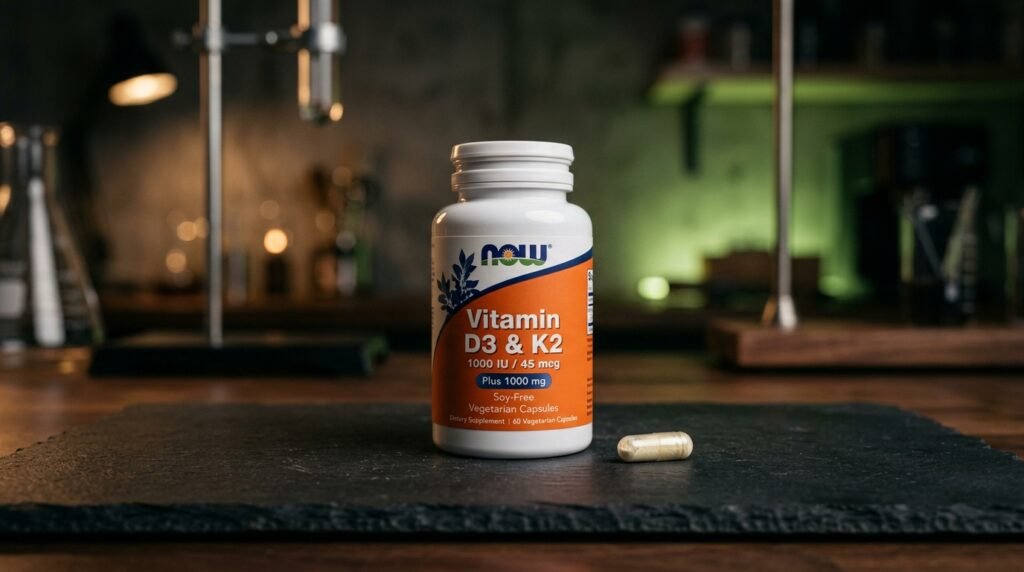
NOW Supplements Vitamin D3 + K2 delivers 1000 IU D3 with 45mcg K2 as MK-4 in a vegetarian capsule — the mid-dose D/K2 combination for men who are mildly deficient or maintaining optimal status through winter months. Vegan, gluten-free, kosher, GMP Quality Assured with NPA A-rated certification and ISO/IEC accredited in-house laboratory.
1000 IU daily is appropriate for men already in the 30-40 ng/mL range who want to maintain through winter. It’s insufficient for men below 20 ng/mL who need to correct established deficiency — those men need 4000-5000 IU daily for 8-12 weeks before dropping to maintenance dosing.
The K2 dose at 45mcg MK-4 is lower than Thorne’s 200mcg MK-7 and works best paired with the moderate 1000 IU D3 dose — appropriate for maintenance rather than correction protocols. At $0.10-0.12 per day for a combined D3/K2 product, it’s the best value D3+K2 combination on this list.
Pros: D3 and K2 combination at best value price, vegetarian capsule, vegan and kosher, GMP Quality Assured with ISO/IEC lab, 120 caps per bottle — 4-month supply, appropriate for maintenance dosing. Cons: 1000 IU insufficient for men with significant deficiency, K2 at 45mcg MK-4 lower than competing D/K2 products, MK-4 shorter half-life than MK-7 forms.
5. Sports Research Vitamin D3 + K2 — Best Vegan Softgel Option (~$20-25/60 servings)
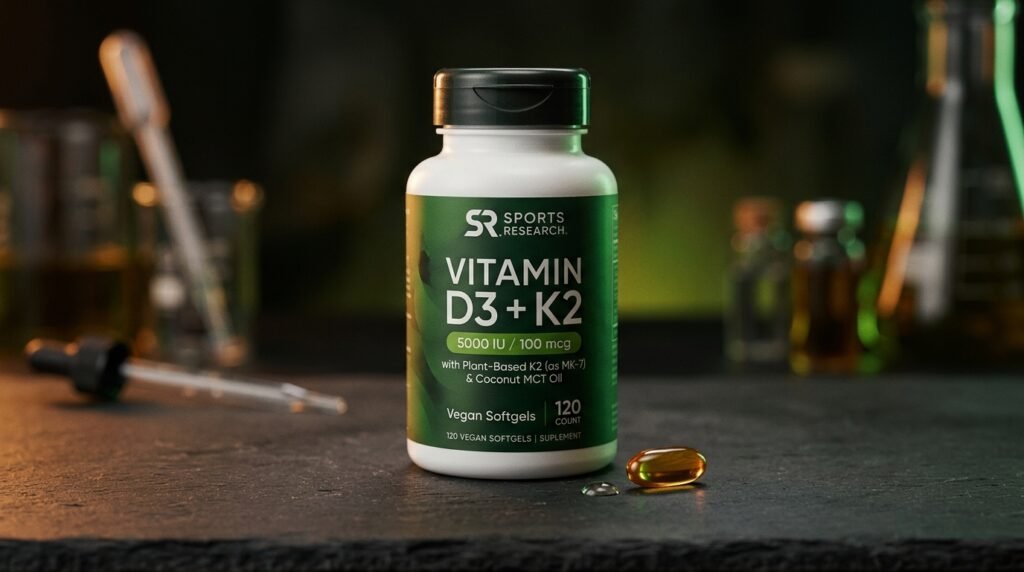
Sports Research Vitamin D3 + K2 delivers 5000 IU vegan D3 sourced from lichen with 100mcg K2 as MK-7 from fermented chickpeas — the only fully vegan D3/K2 combination on this list. Coconut MCT oil base enhances absorption of both fat-soluble vitamins without any animal-derived ingredients. Vegan Certified, Non-GMO Project Verified, cGMP manufactured, third-party tested.
The MCT oil carrier eliminates the need to time supplementation with a fatty meal — relevant for men who take supplements first thing in the morning before breakfast. Studies show vitamin D absorption from oil-based carriers is approximately 32% higher than from dry powder capsules. For vegan men or men who prefer plant-sourced supplements, this is the most complete option in the category.
At $20-25 for 60 softgels at $0.33-0.42 per day, it sits between the budget NOW option and the premium Thorne and Designs for Health products, with the added value of full vegan certification across the formula.
Pros: 5000 IU vegan D3 (lichen-sourced), 100mcg K2 as MK-7, coconut MCT oil for superior fat-soluble absorption, Vegan Certified, Non-GMO Verified, cGMP manufactured, third-party tested, no meal timing required. Cons: 5000 IU requires confirmed deficiency context, 60 softgels = 2-month supply at one daily, Sports Research certification standard below Thorne NSF, coconut allergy contraindication.
Comparison Table
| Product | Price/Serving | D3 Dose | K2 Included | Rating |
|---|---|---|---|---|
| Thorne D3+K2 Liquid | ~$0.33 | 1000 IU/drop (adjustable) | 200mcg MK-7 | 9.5/10 |
| Designs for Health D Supreme | ~$0.50 | 5000 IU | 2000mcg K1+MK-4 | 9/10 |
| NOW Foods D3 5000 IU | ~$0.09 | 5000 IU | None | 8/10 |
| NOW Supplements D3+K2 | ~$0.11 | 1000 IU | 45mcg MK-4 | 8/10 |
| Sports Research D3+K2 | ~$0.37 | 5000 IU | 100mcg MK-7 | 8.5/10 |
What to Look for When Choosing a Vitamin D Supplement for Men
1. Always choose D3 over D2 D3 raises blood 25(OH)D levels approximately twice as effectively per IU as D2 and maintains those levels longer between doses. Verify the form on the label — it should say “cholecalciferol” or “vitamin D3.” If it says “ergocalciferol” or “vitamin D2,” choose a different product.
2. Dose matched to your blood level The right vitamin D dose depends on your current blood level — only knowable through testing. Men below 20 ng/mL are clinically deficient and need 4000-5000 IU daily to correct efficiently. Men at 20-30 ng/mL typically respond to 2000-3000 IU. Men at 30-40 ng/mL can maintain optimal status with 1000-2000 IU. Without testing, 2000 IU daily is a reasonable starting point for men without regular sun exposure.
3. Pair with K2 at doses above 2000 IU The biological rationale for combining vitamin D with K2 — directing calcium to bone rather than arteries — is strongest at higher doses where calcium absorption is more significantly elevated. For men taking 3000-5000 IU daily long-term, K2 as MK-7 at 100-200mcg is the standard functional medicine recommendation.
4. Take with fat for maximum absorption Vitamin D is fat-soluble — it requires dietary fat for absorption from the gut. Studies show 32-56% better absorption when vitamin D is taken with a fat-containing meal versus on an empty stomach. Men who take supplements before eating should choose oil-based softgels (Sports Research MCT oil, NOW olive oil) to compensate for the absence of a fat-containing meal.
5. Third-party testing for potency verification Vitamin D supplements have among the highest rates of potency variance in independent testing of any supplement category. NSF certification (Thorne) provides the strongest potency guarantee. GMP certification with a strong independent testing track record (NOW Foods) is acceptable for budget options. Products with no third-party certification in the vitamin D category warrant more skepticism than most supplement categories.
FAQ
How much vitamin D do men actually need daily?
The RDA of 600-800 IU was established to prevent rickets — not to optimize health outcomes in adults. Research on vitamin D sufficiency consistently shows that most deficient men need 2000-5000 IU daily to reach the 40-60 ng/mL blood level associated with optimal bone density, immune function, and testosterone support. Without blood work, 2000 IU daily is a reasonable starting point for men without regular sun exposure.
Does vitamin D actually affect testosterone levels in men?
Vitamin D receptors are present in Leydig cells — the testosterone-producing cells in the testes — and observational studies consistently show correlation between vitamin D status and testosterone levels. In men with confirmed vitamin D deficiency, supplementation to sufficient levels is associated with improved testosterone markers. The biological mechanism is established and the risk of supplementing to sufficiency is low.
Can you take too much vitamin D?
Yes. Vitamin D toxicity — hypercalcemia from excessive calcium absorption — occurs with sustained very high intake, typically above 10,000 IU daily for extended periods. At 5000 IU daily the risk is minimal for deficient men. Men supplementing at 5000 IU for more than 3-4 months should retest blood levels to confirm they’ve reached the target range and can reduce to maintenance dosing.
Is it better to get vitamin D from sunlight or supplements?
For men living above the 37th parallel, sunlight is insufficient for vitamin D synthesis from October through March regardless of outdoor time. Year-round supplementation is the more reliable strategy for these men. For men in southern latitudes with consistent outdoor exposure — 15-30 minutes of midday sun on skin — summer sunlight may maintain adequate vitamin D status, but winter months typically still require supplementation.
Our Final Verdict
The best vitamin D supplement for men in 2026 starts with getting your blood level tested — it’s the most useful step before spending money on any vitamin D supplement. For most men, Thorne Vitamin D/K2 is the answer — pharmaceutical manufacturing certainty, adjustable dosing, and the D3/K2 combination that addresses both deficiency correction and long-term calcium management. Men with confirmed significant deficiency should use Designs for Health Vitamin D Supreme at 5000 IU to correct blood levels efficiently.
Budget-conscious men who supplement K2 separately can use NOW Foods D3 5000 IU at a fraction of the cost. Men maintaining mild deficiency should consider NOW Supplements D3+K2 — D3 and K2 combined at the best value price. And vegan men get the cleanest plant-sourced combination from Sports Research D3+K2. Check current pricing on Amazon for all five options.